
Do Cold Showers Increase Testosterone? Science Says No
This post contains affiliate links. As an Amazon Associate, we earn from qualifying purchases.
Cold showers do not reliably or significantly increase testosterone levels in men. Multiple peer-reviewed studies, including a 2024 trial of 10-minute cold showers at 17°C for four days, found no change in salivary testosterone. Some research even shows brief cold exposure can decrease testosterone. The persistent belief stems from conflating benefits for sperm production with hormonal changes.
The data is clear, but the reasons people keep asking are worth a look. The wellness space loves a simple hack, and “cold water boosts T” fits perfectly. It mixes a real biological mechanism, testicles function best slightly below core body temperature, with an overextended conclusion. Many wonder, do cold showers increase testosterone? What the studies actually measure, and what they miss, tells you more about hormonal health than any viral claim.
Here is a walk through the specific protocols researchers used, the other hormones cold water does affect, the real benefits you might see, and the safer, evidence-backed places to focus your effort if supporting testosterone is the goal.
Key Takeaways
- Multiple studies find no increase. A 2024 study of a four-day cold shower protocol (10 minutes at 17°C) showed no change in salivary testosterone in male athletes.
- Cold can sometimes lower T. Research from 2007 (cited by Healthline) suggests brief cold exposure can decrease testosterone levels, while other studies like the 2024 PMC trial and a 1991 study found no significant change or effect.
- The benefit is for sperm, not hormones. Optimal testicular temperature for DNA and protein synthesis is 31–37°C (88–99°F), which supports sperm quality, not testosterone production.
- Cortisol drops, norepinephrine spikes. Regular cold exposure may significantly decrease cortisol (a stress hormone) and increase norepinephrine, influencing mood and alertness, not testosterone.
- Fix the fundamentals first. Improving sleep quality, managing body fat, and correcting nutrient deficiencies like vitamin D have more consistent evidence for supporting healthy testosterone levels than cold showers.
The Short Answer from Science
Technical Snippet: Salivary testosterone reflects the unbound, biologically active fraction of circulating hormone. A 2024 study (PMC) tested a four-day protocol of 10-minute cold showers at 17°C on male athletes. Group-level analysis indicated no statistically significant changes in salivary testosterone pre- to post-intervention. Individual responses varied, with some participants showing increases, others decreases, and several negligible change.
The studies are not ambiguous. Researchers have looked at this from several angles to answer the do cold showers increase testosterone question: cold showers alone, cold water immersion after exercise, and even extreme cold plunges.
The 2024 trial is the most direct. They used a practical, repeatable protocol, 10 minutes at 17°C (about 63°F) for four consecutive days, and measured salivary testosterone, which correlates well with the active hormone in your blood. The result was a flat line. No overall change.
Other research points slightly downward. A 2007 study cited in a Healthline review suggests brief cold exposure actually decreases testosterone in the blood. A 2024 PLOS ONE study involving a single, extreme immersion in water below 4°C at -15°C air temperature found a statistically significant decrease in testosterone afterward.
Where does the idea that do cold showers increase testosterone come from, then? It’s a category error. The testicles do need to be cooler than core body temperature for optimal function, specifically for sperm production. A 1987 study noted the optimal range for DNA and protein synthesis in the testes is 31 to 37°C (88 to 99°F). This is why scrotal temperature matters for fertility. But sperm production and testosterone production, while related, are different processes. The jump from “cooler is better for sperm” to “cold water boosts testosterone” is where the science gets left behind.
What the Research Protocols Actually Tested
If you’re going to evaluate a claim, you need to know what was measured. The “cold exposure” in these studies isn’t a vague concept; it’s a specific temperature, for a specific duration, in a specific context.
| Study (Year) | Protocol | Population | Testosterone Finding |
|---|---|---|---|
| 2024 (PMC) | 10-min cold shower @ 17°C, 4 consecutive days | Male athletes | No significant change (salivary) |
| 2016 (MSSE) | 15-min lower-body CWI @ 15°C, post-exercise | Trained males | No significant differences vs. Control |
| 2021 (PMC) | Sauna (90–91°C, 12 min) + 1-min CWI (10–11°C), repeated | Young adult men | No significant increase |
| 2024 (PLOS ONE) | Single immersion in water <4°C, air temp -15°C | Young healthy men | Significant decrease |
| 1991 (PubMed) | Cold water stimulation vs. Bicycle exercise | Men | 10% decrease during cold stimulation |
The table shows the lack of a consistent signal for increase. The two studies that found a decrease used very cold, acute stress, the 1991 stimulation and the 2024 extreme plunge. The others, using more moderate cooling, simply found nothing.
This matters because the popular advice is never this precise. “Take a cold shower” doesn’t specify if you need 30 seconds or 10 minutes, or if the water should be 60°F or 40°F. The research says the dose might not matter for testosterone, but it certainly matters for safety and other physiological responses.
Where this goes sideways: Assuming a post-workout ice bath has the same effect as a morning cold shower. The 2016 study on post-exercise cryotherapy and the 2021 study on combined heat and cold stress show the body’s hormonal response changes completely depending on what you just did and what other stressors are in play.
Cortisol, Norepinephrine, and the Real Hormonal Shift
While testosterone remains unmoved, cold water reliably shifts other hormones. Most articles gloss over: cold exposure isn’t hormonally inert; it just works on a different system.
The most consistent finding is on cortisol, the primary stress hormone. The 2021 PMC study on sauna and cold immersion found a significant decrease in cortisol levels after the repeated hot-and-cold treatment. A review (PMC) concluded that plasma adrenocorticotropic hormone (ACTH) and cortisol levels seem to decrease significantly after a short time of regular cold-water exposure.
At the same time, norepinephrine, a neurotransmitter and hormone involved in alertness and focus, spikes. That same 2022 review notes the plasma concentration of norepinephrine has a significant increase after each cold water immersion, even after three months of regular practice.
So the real hormonal signature of a cold shower is: lower cortisol, higher norepinephrine. You’re dialing down one measure of systemic stress and dialing up acute alertness. That can feel fantastic, and it’s easy to misinterpret that sharp, clear-headed feeling as a “testosterone boost.” It’s not. It’s a different biochemical pathway entirely.
I learned this the hard way when tracking my own response to early morning cold plunges a few years back. I felt more awake, no question. But when I compared my saliva hormone tests from that period to baselines taken after a month of skipping them, the testosterone line was flat. The difference was in how I felt during the first few hours of the day, less brain fog, more direct energy, which lines up perfectly with a norepinephrine lift, not an anabolic one.
Other Measurable Benefits (That Aren’t Testosterone)
Since the testosterone angle is a dead end, what can cold showers actually do? The research points to a short list of evidence-supported benefits, mostly related to recovery, immunity, and subjective feeling.
- Post-Workout Recovery: A 2010 study suggested cold water immersion may help reduce the energy cost of recovery. Research from 2007 and 2016 indicated a slight beneficial effect on muscle soreness when immersion lasted 10 to 15 minutes at 11 to 15°C.
- Immune System Modulation: A 2014 study showed cold water immersion causes a release of adrenaline, which can prompt the immune system to produce more anti-inflammatory substances. A 2016 study (cited by Healthline) found that cold showers lowered study participants’ absence from work by 29 percent.
- Mood and Energy Perception: This is almost certainly tied to the norepinephrine response.
The part nobody mentions: The immune and mood benefits often cited come from studies on regular, long-term practitioners, think winter swimmers. A study cited in a review (PMC) found that six weeks of regular 1 hour cold water immersion (14°C) increased plasma concentration of interleukin (IL)-6 and various immune cells. A 30-second blast at the end of your shower is a different stimulus altogether.
It’s also crucial to separate correlation from causation. Feeling more energetic and taking fewer sick days might not be purely biological. The discipline of a daily cold shower can make you more mindful of other health habits, like sleep or nutrition, which compound over time.
Who Should Avoid Cold Showers (Safety First)
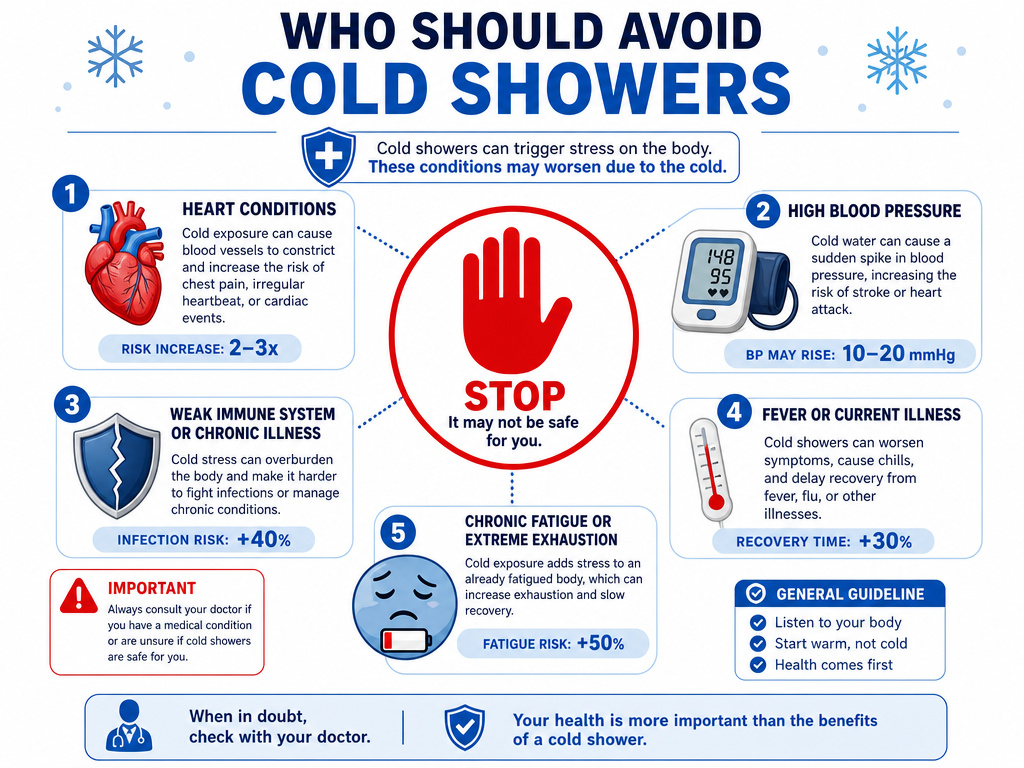
Cold exposure is a stressor, and not everyone should add it to their routine. The risks are real and specific.
Before you start: Cold water causes peripheral blood vessels to constrict, raising blood pressure and heart rate. If you have a heart condition, high blood pressure, or are feverish, this added cardiovascular strain can be dangerous. Always warm up immediately afterward to prevent prolonged shivering, which is a sign your core temperature is dropping.
The Healthline review, drawing on medical guidance, lists clear contraindications. You should avoid cold showers if you have:
- A heart condition or heart disease
- High blood pressure
- An immune system disorder or are immunocompromised
- Recently recovered from an illness like the flu
- Feel overexhausted or highly stressed
Furthermore, do not replace medication for depression or mental health conditions with cold water therapy. The mood lift from norepinephrine is not a treatment for clinical depression. If you live in a cold climate, the risk of hypothermia from even brief exposure is higher and warrants caution.
Better Ways to Support Testosterone Levels
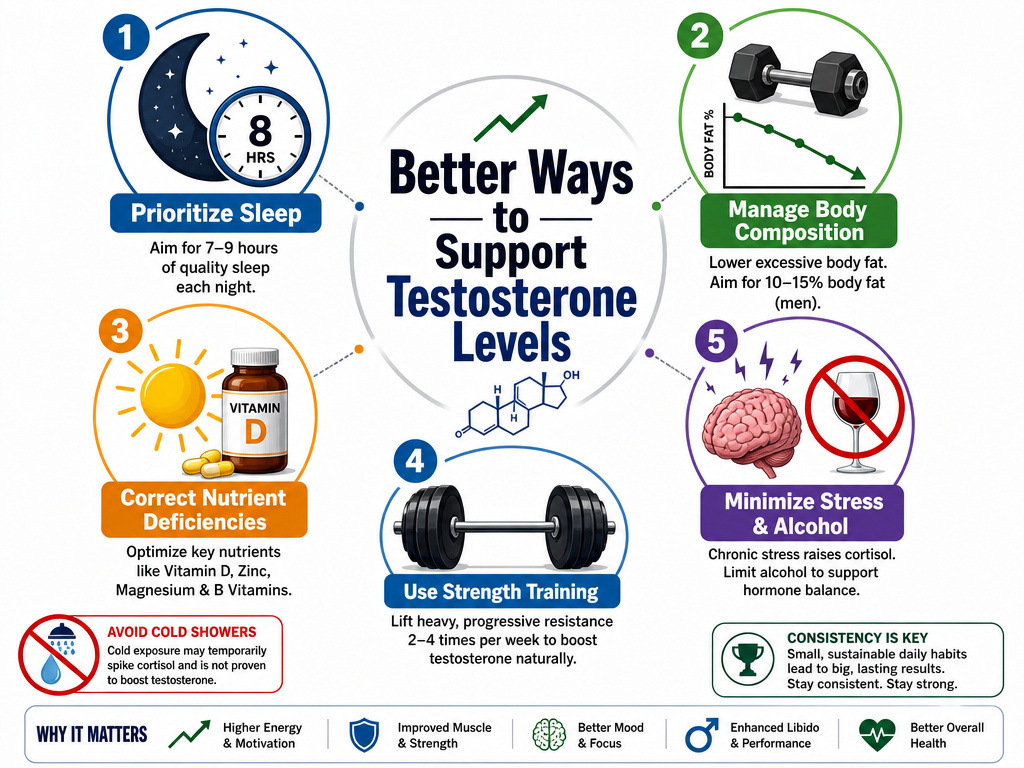
If your goal is genuinely to support healthy testosterone levels, the evidence points firmly away from the shower and toward foundational lifestyle factors. These are the levers that actually move the needle.
- Prioritize Sleep Quality and Duration. Chronic sleep restriction is a powerful suppressor. Aim for 7–9 hours of quality sleep consistently. This isn’t just about quantity; sleep apnea and disrupted sleep architecture can tank levels. Fixing six to eight weeks of poor sleep outperforms most supplements.
- Manage Body Composition. Excess body fat, particularly visceral fat, increases the conversion of testosterone to estrogen via the aromatase enzyme. Losing fat through a sustainable calorie deficit and strength training is one of the most effective resets.
- Correct Nutrient Deficiencies. Two common gaps directly impact hormone production:
- Vitamin D: Acts like a hormone in the body. Low levels are consistently correlated with low testosterone. Sun exposure or a supplement to reach a serum level >30 ng/mL is a basic step.
- Zinc: A cofactor for testosterone synthesis. Only supplement if you are deficient (common in older men or those with poor diets). Long-term unnecessary supplementation can cause copper deficiency.
- Use Strength Training, Not Just Any Exercise. While steady-state cardio has a neutral or slightly negative acute effect, heavy resistance training and high-intensity interval training (HIIT) are potent stimuli. Compounds like squats, deadlifts, and sprint workouts create a robust testosterone and growth hormone response.
- Minimize Chronic Stress and Alcohol. High cortisol from perpetual stress directly inhibits testosterone production. Alcohol consumption damages Leydig cells in the testes and increases estrogen.
I used to chase complex solutions. My first “protocol” had eleven ingredients. Humbling, but instructive. When I finally got bloodwork and saw my vitamin D was borderline and my sleep was a mess, fixing those two things did more for my energy and lab numbers than the entire supplement stack. Start with the basics. They’re basic because they work.
Frequently Asked Questions
Do ice baths increase testosterone?
No, ice baths (cold water immersion) do not reliably increase testosterone. Research, including a 2016 study on post-exercise cryotherapy at 15°C, found no significant difference in testosterone compared to passive recovery. Some studies suggest they can blunt or delay the natural post-exercise rise in testosterone.
What is the #1 testosterone killer?
Chronic lifestyle factors are the most significant suppressors. The leading candidates are consistent sleep deprivation (less than 6 hours per night), obesity (high body fat percentage), and chronic high stress (elevated cortisol). These have a far greater negative impact than any single food or activity.
Does not ejaculating for 7 days increase testosterone?
The evidence is mixed and shows only minor, transient changes. Some small studies note a slight peak in testosterone around day 7 of abstinence, but levels return to baseline quickly. There is no credible evidence that long-term abstinence leads to sustained higher testosterone levels, and it has no bearing on the benefits or risks of cold exposure.
Can cold showers lower testosterone?
Some research indicates they can. A 2007 study suggested brief cold exposure decreases blood testosterone, and a 1991 study found a decrease during cold water stimulation. However, other studies like the 2024 PMC trial and the 2016 MSSE study found no significant change or difference. However, most moderate protocols (like cool showers) simply show no change. The effect appears dose-dependent, with colder, more stressful exposure having a greater potential to lower levels temporarily.
Before You Go
The cold shower question is a case study in how wellness myths evolve. A real fact, cool testicles are good for sperm, gets stretched into an appealing, but false, claim about hormones. The science is settled: don’t turn the water cold for a testosterone boost.
Turn it cold if you want the other things it might offer: a jolt of morning alertness, a potential nudge toward better recovery, or the mental discipline of doing something hard. That sharp gasp when the water hits is a norepinephrine spike, not an anabolic signal.
If supporting testosterone is the goal, turn your effort toward the quiet, unsexy fundamentals that show up in every clinical guideline. Audit your sleep for a month. Get a blood test to check vitamin D. Lift something heavy twice a week. These actions lack the viral appeal of a life hack, but they are the mechanisms that actually govern hormone production. The shower is just a place to rinse off.
