
Causes of High Testosterone in Women: When to See a Doctor
This post contains affiliate links. As an Amazon Associate, we earn from qualifying purchases.
Causes of high testosterone in women trace back to three main pathways: the ovaries, the adrenal glands, or external medications. Polycystic Ovary Syndrome (PCOS) is the most common ovarian cause, accounting for 89% of cases in premenopausal women. Adrenal issues like Congenital Adrenal Hyperplasia (CAH) or tumors are less common but critical to rule out, especially if symptoms appear suddenly or after menopause. A serum testosterone concentration above 5 nmol/L measured via LC-MS/MS warrants imaging to check for tumors.
That threshold is the line where routine evaluation shifts to urgent investigation. It comes from endocrine society guidelines and is measured with a specific, accurate lab test many standard panels do not use. Missing that detail is how people get a ‘normal’ result from one lab and a high flag from another, delaying a diagnosis for months.
What follows is a map of the three pathways, the symptoms that point to each one, the critical red flags that demand a faster workup, and what the testing process actually involves when you walk into a doctor’s office with these concerns.
Key Takeaways
- The most common cause is Polycystic Ovary Syndrome (PCOS), found in 89% of premenopausal women with androgen excess.
- A testosterone level above 5 nmol/L on an LC-MS/MS test is a key threshold that should trigger imaging for ovarian or adrenal tumors.
- Sudden, severe symptoms like voice deepening or clitoral enlargement are red flags for a possible tumor, not typical PCOS.
- In postmenopausal women, new androgen excess points toward a tumor or ovarian hyperthecosis and warrants prompt investigation.
- The standard “total testosterone” immunoassay is often inaccurate for female ranges; insist on the LC-MS/MS method for a reliable result.
The 3 Main Pathways to Androgen Excess
High testosterone doesn’t just happen. It comes from somewhere. Your body makes androgens in two main factories: the ovaries and the adrenal glands. A third, external pathway is medication. Figuring out the causes of high testosterone in women—which factory is overproducing or if something from outside is mimicking the effect—is the entire goal of the diagnostic process.
Think of it like tracking a water leak. You need to know if it’s from the kitchen sink (ovaries), the bathroom pipe (adrenals), or a neighbor’s overflow (medications). The symptoms might look similar, but the fix is completely different.
Here is the breakdown of where the problem can originate:
| Pathway | Primary Source | Common Conditions | Key Biomarker Clue |
|---|---|---|---|
| Ovarian | Ovaries | Polycystic Ovary Syndrome (PCOS), Ovarian Hyperthecosis (OHT), Ovarian Tumors (e.g., Sertoli-Leydig cell tumor) | High Testosterone (ovarian signature) |
| Adrenal | Adrenal Glands | Congenital Adrenal Hyperplasia (CAH), Adrenal Tumors (e.g., Adrenocortical Carcinoma), Cushing’s Syndrome | High DHEAS (adrenal signature); High Androstenedione in tumors |
| External/Other | Exogenous Intake | Anabolic Steroids, Testosterone Therapy, Certain Progestins (e.g., in some birth control), Valproate | Recent medication history; often all androgens are elevated |
Serum testosterone is generally considered representative of ovarian androgen generation. DHEAS is primarily reflective of adrenal androgen production. The source of androstenedione is debated: a review by O’Reilly et al. Suggests likely relatively equivalent contributions from both glands, while another source states pro-androgen precursors are predominantly from the adrenals in postmenopausal women.
This map is your starting point. A doctor will look at your hormone panel and see which arrow is pointing up. High testosterone with normal DHEAS? The investigation leans ovarian. Sky-high DHEAS? The adrenal gland gets the first scan.
Polycystic Ovary Syndrome (PCOS): The Default Diagnosis
For any woman of reproductive age walking into a clinic with acne, irregular periods, and unwanted hair growth, PCOS is the first suspect when you consider the causes of high testosterone in women. In a large study of over 1,200 women with androgen excess, it was the diagnosis 89% of the time for premenopausal women. It’s not just common; it’s the default.
PCOS is a whole-body metabolic condition dressed up as a reproductive disorder. The ovaries develop many small cysts and overproduce testosterone, but the root cause is often insulin resistance. The high insulin levels poke the ovarian cells, telling them to make more androgens. It’s a feedback loop: more testosterone can worsen insulin resistance, which drives more testosterone production.
The symptoms are the textbook picture of hyperandrogenism:
- Hirsutism: Coarse, dark hair growing in a male-like pattern (chin, upper lip, chest, lower abdomen).
- Acne: Often cystic and persistent, especially along the jawline and neck.
- Androgenic Alopecia: Thinning hair at the crown or temples.
- Menstrual Irregularity: Cycles longer than 35 days or absent periods (oligo-ovulation or anovulation).
- Metabolic Signs: Weight gain (particularly around the middle), skin tags, and darkening of skin folds (acanthosis nigricans).
Where this goes sideways: Assuming all irregular periods and acne are PCOS. In one study, 8% of postmenopausal women with new androgen excess had borderline or malignant tumors. Age and symptom onset change the game completely.
Diagnosis follows the Rotterdam criteria: you need at least two of three features—hyperandrogenism (clinical or biochemical), irregular ovulation, and polycystic ovaries on ultrasound. It’s a diagnosis of exclusion, meaning other causes like thyroid disease or elevated prolactin must be ruled out first. Our article on how PCOS raises testosterone explains the hormonal mechanics step-by-step.
Adrenal Causes: CAH, Tumors, and Cushing’s
When the problem isn’t the ovaries, the next stop is the adrenal glands. These small glands atop your kidneys make a variety of hormones, including the androgen precursor DHEAS and cortisol. Dysfunction here can flood your system with androgens.
Congenital Adrenal Hyperplasia (CAH) is a genetic disorder where you lack an enzyme (usually 21-hydroxylase) needed to make cortisol. The adrenal gland, trying desperately to meet demand, overproduces androgen precursors instead. The “classic” form is severe and apparent at birth. The “non-classic” form (NCAH) is milder and often shows up in adolescence or adulthood with symptoms that look identical to PCOS: hirsutism, acne, and irregular periods. It’s a key reason doctors should test for it when PCOS is suspected.
Androgen-Secreting Adrenal Tumors are rare but serious. Adrenocortical carcinoma (ACC) is the most concerning. The signature clue here is often a very high androstenedione (A4) level. In that same cohort of 1,205 women, all 15 cases of ACC had increased androstenedione. These tumors can grow quickly and cause sudden, dramatic symptoms.
Cushing’s Syndrome results from chronically high cortisol, which can be due to a pituitary tumor, an adrenal tumor, or long-term steroid medication use. Excess cortisol can stimulate androgen production. Symptoms include a rounded “moon” face, a fatty hump between the shoulders, purple stretch marks, and—importantly—androgen excess signs like hirsutism.
The adrenal pathway underscores why testing more than just testosterone is crucial. A clinical and biochemical insights review emphasizes that measuring DHEAS and androstenedione is essential to pinpoint an adrenal source.
The Critical Role of Life Stage: Pre vs. Postmenopausal
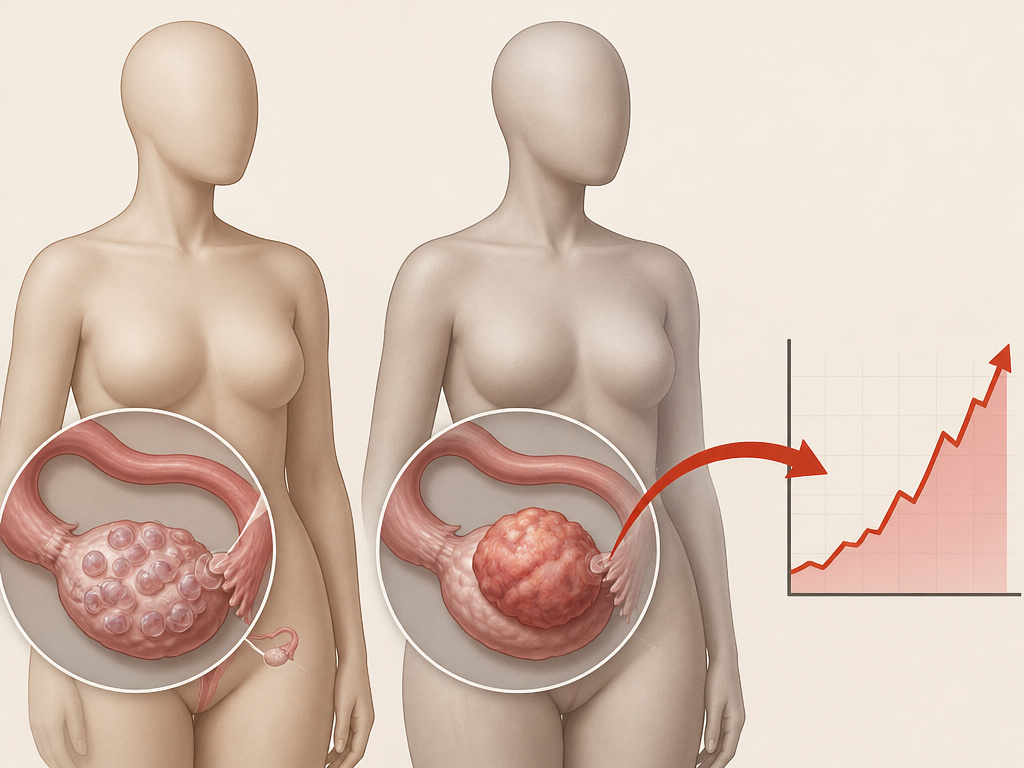
A woman’s age and menstrual status dramatically reshape the list of likely culprits. What’s a safe assumption at 25 becomes a dangerous oversight at 60.
In premenopausal women, the math overwhelmingly favors PCOS. The goal is to manage symptoms and protect long-term metabolic health. The conversation is about birth control, anti-androgen medications like spironolactone, and insulin-sensitizing drugs like metformin.
In postmenopausal women, the calculus flips. The ovaries should be quiet. New, significant androgen excess is a major red flag. In the large cohort study, PCOS was the most common single diagnosis in postmenopausal women at 29%.
- Ovarian Hyperthecosis (OHT): This is a non-tumor condition where ovarian cells (theca cells) become overactive and produce testosterone. It’s strongly associated with insulin resistance and metabolic syndrome in older women. In the study, all 7 cases of OHT had increased testosterone.
- Neoplasms (Tumors): The likelihood of a tumor is higher. One study of 48 postmenopausal women found 8% had borderline or malignant tumors. The postmenopausal hyperandrogenism investigation approach stresses that imaging is mandatory in this group.
The takeaway is blunt: new hair growth, acne, or scalp hair loss that begins after menopause is not “just aging.” It requires a prompt and thorough workup by an endocrinologist.
Symptoms vs. Red Flags: When to Worry
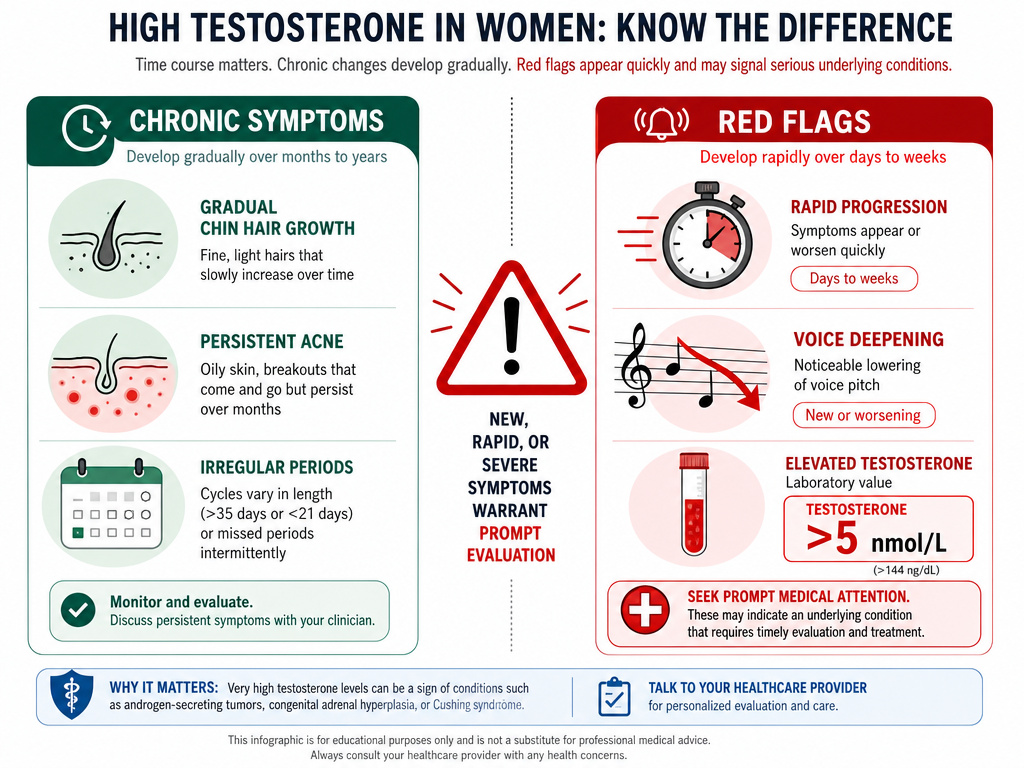
Most high testosterone symptoms are a gradual nuisance. You notice a few more chin hairs each year. Your acne never really left after high school. Your period has always been unpredictable. This pattern points toward a chronic, systemic condition like PCOS.
The red flags are different. They are sudden, severe, and progressive. They indicate that something is changing quickly, which in medicine often points toward a space-occupying tumor. The Society for Endocrinology clinical guideline explicitly lists these as features that should move the diagnosis toward a neoplastic or monogenic disorder:
- Virilization: This is the key distinction from simple hirsutism. Signs include:
- Clitoromegaly: Enlargement of the clitoris.
- Voice Deepening: A noticeable lowering of the voice pitch.
- Increased Muscle Mass: A masculine body shape change.
- Temporal Balding: Receding hairline at the temples.
- Rapid Progression: Symptoms that worsen noticeably over weeks or months, not years.
- Very High Hormone Levels: A total testosterone level >5 nmol/L (or >150 ng/dL) on a reliable LC-MS/MS assay. This is the numeric threshold that should trigger a search for a tumor.
Common mistake: Dismissing rapid changes as “stress” or “hormones acting up.” Virilization is not a typical part of PCOS. If you or your doctor notices these signs, the pace of evaluation needs to accelerate immediately.
Understanding the full spectrum of symptoms of elevated testosterone helps you track what’s happening. But knowing these red flags tells you when to push for answers faster.
How It’s Diagnosed: Tests, Limits, and the Right Questions

You can’t fix what you don’t measure correctly. The diagnostic process for high testosterone is a minefield of outdated tests and misinterpreted results. Walking in prepared is your best defense.
Step 1: The Right Blood Test (This is the most important step)
Ask for a full androgen panel measured by Liquid Chromatography-Tandem Mass Spectrometry (LC-MS/MS). Do not accept a standard “total testosterone” immunoassay result as final. As noted in commentary from The Lancet Diabetes & Endocrinology, direct immunoassays have poor accuracy at the low levels found in women. They often overestimate or underestimate the true value. LC-MS/MS is the gold standard.
- What to measure: Total Testosterone, Free Testosterone (calculated), DHEAS, Androstenedione (A4), SHBG.
- When to test: For premenopausal women, during the early follicular phase of your cycle (days 2-5 of your period) for the most consistent baseline.
Step 2: Interpreting the Numbers
Don’t just look for a “H” next to the result. Compare your numbers to female-specific reference ranges from the lab. The diagnostic threshold from guidelines is a serum testosterone >5 nmol/L via LC-MS/MS. This number should prompt imaging. For context, review the normal testosterone ranges to see where your result falls.
Step 3: Imaging
If testosterone is significantly elevated or red flags are present, the next step is visualization.
- Pelvic Ultrasound: Looks at the ovaries for PCOS morphology (many small cysts) or solid tumors.
- Adrenal CT Scan: Checks the adrenal glands for tumors. This is especially critical if DHEAS or androstenedione is very high.
Step 4: Dynamic Testing (For specific suspected conditions)
- ACTH Stimulation Test: The definitive test for Congenital Adrenal Hyperplasia (CAH).
- Dexamethasone Suppression Test: Helps diagnose Cushing’s syndrome.
The data from this process is what creates the diagnosis. The causes and patterns study of 1,205 women provides the epidemiological backbone for this entire approach, showing how often each condition appears in a real-world clinic.
The Long-Term View: More Than Just Symptoms
High testosterone is often a marker of deeper metabolic dysfunction, not just a cosmetic issue. This is the part that affects longevity and quality of life decades down the line.
Insulin Resistance and Metabolic Syndrome are tightly linked with PCOS and ovarian hyperthecosis. The high insulin drives androgen production, and the androgens worsen insulin resistance. This cycle increases the risk for:
- Type 2 Diabetes
- High blood pressure and unhealthy cholesterol levels
- Nonalcoholic fatty liver disease (NAFLD)
- Sleep apnea
Cardiovascular Risk is elevated. Studies, including the Rotterdam Study, have shown that high androgens in postmenopausal women are associated with a higher risk for atherosclerosis and cardiovascular disease. Managing androgen excess is, in part, managing heart disease risk.
Mental Health Impact is real and often overlooked. The physical symptoms can severely impact self-esteem and body image, contributing to higher rates of anxiety, depression, and disordered eating.
Fertility Implications are central for many with PCOS. Anovulation (not releasing an egg) is a direct cause of infertility. Treatment often focuses on inducing ovulation when pregnancy is desired.
Addressing these root causes is where diet and lifestyle changes show their true value. They’re not just for symptom management; they’re for systemic health.
Medications that can cause high testosterone
Certain medications can lead to elevated testosterone levels in women. This includes some forms of hormone therapy, anabolic steroids, and other drugs that affect the endocrine system. If you are experiencing symptoms of high testosterone, review all medications and supplements with your doctor. They can help determine if a prescription or over-the-counter product could be contributing to your symptoms. A change in medication may be necessary, but you should never stop or alter your dosage without direct medical supervision.
Normal vs. High testosterone level ranges
Determining what constitutes a high level requires accurate measurement. Standard direct immunoassays are often unreliable for the low levels typical in women. The recommended method is Liquid Chromatography-Tandem Mass Spectrometry (LC-MS/MS). According to a clinical guideline, a serum testosterone concentration above a specific threshold measured via LC-MS/MS warrants further investigation with imaging of the ovaries and adrenal glands, regardless of whether a woman is premenopausal or postmenopausal. This testing helps identify the source of excess androgen production.
Frequently Asked Questions
What causes very high testosterone in females?
Very high testosterone levels (e.g., >5 nmol/L) are most concerning for an androgen-secreting tumor, either in the ovary or the adrenal gland. This is especially true if the high level is accompanied by virilization (voice deepening, clitoral enlargement) or if it occurs in a postmenopausal woman. A thorough workup with specialized testing and imaging is essential.
How do I lower my testosterone as a woman?
The approach depends on the cause. For PCOS, first-line strategies include lifestyle changes (diet and exercise to improve insulin sensitivity), combined oral contraceptives to suppress ovarian androgen production, and anti-androgen medications like spironolactone. For adrenal causes, treatment targets the underlying condition (e.g., medication for CAH, surgery for a tumor). Always work with an endocrinologist to match the treatment to the diagnosis.
What raises testosterone in women naturally?
Aside from medical conditions, significant weight gain can increase testosterone production by exacerbating insulin resistance. Extreme physical or emotional stress can temporarily raise cortisol and adrenal androgens. However, these are typically minor compared to pathological causes. Certain supplements, like DHEA, are marketed for this purpose but can actually cause or worsen high testosterone and should be avoided unless prescribed.
At what age is a woman’s testosterone the highest?
Testosterone levels in women peak in their early 20s and then gradually decline with age. The most significant drop occurs after menopause when ovarian production ceases, though the adrenals continue to produce precursors. It’s crucial to understand that “highest” refers to the normal physiological range. Any level above the normal range for a woman’s age is considered abnormal and requires investigation, regardless of her age.
Before You Go
If you take one thing from this, let it be this: the single most important factor in getting the right answer is getting the right test. Insist on an LC-MS/MS androgen panel. A normal result on an inaccurate immunoassay has sent countless women home without answers, while their actual hormonal imbalance continued unchecked.
Track your symptoms with a timeline. Note when they started and how quickly they’ve changed. That history is diagnostic gold for your doctor. And finally, know your thresholds. A testosterone level over 5 nmol/L isn’t just high—it’s a signal that the investigation needs to shift gears from management to urgent rule-out.
This all assumes access to specialized care, which is a real barrier. If your doctor dismisses your concerns, seek a second opinion, preferably from a reproductive endocrinologist or an endocrinologist familiar with androgen disorders. Your role of testosterone in health is too important to let a misunderstanding about its excess go unresolved.
