
What Does Testosterone Do in Women?
This post contains affiliate links. As an Amazon Associate, we earn from qualifying purchases.
Testosterone in women supports libido; its roles in cognitive function, bone and muscle health, and energy regulation are areas of ongoing research but are not evidence-based indications for therapy. The typical adult level is around 40 ng/dL, with a normal range from 15 to 70 ng/dL. Testosterone therapy is only evidence-based for treating low sexual desire in postmenopausal women, and its use is off-label in the U.S. With specific risks like acne, voice changes, and blood lipid shifts.
That range, 15 to 70 nanograms per deciliter, is where most of the clinical confusion starts. A level of 25 ng/dL might be normal for one woman and signal a problem for another, and the standard lab tests aren’t precise enough at these low concentrations to make a definitive call. This uncertainty is central to the question of what does testosterone do in women.
This guide explains testosterone’s functions, the effects of imbalanced levels, and the evidence for therapy options, including the central question of what testosterone does in women. The guide addresses normal ranges, the symptoms that matter, and the essential safety debates to understand before considering treatment.
Key Takeaways
- Testosterone’s role in women is multifaceted, directly affecting sexual desire, mood, bone density, and muscle mass.
- There is no defined deficiency level for women; diagnosis focuses on symptoms, particularly low libido, not just a lab number.
- The only evidence-based use for testosterone therapy in women is for treating low sexual desire (Hypoactive Sexual Desire Disorder) in postmenopausal women.
- Prescription creams are the safest, most common delivery method; oral testosterone is linked to unfavorable cholesterol changes.
- Therapy requires regular blood monitoring (every 6 months) and is not recommended long-term (beyond two years) due to sparse safety data.
What Does Testosterone Do for Women?
Testosterone is not just a “male hormone,” which is why the what does testosterone do in women query is so important. It’s a key player in female physiology from head to toe. Its effects are mediated through androgen receptors found in tissues like the brain, bone, muscle, and skin.
The hormone acts as a fundamental driver for sexual desire and modulates the brain’s response to sexual stimuli. Beyond libido, it influences specific brain receptors linked to mood, potentially reducing feelings of depression and anxiety and supporting a sense of well-being. Its anabolic effects help maintain muscle mass and strength, contribute to bone mineral density, and play a role in regulating energy levels and combating fatigue.
Testosterone in women exerts its effect through androgen receptors located in several organs, including the breast, brain, ovaries, bone, muscle, fat, liver, and skin. It plays an important role in female sexual function and has multiple anabolic effects on muscles, body fat, and bone.
Normal Testosterone Levels and the Measurement Problem
A normal testosterone level for an adult woman is typically cited as around 40 nanograms per deciliter (ng/dL), but the healthy range is broad, anywhere from 15 to 70 ng/dL. For context, the normal range for men is vastly higher, from about 193 to 824 ng/dL.
The Cleveland Clinic notes a critical caveat: there isn’t a defined testosterone deficiency level in women. You can’t point to a single number on a lab report and declare a problem. This is partly because levels fluctuate naturally throughout the menstrual cycle and decline with age, especially after menopause.
The bigger issue is the test itself. Most standard commercial lab assays are designed to measure the much higher testosterone levels found in men. They are notoriously unreliable at accurately quantifying the low concentrations typical in women. One lab might report 22 ng/dL, while another tests the same sample at 30 ng/dL. This inconsistency makes basing a treatment decision solely on a single lab value a flawed approach.
Symptoms of Low and High Testosterone
When testosterone is out of balance, the symptoms are often vague and overlap with many other conditions. This is where the “multifactorial” nature of the problem becomes clear.
A sign linked to low testosterone includes: – Diminished sex drive (the only evidence-linked symptom for considering therapy) Other symptoms like fatigue, mood changes, or brain fog are not evidence-based indications for testosterone therapy and may have other causes.
Signs of high testosterone are often more physically distinct and can indicate conditions like Polycystic Ovary Syndrome (PCOS):
- Hirsutism (excess hair growth on the face, chest, or back)
- Severe or persistent acne
- Male-pattern hair loss (thinning at the crown)
- Irregular or absent menstrual periods
- Deepening of the voice
- Changes in body composition, like increased abdominal fat
The Only Evidence-Based Use for Testosterone Therapy

After sifting through the symptoms, the clinical evidence lands on one clear point. According to the Cleveland Clinic, low libido is the ONLY symptom of low testosterone in women where there’s adequate evidence to support the use of testosterone therapy.
This specific condition is often diagnosed as Hypoactive Sexual Desire Disorder (HSDD), a persistent lack of sexual interest that causes personal distress. The therapy is considered for postmenopausal women.
It’s crucial to understand the regulatory landscape. The U.S. Food and Drug Administration (FDA) hasn’t approved any specific testosterone treatment for women. Any prescription is an off-label use of a product approved for men, prescribed at a much smaller dose. In contrast, countries like the United Kingdom, Australia, and New Zealand have approved specific testosterone products for female use.
| Therapy Consideration | Key Fact | Why It Matters |
|---|---|---|
| Approved Indication | Only for low libido/HSDD in postmenopausal women | Evidence does not support use for low energy, bone health, or “well-being” |
| FDA Status in U.S. | No approved product for women; all use is off-label | Prescriptions use scaled-down male doses |
| International Status | Approved in UK, Australia, NZ, South Africa | Recognizes specific female formulations |
| Clinical Guidance | 2019 Global Consensus Position Statement restricts use to HSDD | Defines a strict, evidence-based boundary for treatment |
Forms of Testosterone Therapy and Critical Safety Differences

Not all testosterone is delivered the same way, and the route of administration dramatically changes the risk profile. This is one of the most important non-commodity insights in the data.
Prescription creams are considered the safest and most common method for women in the U.S. Testosterone cream is typically applied to the lower abdomen or buttocks. The dose is easier to control, and the hormone absorbs slowly, avoiding large spikes in blood levels.
Injections or subcutaneous pellet implants are cautioned against by experts like the Cleveland Clinic’s Dr. Crawford. These methods can result in very high, unpredictable testosterone levels, leading to a higher risk of adverse side effects like masculinization.
The most critical safety difference involves blood lipids, specifically cholesterol. Research, including a 2019 Lancet meta-analysis, shows a split: oral testosterone is associated with a significant increase in LDL and decrease in HDL, while non-oral routes show no significant negative impact. However, the Cleveland Clinic lists blood lipid abnormalities as a potential side effect of testosterone therapy in women regardless of route.
This means the delivery method isn’t just about convenience; it directly influences cardiovascular risk factors. This is a prime example of why you cannot generalize about “testosterone therapy” as a single entity.
Common mistake: Using over-the-counter “testosterone booster” supplements. These are largely unregulated, their quality and strength are unknown, and they are not a substitute for diagnosed, monitored medical treatment.
Documented Benefits, Risks, and Required Monitoring
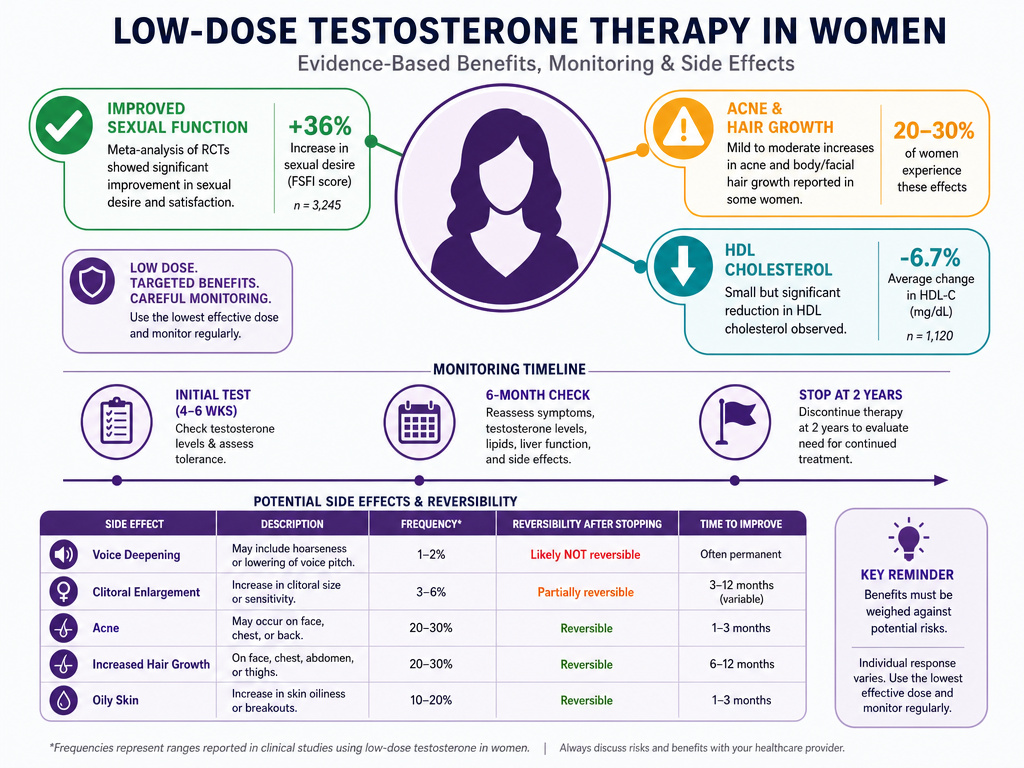
The benefits of therapy, when appropriately applied, are supported by data. A 2017 meta-analysis in the Journal of Clinical Endocrinology & Metabolism that reviewed 35 randomized trials found testosterone use in postmenopausal women was associated with a statistically significant improvement in various domains of sexual function and personal distress.
The same meta-analysis cataloged the documented risks and metabolic effects:
- Increased incidence of acne and hirsutism.
- Blood lipid changes: a reduction in total cholesterol and triglycerides, but also a reduction in HDL and an increase in LDL.
- No significant effect on body measurements (anthropometrics) or bone density.
The part nobody mentions: The long-term safety data for testosterone use in postmenopausal women is explicitly described in the research as “sparse, and the quality of such evidence is low.” This is why treatment duration is capped.
Because of these risks, rigorous monitoring is essential. The standard protocol involves:
- Initial blood test 4 to 6 weeks after starting therapy.
- Follow-up tests every 6 months to ensure levels stay within a safe, physiological range for women.
- Limited treatment duration. Experts like Dr. Crawford advise against extending therapy beyond two years due to the unknown long-term risks.
Therapy is generally not recommended for women with cardiovascular disease, liver disease, or hormone-sensitive cancer, such as breast cancer or uterine cancer.
| Potential Side Effect | Likelihood / Notes | Reversibility |
|---|---|---|
| Acne / Oily Skin | Common, dose-dependent | Usually reversible upon stopping |
| Hirsutism (Extra Hair) | Common, especially with high doses | May be partially reversible; some hair may remain |
| Voice Deepening | Less common, but a significant concern | Often not fully reversible |
| Male-Pattern Baldness | Possible with prolonged use | May not fully reverse |
| Blood Lipid Changes | Depends on administration route (see oral vs. Non-oral) | Typically reversible |
| Clitoral Enlargement | Possible with higher doses | Often not fully reversible |
How to Talk to Your Doctor About Testosterone
What causes high testosterone in women?
High testosterone levels in women are often linked to underlying health conditions. Symptoms of high testosterone may include acne, increased body or facial hair (hirsutism), male-pattern hair loss, and irregular menstrual cycles.
How do testosterone levels change with age and menopause?
Testosterone levels in women naturally decline with age, with a more pronounced drop occurring around menopause as ovarian function decreases. While there isn’t a defined deficiency level for women, this decline coincides with symptoms like low libido for which therapy is sometimes considered. A 2017 meta-analysis found testosterone use in postmenopausal women is associated with a statistically significant improvement in sexual function and personal distress, and also with an increase in LDL cholesterol. Long-term safety data for this use is sparse. Treatment, if considered, involves off-label use of low-dose products, with prescription creams being the most common. Regular monitoring of hormone levels is required, and experts advise against extending therapy beyond two years due to potential risks.
Frequently Asked Questions
What are normal testosterone levels for a woman?
Normal total testosterone for an adult woman ranges from 15 to 70 nanograms per deciliter (ng/dL), with a typical level around 40 ng/dL. There is no single “optimal” number, and levels naturally decline with age, particularly after menopause.
Can testosterone help a woman lose weight?
The evidence says no. The 2017 meta-analysis found testosterone use in postmenopausal women had no significant effect on anthropometric measures like weight or BMI. It is not a weight-loss treatment.
Why is testosterone not FDA-approved for women?
The FDA approves drugs for specific uses based on sponsor-submitted data. While evidence supports its use for low libido, no pharmaceutical company has completed the large, long-term safety studies required for a formal FDA indication for women in the U.S., leading to the current off-label status.
How long does it take for testosterone therapy to work in women?
For its primary use (improving libido), effects on sexual desire may take time to develop. Blood levels are first checked 4 to 6 weeks after starting to ensure safety.
What is the safest form of testosterone for women?
Prescription transdermal cream or gel is widely regarded as the safest and most common method. It allows for steady, low-dose absorption and avoids the first-pass liver metabolism and negative lipid effects associated with oral testosterone.
Before You Go
The core takeaway is specificity. Testosterone in women isn’t a mystery, it has defined roles, and its therapeutic use has a narrow, evidence-based lane. If you’re struggling with low sexual desire that’s affecting your life, that’s the legitimate door to a medical conversation.
Start with thorough labs, not guesswork. Understand that a cream is the default safer choice, and commit to the required twice-yearly monitoring if you proceed. The rule is two years; exceeding that timeline ventures beyond the existing safety data.
For every other symptom, fatigue, brain fog, low mood, the research is clear: look to thyroid, iron, sleep, and stress first. Testosterone therapy is a specialized tool, not a general wellness fix.
