
Does Napping Increase Testosterone? The Short Answer
This post contains affiliate links. As an Amazon Associate, we earn from qualifying purchases.
Napping does not directly increase testosterone in healthy, well-rested individuals. The hormonal benefit comes from preventing the drop in testosterone caused by severe sleep loss. A strategic nap can mitigate the effects of significant nighttime sleep deprivation, but it is not a substitute for quality, consolidated nighttime sleep, which is when the majority of testosterone is produced and released.
Think of it as damage control, not a performance enhancer. If you’re chronically short on sleep, a nap might help keep your levels from cratering. If you’re already getting seven or eight solid hours, a nap won’t give you a hormonal boost. A common question is does napping increase testosterone.
What follows is a breakdown of the specific research, the critical importance of sleep timing, the surprising role of cortisol, and the practical line between a helpful nap and one that sabotages your night.
Key Takeaways
- Napping is a damage-control tool for testosterone, not a booster. It helps prevent the drop from severe sleep loss but doesn’t raise levels above baseline.
- The timing of sleep loss matters more than total hours. Losing sleep in the second half of the night (early morning) crashes testosterone harder than losing it earlier.
- A 90-minute afternoon nap can trigger a cortisol spike, which may indirectly support alertness but doesn’t equate to a testosterone rise.
- Consolidated nighttime sleep is essential. A substantial portion of daily testosterone release is tied to deep sleep stages you only get in a full night’s cycle.
- Fixing nighttime sleep hygiene always beats adding naps for hormonal health. Start with a consistent wake time and limit evening alcohol.
The Short Answer on Napping and Testosterone
No study shows a direct, causal increase in testosterone from napping in men who are not sleep-deprived. The connection is indirect and defensive. Research frames the does napping increase testosterone question as a potential countermeasure against the testosterone-lowering effects of acute, severe sleep loss.
The most telling evidence comes from a 2012 study by Schmid and colleagues. They found that sleep restricted to 4.5 hours in the first half of the night (22:30 to 03:00) did not reduce morning testosterone levels. However, total sleep deprivation or early awakening that caused wakefulness during the second half of the night significantly decreased morning testosterone. This points to a critical window for testosterone production tied to your circadian rhythm and sleep architecture, not just to being asleep.
A 90-minute afternoon nap produced a significant cortisol awakening response, while a 50-minute morning nap did not. This suggests nap timing and sleep architecture influence stress hormone reactivity, which is a separate system from testosterone regulation.
So, can a nap help? If you’ve pulled an all-nighter or are severely sleep-deprived, a nap might help blunt the sharpest edges of the resulting hormonal crash. But for the guy asking if a daily power nap will boost his T above his normal baseline, the science says no. Your body’s testosterone production is heavily scheduled around deep, consolidated nighttime sleep.
How Nighttime Sleep Builds Testosterone (And Why Naps Can’t Replicate It)
Your body isn’t just looking for total sleep minutes. It’s running a precise hormonal production schedule tied to light, darkness, and specific sleep stages. Testosterone release isn’t steady; it’s pulsatile, with the largest pulses occurring during REM and slow-wave (deep) sleep stages in the latter half of the night.
This is why the Schmid study finding is so crucial. Messing with the second half of your night is like interrupting the factory right at the end of the production line. The parts assembled earlier (in the first half of the night) don’t get shipped out.
Think of it like this: Nighttime sleep is the main manufacturing shift. A nap is a small, emergency maintenance crew that can fix a critical machine if the day shift completely broke down. But that crew doesn’t have the staff or blueprint to run the full production line. They can only prevent total disaster.
The circadian rhythm of testosterone is pegged to this schedule. Levels naturally rise overnight and peak in the early morning. This peak is a result of the cumulative secretion during those later sleep cycles. A nap, occurring outside this circadian window and typically lacking the full architecture of a night’s sleep, doesn’t trigger the same secretory process.
When Sleep Loss Hurts Testosterone (And When It Might Not)

The relationship between sleep loss and testosterone isn’t a simple on/off switch. Research reveals a tiered effect, and recent studies have added nuance that much of the common advice gets wrong.
Total Sleep Deprivation (≥24 hours): A meta-analysis of testosterone and sleep loss concludes it reliably reduces serum testosterone, though some individual studies, such as the RCT cited, found certain forms of severe sleep restriction did not significantly affect levels. Your system needs the offline time for regulation.
Severe Acute Restriction (4 hours/night for 5 nights): Here’s where it gets interesting. A rigorous PMC randomized controlled sleep study found this severe short-term restriction did not significantly affect plasma testosterone in healthy young men. This challenges the older, blanket statement that any sleep loss tanks T.
Mild Chronic Restriction (1.5 hours less/night for 6 weeks): The same RCT (PMCID: PMC6917985, cited in WEB RESEARCH) found this longer-term, moderate restriction also had no significant effect. This suggests the male hormone axis can be resilient to moderate, predictable shortfalls.
Where this goes sideways: Assuming all sleep loss is equal. The 2012 Schmid study shows losing sleep from 3:00 AM to 7:00 AM is more harmful to testosterone than losing it from 10:30 PM to 3:00 AM. Your body prioritizes the hormonal work for the early morning window.
The practical takeaway? An occasional short night might not wreck your hormones, but consistently cutting your sleep short right before dawn likely will. This is also why the does napping increase testosterone strategy to “catch up” after chronically robbing your second half of the night is flawed. You’re missing the scheduled production window.
| Type of Sleep Loss | Effect on Morning Testosterone | Key Research Insight |
|---|---|---|
| Total Deprivation (24+ hrs) | Significant decrease | Consistent finding across meta-analyses. |
| Second-Half Night Loss | Significant decrease | Early awakening (e.g., 3:00 AM) disrupts key release window. |
| First-Half Night Loss | No significant decrease | Sleep from 10:30 PM–3:00 AM preserved levels in one study. |
| Severe Acute Restriction | No significant decrease (in one RCT) | 4 hours/night for 5 nights did not alter levels in healthy men. |
| Mild Chronic Restriction | No significant decrease (in one RCT) | 1.5 hours less/night for 6 weeks showed resilience. |
The Cortisol Complication: What Naps Actually Do to Your Stress Hormones

If naps don’t boost testosterone, what do they do? They can significantly affect cortisol, your primary stress hormone. Cortisol and testosterone often exist in a see-saw relationship; chronic high cortisol can suppress testosterone production.
Research on the cortisol awakening response (CAR)—the natural spike in cortisol that helps you become alert in the morning—shows naps can trigger a similar response. One study found a 90-minute afternoon nap (long enough to include slow-wave sleep) produced a significant CAR. A 50-minute morning nap did not. Another study showed a 1-hour early evening nap (ending between 6:45 PM and 8:30 PM) caused no cortisol increase.
A pharmacological manipulation to induce slow-wave sleep in a morning nap also produced a cortisol awakening response. This tells us it’s the sleep architecture, not just the time of day, that drives the hormonal signal.
This has two implications:
- The Alertness Benefit: The cortisol spike from a long afternoon nap might explain the feeling of rejuvenated alertness, as it mimics your morning wake-up call.
- The Timing Risk: A nap that triggers a strong CAR too late in the day could potentially interfere with your evening wind-down and the onset of nighttime sleep, which is far more important for testosterone.
So, while you might feel more awake, you’re not stimulating your testosterone pipeline. You’re activating a different, stress-related system. For hormonal health, managing chronic cortisol is part of the link between sleep and testosterone, which is why using naps as a band-aid for poor nighttime sleep can become a vicious cycle.
Napping vs. Growth Hormone: Clearing the Confusion
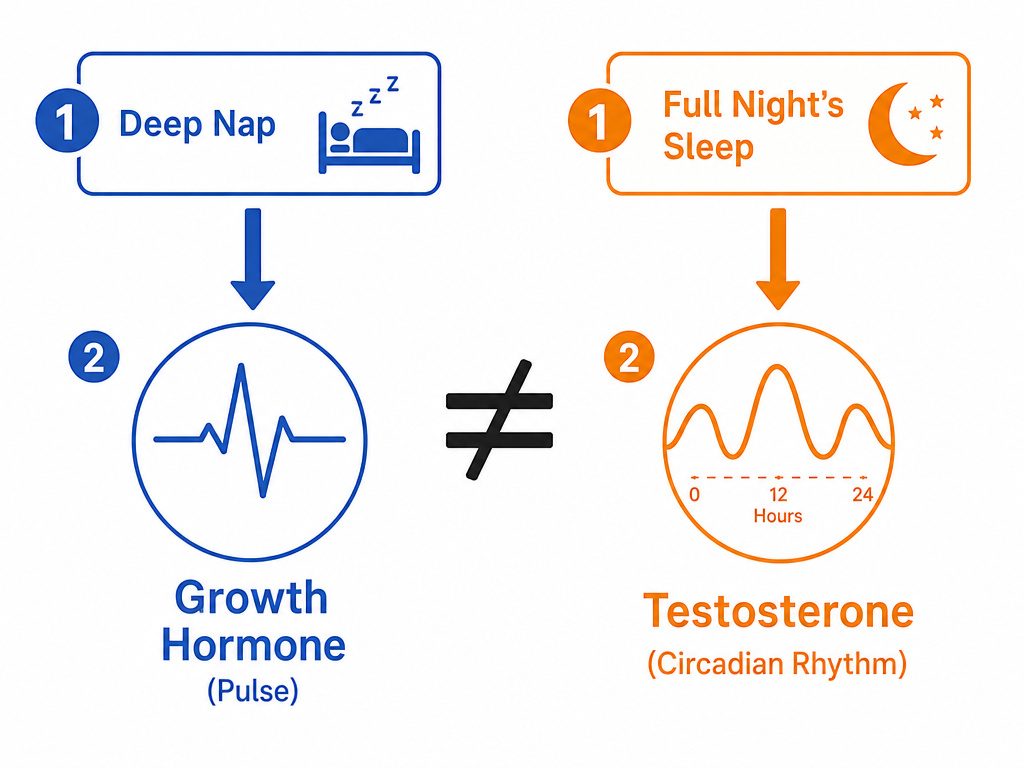
This is a common mix-up in forums and generic articles. Napping, particularly naps that include deep sleep, can stimulate a release of growth hormone (GH). GH is crucial for repair, muscle growth, and metabolism. A robust nap can trigger a GH pulse similar to the one released early in nighttime sleep.
Testosterone and GH are partners, but they are not the same. The conditions that release them are different:
- Growth Hormone: Released in response to deep sleep (slow-wave sleep), which can occur in a long nap (>60 minutes) or early in the night.
- Testosterone: Released in a circadian pattern, heavily dependent on later-night sleep cycles (including REM) and the overall nightly secretion pattern.
You might get a GH boost from a deep nap, which is beneficial for recovery. Do not mistake that for a testosterone boost. This distinction is key when evaluating claims about “hormonal benefits” of napping. You’re getting one, not the other.
Strategic Napping: If You’re Going to Do It, Do It Right
Since napping’s primary hormonal value is in offsetting severe sleep debt, the protocol matters. The goal is to gain alertness and minimal recovery without harming that night’s sleep, which is your main hormonal event.
Here’s how to layer it in without making things worse:
- Keep It Short or Commit to a Cycle: Aim for a short “power nap” to stay in light sleep and avoid sleep inertia (that groggy feeling). If you have time, go for a longer nap to complete a full sleep cycle and get slow-wave sleep without waking in the middle of deep sleep.
- Nap Early: The sweet spot is typically early to mid-afternoon. This aligns with a natural dip in circadian alertness and is far enough from bedtime to avoid interfering with nighttime sleep.
- Create a Cave Environment: Dark, cool, and quiet. Use an eye mask or blackout curtains. This signals your brain for sleep quickly, making a short nap more efficient.
- Set an Alarm: Never nap “until you wake up.” This risks oversleeping and ruining your night. The alarm protects your schedule.
Skip this if: You struggle with insomnia or falling asleep at night. For you, any nap might reduce your sleep drive (the pressure to sleep) and make a bad connection between low testosterone and sleep even worse. Your single focus should be improve sleep for testosterone at night.
Remember, this is a tactical tool for an acute deficit. It is not a foundational strategy for hormonal health. The foundation is, and always will be, the quality and quantity of your nighttime sleep.
The Foundation: Fix Your Nighttime Sleep First
Chasing nap optimization while neglecting nighttime sleep is like using a bucket to bail out a boat while ignoring a gaping hole in the hull. Your first, second, and third investments should be in fixing the hull.
The most effective, research-backed levers to pull for better sleep—and by extension, supportive testosterone levels—are not exotic. They are boring and consistent.
- Lock In Your Wake Time: This is the most underrated tool. Wake up at the same time every day, even on weekends. This stabilizes your circadian rhythm more than any other single habit. Your testosterone rhythm follows this clock.
- Get Morning Light: View bright, outdoor light within 30-60 minutes of waking. This reinforces the circadian signal that “daytime has started,” helping to regulate all downstream hormones.
- Manage Caffeine and Alcohol: Have a strict caffeine cutoff time in the afternoon. Even if it doesn’t keep you awake, it can shallow your sleep. Alcohol, while sedating, fragments sleep and devastates sleep quality, particularly in the second half of the night—precisely the window you need for testosterone.
- Address Sleep Disorders: Loud snoring, gasping for air, and daytime exhaustion are red flags. Sleep apnea and testosterone are intimately linked, as the disorder fragments sleep and creates hypoxia, both of which suppress production. This requires a medical diagnosis.
These basics do more for your hormonal health than any nap schedule ever will. They protect the sleep duration for testosterone your system is designed to use.
General sleep hygiene tips to boost testosterone
Focus on protecting the second half of your night’s sleep. Research shows that being awake during this period, or suffering total sleep deprivation, can significantly decrease morning testosterone. While short-term partial sleep restriction may not show a major effect, the goal is to avoid severe deficits. Prioritize a consistent sleep schedule that allows for full, uninterrupted cycles. Create a dark, cool environment and establish a wind-down routine to make falling asleep easier. The key is consistent, quality rest to prevent the hormonal disruption linked to significant sleep loss.
Symptoms and health impacts of low testosterone
Low testosterone can manifest in several ways that affect daily life and long-term health. Common symptoms include persistent fatigue, reduced muscle mass, increased body fat, and a decline in libido or sexual function. Men may also experience mood changes, such as irritability or a lack of motivation, and find it harder to concentrate. Over time, low levels can contribute to decreased bone density, raising the risk of osteoporosis. If you’re experiencing a cluster of these symptoms, it’s a valid reason to consult a healthcare professional for an evaluation and to discuss potential underlying causes, including lifestyle factors like chronic sleep patterns.
Frequently Asked Questions
Can a nap increase testosterone?
Not directly. In well-rested men, a nap does not raise testosterone levels above their normal baseline. Its potential benefit is defensive: it may help mitigate the drop in testosterone that would otherwise occur following a period of severe total sleep deprivation. The hormonal production cycle for testosterone is tied to consolidated nighttime sleep.
What is the #1 testosterone killer related to sleep?
The single most destructive pattern is chronic sleep fragmentation, particularly from conditions like untreated sleep apnea or consistently interrupted sleep in the early morning hours. This prevents the deep, uninterrupted sleep cycles in the second half of the night where the largest pulses of testosterone are released. It’s more damaging than simply short sleep duration.
Does not ejaculating for 7 days increase testosterone?
The evidence for this is weak and often misinterpreted. Some small studies show a transient, modest increase around day 7, but levels typically return to baseline. This is not a sustainable or meaningful strategy for elevating testosterone compared to foundational factors like sleep, nutrition, and strength training. The effect is negligible for hormonal health.
Do naps boost growth hormones?
Yes, they can. Naps that are long enough (typically 60-90 minutes) to include slow-wave sleep (deep sleep) can trigger a release of growth hormone, similar to the pulse that occurs early in nighttime sleep. This is separate from testosterone and is beneficial for recovery and repair. This is likely the source of the common confusion between napping and testosterone.
Before You Go
The data draws a clear line: napping is a tactical response to acute sleep debt, not a hormonal enhancement protocol. Its value lies in damage control, not elevation.
If you are using naps to compensate for consistently poor nights, you are treating a symptom. The cure is to audit your nighttime strategies for better sleep. Start with a fixed wake time and morning light viewing. Measure the effect of cutting off caffeine and alcohol earlier. These dull fundamentals move the needle where it counts.
For your hormones, protect the night shift. Let the day shift handle alertness.
