
Does Testosterone Affect Height? Key Takeaways Explained
This post contains affiliate links. As an Amazon Associate, we earn from qualifying purchases.
Testosterone does affect height, but only during puberty by stimulating the adolescent growth spurt. It does not increase final adult height in healthy adults. In medical settings, low-dose testosterone can treat delayed puberty without harming final height, while high-dose regimens are used to limit excessive height. The effect hinges entirely on the status of the growth plates in your bones.
The mechanism isn’t magic, it’s endocrinology. Testosterone works alongside growth hormone to drive the pubertal growth spurt, but it also signals the growth plates to mature and eventually fuse, which stops vertical growth for good. This dual role, accelerator and brake, explains why timing and dose are everything when considering how does testosterone affect height.
What follows: a breakdown of how testosterone triggers your growth spurt, why the window slams shut in adulthood, what the clinical studies actually say about treatment when you compare a does testosterone affect height study, and the other factors, from genetics to nutrition, that play a far bigger role.
Key Takeaways
- Testosterone fuels the pubertal growth spurt by working with growth hormone, but it also directs growth plates to fuse, permanently ending height gain.
- For boys with constitutional delay of growth and puberty (CDGP), low-dose, short-course testosterone (e.g., 50-125 mg/month) can safely induce puberty without reducing final adult height.
- Once growth plates fuse in late adolescence, testosterone cannot increase height; any perceived changes in adults are from posture or spinal disc health.
- The primary determinant of your height is your genetic blueprint, with nutrition, sleep, and overall health modulating the final outcome.
- High-dose testosterone therapy (e.g., 500 mg every two weeks) is a medical intervention to limit final height in excessively tall adolescents by accelerating growth plate closure.
How Testosterone Influences Puberty and the Growth Spurt
Your genes set the blueprint, but hormones are the construction crew. During puberty, the hypothalamus signals the pituitary gland, which in turn tells the testes to ramp up production. This surge in testosterone levels doesn’t work alone.
It stimulates the liver to produce more Insulin-like Growth Factor 1 (IGF-1). Think of testosterone as the project manager and IGF-1 as the foreman carrying out the day-to-day work of building bone and muscle. This partnership is why a teenage boy can seem to grow inches overnight, the hormonal machinery is running at full capacity.
The growth spurt itself has a predictable pattern. It typically begins with a rapid increase in limb length (arms and legs), followed by trunk growth. This sequence is why many teens go through an awkward, lanky phase. The pace is intense, with significant growth occurring during the peak of the pubertal growth spurt. This entire process, central to the does testosterone affect height mechanism, is one of the core testosterone functions, transforming a child’s body into an adult’s.
The Technical Snapshot: Testosterone exerts its growth-promoting effects indirectly by amplifying the production of Insulin-like Growth Factor 1 (IGF-1) in the liver. This synergy with the growth hormone (GH) axis is critical for the accelerated linear bone growth observed during the pubertal growth spurt. The hormone also promotes protein synthesis and bone mineralization, contributing to increased bone density and muscle mass concurrent with the height increase.
The spurt doesn’t last forever because testosterone has a second, contradictory job. Even as it’s pushing growth, it’s beginning the process of maturing the cartilage cells in the growth plates. This is the setup for the final act: fusion.
Growth Plates: The Gatekeepers of Height
Growth plates, or epiphyseal plates, are areas of specialized cartilage at the ends of long bones. This cartilage is the factory where new bone is manufactured, lengthening the bone. On an X-ray, they appear as dark lines near the bone ends, and their width is a direct indicator of remaining growth potential.
Testosterone’s relationship with these plates is a double-edged sword. It stimulates the chondrocytes (cartilage cells) to proliferate rapidly, this is the growth part. But it also accelerates their maturation program. Once these cells fully mature, they are replaced by solid bone. The dark line on the X-ray disappears, the plate “closes” or fuses, and longitudinal growth stops permanently.
This is why timing is critical. The entire system is designed for a finite window. An adolescent’s growth plates are wide open and highly responsive. An adult’s are fully closed and inert. No amount of testosterone can reactivate a closed growth plate, just as no amount of water can make a finished brick revert to clay.
The closure process is systematic. It typically starts in the smaller bones of the hands and feet, moving to the elbows and knees, and finishing at the spine and pelvis. Doctors use this pattern, assessed via a bone age X-ray (often of the left hand and wrist), to estimate how much growth a teenager has left. The two most common assessment methods cited in studies are the Greulich-Pyle method and the RUS (TW2) method of Tanner and Whitehouse.
Where this goes sideways: Assuming testosterone is a general “growth hormone” at any age. After plate fusion, its anabolic effects shift entirely to muscle and bone density maintenance, not length. Taking testosterone supplements as an adult hoping to grow taller will not work and carries significant health risks.
Does Testosterone Therapy Increase Final Adult Height?
This is where the clinical data gives a nuanced, context-dependent answer. The question splits into two distinct medical scenarios: treating delayed puberty and limiting excessive tallness.
For boys diagnosed with constitutional delay of growth and puberty (CDGP), the goal is to trigger the delayed pubertal process. The concern for parents is whether jump-starting puberty with testosterone will cause early plate closure and ultimately stunt the child’s growth. The research here is reassuring.
A landmark study published in the New England Journal of Medicine followed boys with CDGP (mean age 14.1 years) given a low-dose regimen of 50 mg of testosterone enanthate per month for ~1.2 years. Their final adult height averaged 167.6 cm, which was virtually identical to their pretreatment predicted height of 168.0 cm. The treatment triggered the growth spurt without cheating them out of their genetic potential.
Later studies reinforced this. One retrospective analysis used a regimen of intramuscular testosterone oenanthate (125 mg/month for 3 months). It found no significant difference in final height between treated and untreated groups (168.9 cm vs. 168.2 cm). Another clinical investigation report on PubMed on short-term treatment starting at a bone age of ~12.5 years concluded it does not reduce adult height.
However, a 2026 meta-analysis in Endocrine Connections added a new layer. It reviewed retrospective cohort studies and found that androgen therapy for CDGP increased final adult height versus untreated controls by a mean difference of 1.78 cm. Crucially, it noted the greatest benefit came from low-dose, short-course testosterone regimens.
| Study / Source | Key Finding on Height | Treatment Regimen (CDGP) |
|---|---|---|
| New England Journal of Medicine (1988) | Final height matched predicted height. | 50 mg/month for ~1.2 years |
| PubMed (PMID: 12608930) | No significant difference vs. Untreated. | 125 mg/month for 3 months |
| Endocrine Connections Meta-Analysis (2026) | Increased height by ~1.78 cm vs. Controls. | Low-dose, short-course regimens showed greatest benefit |
The takeaway? For CDGP, low-dose testosterone is a safe tool to alleviate psychosocial stress and trigger natural development. Some studies (e.g., PubMed PMIDs 3667329 & 12608930) find it doesn’t steal height, while a 2026 meta-analysis in Endocrine Connections suggests it might offer a slight net gain, helping boys fully realize their genetic blueprint.
The Opposite Goal: Using Testosterone to Limit Height

The flip side of the coin is using testosterone to manage excessively tall stature, often for psychosocial or practical reasons. Here, the intent is to accelerate growth plate closure. A 1988 study in the European Journal of Pediatrics documented this approach.
Tall pubertal boys were given a high-dose regimen: 500 mg of testosterone enanthate every two weeks for six months. The result was a significant acceleration in bone age and, in a 12-boy subgroup, a reduction in adult height of 7.26 cm compared to their initial prediction using the Bayley-Pinneau (BP) method.
This study is critical because it demonstrates the dose-dependent duality of testosterone. Low dose for delay: trigger growth. High dose for tall stature: hasten the end of growth. The hormone itself is just a signal; the outcome depends on the strength and timing of that signal relative to the bone’s maturity.
Testosterone vs. Human Growth Hormone (HGH): A Clear Comparison
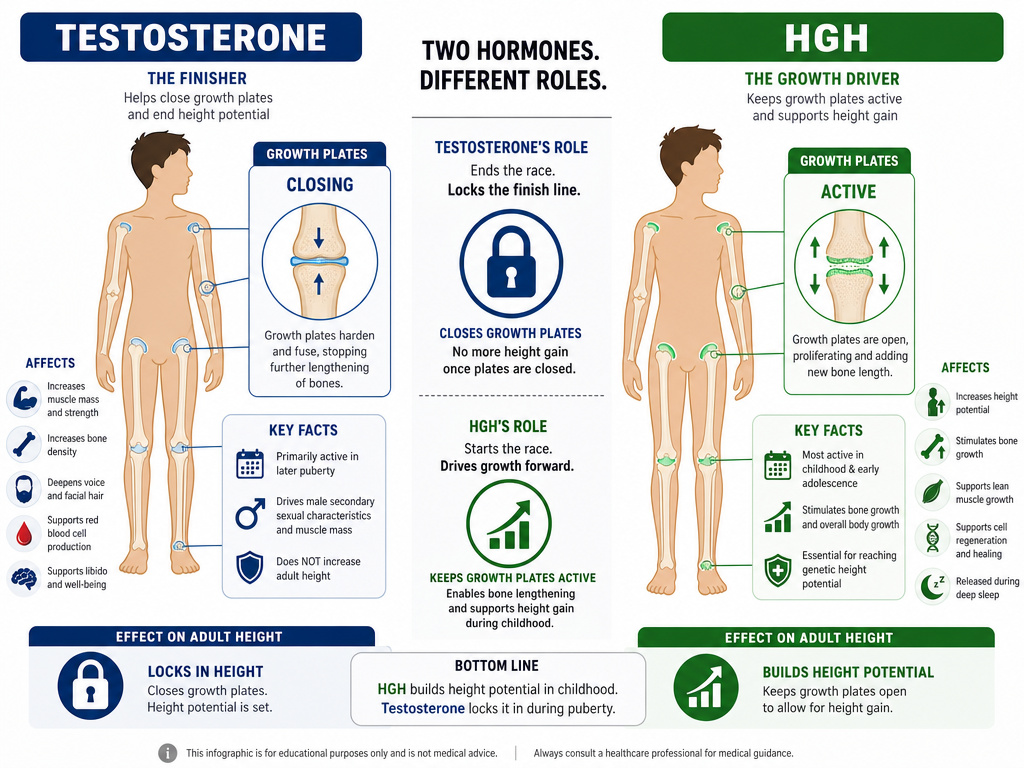
People often conflate testosterone therapy with HGH therapy, but their mechanisms and applications are distinct. This confusion fuels many of the myths about adult height increase.
| Aspect | Testosterone | Human Growth Hormone (HGH) |
|---|---|---|
| Primary Role in Growth | Stimulates pubertal spurt via IGF-1; signals growth plate maturation/fusion. | Directly stimulates growth plate cartilage cell proliferation; essential for growth from childhood. |
| Use in Youth | Treats delayed puberty (CDGP). | Treats diagnosed growth hormone deficiency (GHD). |
| Effect on Adult Height | Does not increase after plate fusion. | Can increase height in adults only if growth plates are still open (a rare medical condition). |
| Adult Use | For low testosterone (hypogonadism); benefits muscle, bone density, mood. | For adult GHD; benefits body composition, lipid profile, quality of life. Not for height. |
| Key Misconception | That it acts like HGH. | That it can make healthy adults taller. |
Testosterone’s effects on muscle growth and bone density are lifelong, but its role in height is locked to the adolescent window. HGH is the primary driver of childhood growth and remains active at the growth plate level. In cases of true pediatric deficiency, HGH replacement can lead to dramatic catch-up growth. Neither hormone is a “height drug” for a healthy adult with closed growth plates.
Why Testosterone Doesn’t Increase Height in Adults
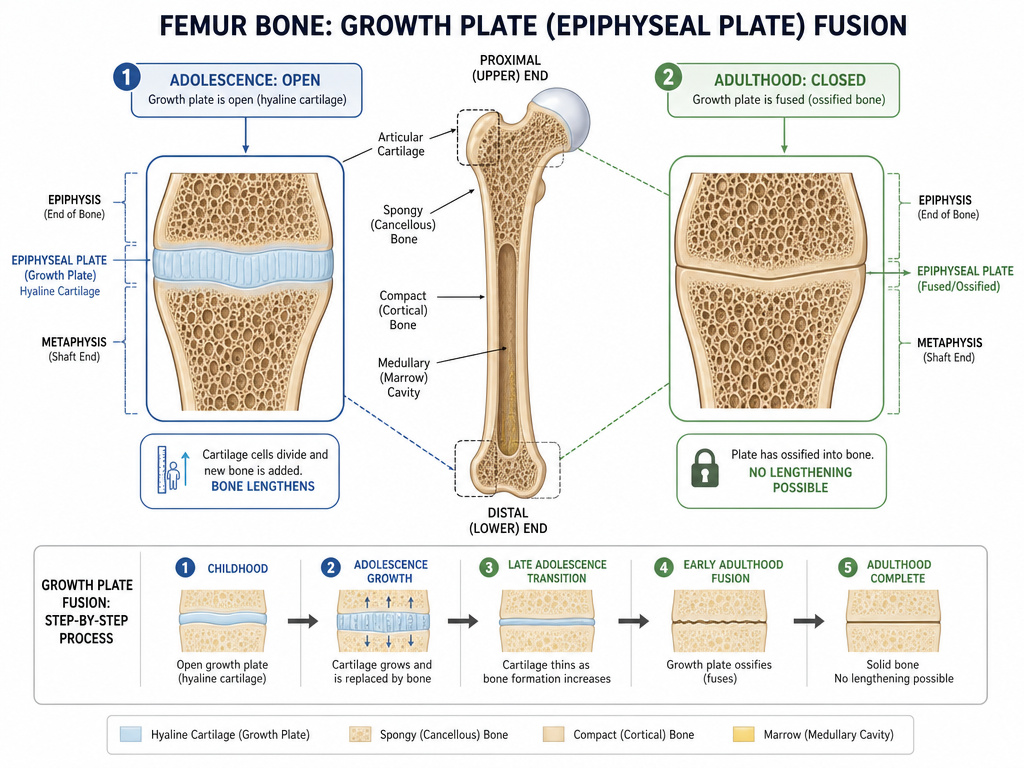
The growth plates are sealed. That’s the biological deadbolt. Once the epiphyseal cartilage has fully ossified, the long bones cannot lengthen. This fusion is typically complete in late adolescence, though the timing can vary.
So why do some men on testosterone replacement therapy (TRT) report feeling taller? The change is in posture and spinal health, not skeleton length. Low testosterone can contribute to reduced muscle mass, lower energy, and even mild depressive symptoms, all of which can lead to a stooped, less upright posture. When TRT resolves these issues, a man may stand straighter, with his shoulders back and spine aligned. This can recover an inch of “lost” height, but it’s not new growth.
Furthermore, testosterone is crucial for maintaining vertebral bone density and the health of the intervertebral discs. Healthy discs are hydrated and plump, while degenerated discs are compressed. Optimizing hormone levels supports spinal integrity, which can also contribute to maintaining one’s full natural height later in life. It’s about preservation, not addition.
Genetics and Other Factors: What Really Determines Your Height
While hormones execute the plan, genetics write it. A large proportion of your final height is determined by the DNA you inherited. Hundreds of genetic variants, each with small effects, combine to set your growth potential.
This genetic potential is then modulated by environmental factors:
- Nutrition: Chronic undernutrition, especially deficiency in protein, vitamin D, calcium, and zinc, can prevent a child from reaching their genetic height. This is why average population heights have increased with improved food security.
- Overall Health: Chronic childhood illnesses (e.g., severe asthma, celiac disease, inflammatory bowel disease) can consume energy and nutrients needed for growth, potentially stunting final height.
- Sleep: Growth hormone is secreted in pulses during deep sleep. Consistently poor sleep in childhood and adolescence can dampen this secretion.
- Prenatal Environment: A mother’s health and nutrition during pregnancy form the foundation for her child’s future growth.
Testosterone is a powerful actor, but it performs on a stage built by genes and supported by health. It cannot rewrite the script.
Frequently Asked Questions
Can testosterone make you taller after 18?
For the vast majority of men, no. Growth plate fusion is usually complete by this age. Testosterone therapy after fusion will not increase bone length. Any perceived height change is likely due to improved posture or spinal disc health.
Do tall men have higher testosterone?
Not necessarily. There’s no consistent correlation between adult height and testosterone levels. Height is primarily genetic. A tall man and a shorter man can have identical, healthy testosterone levels. Pubertal timing can play a role, an earlier spurt might lead to slightly different proportions, but circulating hormone levels in adulthood don’t dictate stature.
I’m 16 and short. Should I take testosterone?
Never self-administer testosterone. If you are concerned about your growth, the only correct step is to see a doctor. They can assess your growth history, perform a bone age X-ray, and check for conditions like CDGP. If treatment is appropriate, it will be a specific, monitored, low-dose medical regimen, not a bodybuilding supplement.
Can testosterone affect height in transgender men (FTM)?
Yes, during adolescence. For transgender males (female-to-male) who begin testosterone therapy before the end of puberty, it can cause a growth spurt and potentially increase final adult height, as it will induce male-typical pubertal changes, including growth plate maturation. For those who start after puberty, it will not increase height but will alter facial structure and body composition.
What are the risks of testosterone therapy for height?
When prescribed medically for CDGP, risks are generally considered minimal but can include side effects related to androgen exposure. The major risk of improper use, especially high doses, is the accelerated closure of growth plates, which can limit final height. In adults, misuse can cause significant health risks.
The Bottom Line
Testosterone’s effect on height is a masterclass in biological timing. It is the catalyst for your growth spurt and the foreman that eventually closes the construction site. For parents worried about a late-blooming son, the clinical evidence is clear: a supervised, low-dose regimen can help without cost to final height. In fact, a recent meta-analysis of androgen therapy effects suggests it might offer a slight net gain.
For everyone else, the search for a height-increasing supplement is a dead end. Your energy is better spent on the fundamentals that support your genetic potential: quality nutrition, consistent sleep, and regular exercise. These are the levers that truly matter for health and vitality, long after the growth plates have sealed.
