
Does TRT Cause Hair Loss? Your Treatment Options Explained
This post contains affiliate links. As an Amazon Associate, we earn from qualifying purchases.
Testosterone replacement therapy (TRT) can cause hair loss, but it’s not a guarantee. The risk hinges on two things: your genetic predisposition to androgenetic alopecia (male pattern baldness) and how much of your testosterone converts to DHT. If you have the genes for it, TRT can accelerate hair loss by providing more raw material for DHT production, which miniaturizes hair follicles.
The answer to the does trt cause hair loss question isn’t a simple yes or no. It’s a conditional probability. For a man with no family history of baldness, the risk from TRT is low. For someone already thinning, TRT can be the nudge that speeds up the process. The mechanism is well understood, which means the risk is also manageable with the right plan.
What follows is a breakdown of that mechanism, the actual numbers from recent studies, a practical protocol for anyone starting TRT, and the treatments that work if hair loss begins.
Key Takeaways
- TRT can accelerate hair loss if you are genetically prone to androgenetic alopecia, by increasing the substrate for DHT production.
- The key actor is dihydrotestosterone (DHT), not testosterone itself; DHT miniaturizes sensitive hair follicles.
- Studies on transgender men show a clear, time-linked risk, with over 60% developing hair loss after about 10 years of therapy.
- A pre-TRT baseline assessment, checking family history and current hair, is your single best move for managing risk.
- If hair loss starts, early intervention with minoxidil is the first-line recommendation; finasteride is a potent second option but requires careful protocol management.
The Role of DHT and Genetics
The conversion of testosterone to dihydrotestosterone (DHT) by the enzyme 5-alpha-reductase type 2 is the central mechanism. DHT binds to receptors in genetically susceptible hair follicles, triggering a gradual miniaturization process that shortens the hair’s growth phase and produces finer, shorter hairs until the follicle becomes dormant.
This isn’t about having “high testosterone.” It’s about having active 5-alpha-reductase enzymes in your scalp and the genetic receptors for DHT to latch onto. Think of testosterone as the raw lumber. 5-alpha-reductase is the workshop. DHT is the finished product that, in the wrong place, starts taking apart the furniture.
Your genes decide if your hair follicles are that “wrong place.” If you inherited follicles with high sensitivity to DHT, they will react when levels rise. This is why two men on the exact same TRT protocol can have completely different hair outcomes. One might see no change; the other might notice thinning at the temples and crown within a year. It explains the seemingly contradictory study data. For a deeper look at this mechanism, see our article on the mechanism of how DHT causes baldness.
The visual cue is a predictable pattern: recession at the temples and thinning at the crown. You won’t wake up with patches missing. It’s a slow retreat.
What the Studies Actually Say: Cisgender Men vs. Transgender Men
The research paints two different pictures, and the difference is crucial. For cisgender men (men assigned male at birth), the link between natural testosterone levels and hair loss is complex and studies disagree. A 2024 cross-sectional study of 373 men in Germany found no significant association between hair loss and levels of total or free testosterone, while other cited studies found significantly higher testosterone levels in men with vertex baldness or hair loss compared to controls.
However, other studies cited in that same review tell a different story. One found men with vertex baldness had significantly higher total testosterone (295 ng/dl) than men with no hair loss (276 ng/dl). Another found a hair loss group had a mean testosterone level of 4.36 ng/ml versus 3.05 ng/ml in controls.
So what gives? The data is mixed because genetics are the gatekeeper. In a general population of cis men, varying testosterone levels alone don’t predict baldness. But introduce a sustained, supra-physiological dose via TRT to a genetically prone individual, and the dynamic changes.
The picture becomes much clearer when we look at transgender men on TRT. Here, the association is strong and time-linked. A 2025 case series in the Journal of Medical Case Reports notes that among transgender men, 17% develop androgenetic alopecia after 1 year of TRT, and 63% develop it after 10 years. This shows a direct, dose-and-duration relationship when testosterone is introduced exogenously to a new system.
| Population | Key Finding on TRT & Hair Loss | What It Means |
|---|---|---|
| Cisgender Men | Mixed data; some studies show higher T in bald men, others show no link. | Genetics heavily moderate the effect. TRT may unmask or accelerate a pre-existing genetic tendency. |
| Transgender Men | Clear, time-dependent risk: >60% prevalence after ~10 years of therapy. | Introducing exogenous testosterone to a new system carries a high probability of triggering hair loss in those with the genetic predisposition. |
This distinction is vital. It means your personal risk isn’t about averages, it’s about your personal blueprint. For a detailed review of the data on men, you can refer to this PMC review on testosterone and hair loss.
Your Practical, Step-by-Step Protocol Before Starting TRT
If you’re considering TRT and are concerned about your hair, this sequence removes guesswork. Change one thing at a time.
1. Take a Baseline. Before your first injection or gel application, document your starting point. Take clear, well-lit photos of your hairline and crown. Use the Norwood-Hamilton scale to note your current stage. Just as important: map your family history. Look at your maternal grandfather, your father, and your brothers. Their hair patterns are your best genetic crystal ball.
2. Choose Your TRT Formulation Wisely. Not all testosterone delivery methods have the same impact on DHT. This is an underrated lever.
- Topical Gels & Creams: These are applied directly to the skin. Injections (Cypionate/Enanthate): Provide a systemic release. The impact on DHT and hair loss risk can vary.
- Injections (Cypionate/Enanthate): Provide a more systemic, steady release. DHT conversion still occurs, but may be less pronounced than with direct skin application.
- Pellets: Offer a slow, steady release over months.
The choice of TRT formulation involves weighing factors like convenience and blood level stability against the central does trt cause hair loss mechanism. You’re weighing this against other factors like convenience and blood level stability. For a full breakdown of these trade-offs, read our guide on TRT pros and cons.
3. Establish a Monitoring Schedule. Don’t just look in the mirror. Schedule a 3-month and 6-month follow-up to repeat those baseline photos. Objectively compare them. Is the hairline slightly softer? Is the crown looking more translucent? Catching change early is everything. This also applies to your bloodwork, monitoring DHT levels can provide data, though the scalp tissue level is what truly matters.
4. Have a Response Plan Ready. Decide in advance what you’ll do at the first sign of thinning. This removes panic and leads to rational action. The standard escalation is: minoxidil first, then consider a 5-alpha-reductase inhibitor like finasteride.
If Hair Loss Begins: Your Treatment Options
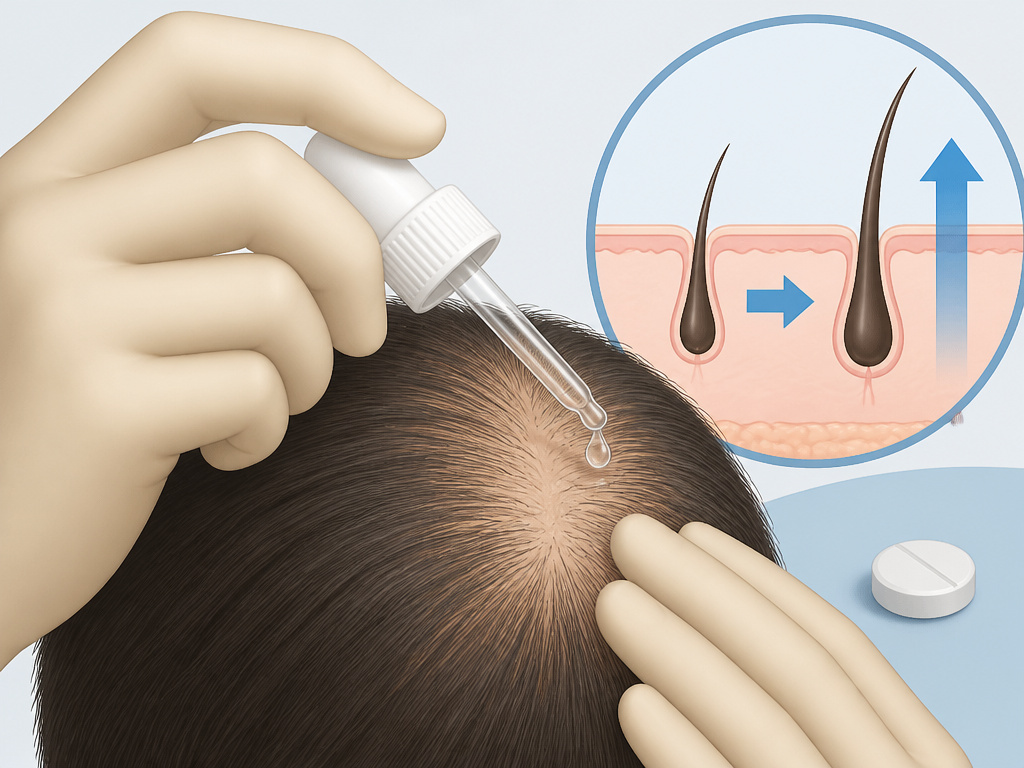
You followed the protocol, but at your 6-month check, the photos show thinning. Now what? You have proven tools, each with a specific job.
Minoxidil (Rogaine) is the first move. The 2025 case report recommends it at an early stage. It’s a vasodilator; it doesn’t block DHT but works by prolonging the growth phase of the hair follicle. It’s over-the-counter, topical, and has a solid track record. The catch? It only works as long as you use it. Stop, and the gained ground is lost. For more on its hormonal impact, see minoxidil and testosterone.
Finasteride (Propecia) is the heavy artillery. It works directly on the mechanism by inhibiting the 5-alpha-reductase type 2 enzyme, dramatically lowering DHT levels. That same 2025 trial gave three transgender men finasteride (0.2mg, then 1.0mg), and all three showed improvement of at least one stage on the Norwood-Hamilton scale after 6 months.
Where this goes sideways: Using finasteride without understanding the trade-offs. In that trial, two of the three patients (66%) resumed menstruation, a feminizing effect, because finasteride reduced the efficacy of their TRT for that outcome. For cisgender men, the concern is the potential for sexual side effects.
Finasteride is powerful, but it’s not a casual add-on. It requires a reassessment of your entire TRT protocol with your doctor. You can learn more about its systemic effects in our article on finasteride and testosterone.
Natural DHT Blockers are a supportive step. Saw palmetto, beta-sitosterol, and other natural supplements found in the best DHT blocker supplements can have a mild inhibitory effect on 5-alpha-reductase. Their effect is orders of magnitude weaker than finasteride. Think of them as a background supplement, not a primary treatment for TRT-accelerated loss.
| Treatment | How It Works | Best For | Major Consideration |
|---|---|---|---|
| Minoxidil | Vasodilator; extends hair growth phase. | Early intervention, maintaining existing hair. | Must be used indefinitely; shedding phase when starting. |
| Finasteride | Inhibits 5-alpha-reductase, lowers DHT >60%. | Stopping progression and regrowing hair in established loss. | Can interfere with TRT masculinization; risk of sexual side effects. |
| Natural DHT Blockers | Mild 5-alpha-reductase inhibition. | Supplemental support, very early prevention. | Weak effect; not sufficient for treating significant loss. |
Common Confusions Cleared Up

Does low testosterone cause hair loss? Not typically. In fact, low T is not a common cause of male pattern baldness. The hair loss associated with low testosterone is often a general, diffuse thinning related to poor overall health and nutrient status, not the patterned loss of AGA. The relationship is explored in our article on low testosterone and hair loss.
Is TRT hair loss permanent? The miniaturization caused by DHT can become permanent if the follicle is dormant long enough. However, if caught early and treated with finasteride, the process can often be halted and sometimes reversed. Hair lost recently has a better chance of returning.
Do synthetic androgens cause the same hair loss? This is a critical edge case. Many synthetic anabolic steroids are already 5-alpha-reduced or don’t require conversion. This makes 5-alpha-reductase inhibitors like finasteride largely ineffective against hair loss caused by them. The risk profile is different and often worse.
Frequently Asked Questions
How can I prevent hair loss while on TRT?
Prevention starts before your first dose. Document your baseline hair, understand your genetic risk, and choose your TRT formulation with DHT conversion in mind. Having minoxidil on hand to start at the first sign of thinning is a proactive prevention strategy.
Will hair grow back if I stop TRT?
If hair loss was triggered by TRT, stopping therapy may slow or halt further loss. However, hair that has miniaturized likely won’t fully recover on its own. Regrowth usually requires active treatment like finasteride or minoxidil to reverse the DHT effect on the follicles.
How often does TRT cause hair loss?
The frequency depends entirely on genetic predisposition. For those with strong family history of male pattern baldness, the risk is high. For those with no genetic risk, the chance is low. In studies of transgender men where genetics vary, over 60% developed hair loss after a decade of therapy.
Does the type of TRT (gel vs. Injection) change the risk?
It might. Topical gels may result in higher local scalp conversion to DHT, potentially increasing risk compared to injections. However, individual response varies greatly, and this should be one factor among many (like convenience and blood level stability) when choosing a method.
The Bottom Line
TRT can cause hair loss, but it’s a conditional risk, not a certainty. Your genes hold the key. If you have them, TRT provides the fuel. DHT, to accelerate the process.
The one rule most guides skip: if you have a strong family history of baldness, assume TRT will affect your hair. Plan for it from day one with photos and a watchful eye. The goal isn’t to avoid TRT if you need it; it’s to manage a well-understood side effect with the same precision you use for dosing.
If you’re already on TRT and seeing loss, start with minoxidil today. If that doesn’t hold the line, talk to your doctor about finasteride, but go in knowing the trade-offs. Your hair matters, but so does the rest of your hormonal balance. Manage both, not just one.
