
How Night Shift Work Affects Testosterone?
This post contains affiliate links. As an Amazon Associate, we earn from qualifying purchases.
Night shift work’s effect on testosterone is not a simple up-or-down story. The Endocrine Society experimental study found night-shift work marginally increased cortisol by 1 μg/dL but did not alter the mesor (mean) of testosterone or 11-ketotestosterone. The real impact is on timing and measurement: adrenal steroids keep a strong circadian rhythm, but testosterone’s pattern depends entirely on your sleep schedule. This means a single morning blood draw for a night worker is often useless.
The cortisol bump is small but consistent. It’s a signal of stress system activation, not a crash. The bigger issue is that the tools we use to measure hormone health are built for a 9-to-5 world. If you get your blood drawn at 8 a.m. After sleeping from 4 a.m. To noon, the result tells you almost nothing about your testosterone status. That mismatch is where misdiagnosis happens, which is a key part of understanding how night shift work affects testosterone.
What follows is a breakdown of the specific numbers from the key studies, an explanation of why the research seems to contradict itself, and the practical steps night workers can take to protect their hormonal health without guessing.
Key Takeaways
- The Endocrine Society experimental study found night-shift work increased cortisol by 1 μg/dL but left the average (mesor) of testosterone unchanged, highlighting a split between stress and sex hormone responses.
- Sources disagree on the circadian regulation of testosterone: one view (citing a 2022 experimental study) is that testosterone showed no endogenous circadian pattern after shift work, while another (citing a 2016 police study) is that testosterone’s diurnal rhythm completely followed the sleep/wake cycle.
- Research contradictions exist: some studies (e.g., citing a 2024 meta-analysis) show higher androgen/testosterone levels in night workers, while others (e.g., citing a 2023 serum study) show lower morning testosterone levels in shift workers. The measurement method (e.g., 24-hour urine vs. Single-timepoint blood) may contribute to these differing findings.
- Sleep timing matters more than duration for testosterone; sleeping the first half of the night (e.g., 10 p.m.–3 a.m.) supports better levels than sleeping the second half.
- For an accurate assessment, testosterone must be measured relative to your biological morning, not the clock time, to avoid a false “low” reading.
The 2022 Endocrine Society Study: A Controlled Look at Hormones
Most of what you read about shift work and hormones is observational. People self-report their sleep, and researchers take a blood sample whenever they can schedule it. The Endocrine Society experimental study published in the Journal of the Endocrine Society took a harder approach. They put 14 healthy adults through three days of simulated night or day shifts, then placed them in a 24-hour “constant routine” protocol. This method strips away external cues like light, food, and activity to reveal the pure, endogenous hormone rhythms driven by the body’s internal clock.
Night-shift work marginally increased cortisol by 1 μg/dL but did not alter the mesor (mean) of testosterone and 11-ketotestosterone. Adrenal-derived steroids showed robust circadian rhythmicity after either shift. Testosterone showed no circadian pattern after both conditions.
The results were clear and counterintuitive. Simulated night work nudged the stress hormone cortisol upward. But the average levels of the potent androgens testosterone and 11-ketotestosterone? No change. The adrenal hormones (cortisol, 11-ketotestosterone) kept a strong, predictable 24-hour rhythm regardless of shift schedule. Testosterone, however, showed no circadian pattern. Their peaks and troughs were not governed by a central biological clock in the same way. This is a fundamental split. It means that while your stress system is time-locked, your gonadal hormone production is more flexible, it’s tethered to your behavior, specifically your sleep.
This has a direct, practical consequence for anyone getting bloodwork. The study authors concluded that adrenal steroids must be evaluated in the biological morning, but assessment of gonadal steroids like testosterone is dependent on the shift-work schedule. If you sleep from 8 a.m. To 4 p.m., your “morning” is 4 p.m. Getting a blood draw at 8 a.m. Would catch you at your biological midnight, rendering the result nearly meaningless for diagnosing a true deficiency. This single point explains more confusion than any other in the sleep and testosterone conversation.
The Confusing Data: Why Studies Disagree
Look at any list of studies on this topic, and you’ll find a mess. A 2024 meta-analysis suggested shift workers had higher androgen/testosterone levels than day workers. A 2023 case-control study found shift workers had lower morning testosterone levels than daytime workers. Which is it? The answer isn’t that one study is wrong. It’s that they are measuring different things in different ways.
The table below breaks down the core disagreement.
| Study Type | What It Measured | Typical Finding | Why the Finding Differs |
|---|---|---|---|
| 24-Hour Urine Collection | Total hormone metabolite production over a full day. | Often shows higher total androgen output in night workers. | Captures round-the-clock production, which may be “mistimed” but not reduced. |
| Single-Timepoint Serum Test | Hormone concentration in the blood at one moment (often 8 a.m.). | Often shows lower testosterone in shift workers. | Samples at the wrong biological time for a shifted sleep schedule, missing the peak. |
| Controlled Experimental | Hormone levels in a time-free lab environment. | Shows no change in average testosterone levels. | Isolates the endogenous rhythm, removing the masking effect of sleep timing. |
The urinary studies, like the 2015 research from Cancer Epidemiology, Biomarkers & Prevention, are looking at the total factory output. They find night workers might produce more hormones, but at the wrong time, a state researchers call “increased and mistimed production.” The single-blood-draw studies are taking a snapshot. If that snapshot is taken at the wrong time in your personal cycle, it looks low. This isn’t just academic. It’s the difference between a doctor seeing a low number on a lab report and assuming you have hypogonadism, versus understanding the nuance of how night shift work affects testosterone.
This is why the HORMONIT study on night shift work is so valuable. It tracked urinary metabolites in men on rotating shifts and found the peak time for testosterone was delayed by nearly 7 hours during night shifts, aligning with a delayed melatonin rhythm. The hormone wasn’t gone; its schedule had moved.
How Sleep Disruption Beats You Up
The direct effect of shift work on testosterone might be nuanced, but the indirect effects in the story of how night shift work affects testosterone are a sledgehammer. You don’t need a hormone assay to feel them. The cascade starts with circadian misalignment, your internal clock says sleep, your job says work. This directly degrades sleep architecture.
Where this goes sideways: Daytime sleep after a night shift. Compared to nighttime sleep, it is associated with a reduction in slow-wave sleep (SWS), the deepest, most restorative stage. The severity of obstructive sleep apnea is also considerably worse during daytime sleep.
That loss of deep sleep is a direct hit to hormonal recovery. Growth hormone, which is crucial for repair, is predominantly released during SWS. Less deep sleep means less repair. Furthermore, the relationship between sleep disorders and testosterone is often mediated by weight. Poor sleep dysregulates hunger hormones like ghrelin and leptin, driving weight gain. Obesity is a primary cause of both sleep apnea and low testosterone, not the other way around. Treating sleep apnea with a CPAP machine often improves sleep quality but, according to the review, usually doesn’t move testosterone levels unless it leads to weight loss.
The effect of pure sleep restriction is clearer. Restriction of sleep for eight nights to 5 hours (00:30–05:30 hours) a night decreased testosterone levels by 10%–15%. Most people overlook that timing is more important than duration alone. One study restricted sleep to 4.5 hours but let subjects sleep either the first half of the night (e.g., 10 p.m.–2:30 a.m.) or the second half (e.g., 2:30 a.m.–7 a.m.). The group that slept the first half had lower morning testosterone. Why? Testosterone levels decrease with increasing time awake. Your level is highest after the first few hours of sleep and then trends down. If you are awake during that prime secretion window, you miss the boost. This is a core reason why the morning testosterone peak exists, it’s the tail end of that overnight release.
What You Can Actually Do About It
You can’t always quit your job. But you can control your environment and your habits. The goal is to reduce circadian and sleep stress, giving your hormonal systems the best chance to function normally. This isn’t about exotic supplements; it’s about nailing the fundamentals of light, timing, and recovery.
First, own your light exposure. Light is the primary signal for your central circadian clock. When you leave work at 7 a.m., you’re hit with a blast of morning sunlight that screams “WAKE UP!” to a brain that needs to wind down. Wear blue-light-blocking sunglasses on your drive home. Once home, use blackout curtains or a high-quality sleep mask to make your bedroom pitch black. Conversely, during your “awake” period at night, ensure your work environment is brightly lit. This helps reinforce your new, shifted wake phase.
Second, defend your sleep window with ritual. Your body craves predictability. Go to bed and wake up at the same time every day, even on your days off. This is the single most powerful tool for entraining a new circadian rhythm. The police officer hormone study showed hormone rhythms could follow a shifted schedule, but consistency was key. Create a pre-sleep routine: an hour of dim light, no screens, perhaps a shower. This signals the transition to rest, regardless of what the clock says.
Third, manage the downstream damage. Poor sleep can tank your motivation to eat well and exercise, creating a vicious cycle. Prioritize protein and vegetables in your meals to support stable energy and avoid the carb-heavy crash. Schedule your workouts for the beginning of your “day,” when your energy and cortisol are naturally higher. Consider targeted nutritional support for night shifts, like Vitamin D (which you miss from sun exposure) and magnesium glycinate before bed to support sleep quality and neuromuscular relaxation.
Easy to miss: Alcohol to unwind. Using a drink to fall asleep after a stressful shift is common. It might help you nod off, but it fragments sleep architecture, suppresses REM sleep, and worsens sleep apnea. The net effect is less restorative sleep, which over time amplifies every negative hormonal trend.
Finally, if you’re concerned about your levels, test smart. Use the insight from the Endocrine Society journal article. Schedule your blood draw for your biological morning, as assessment of gonadal steroids like testosterone is dependent on the shift-work schedule. This captures your personal “morning” peak and gives you a meaningful baseline. Charting your daily testosterone fluctuations is more informative than a single number.
How does Shift Work Sleep Disorder affect testosterone?
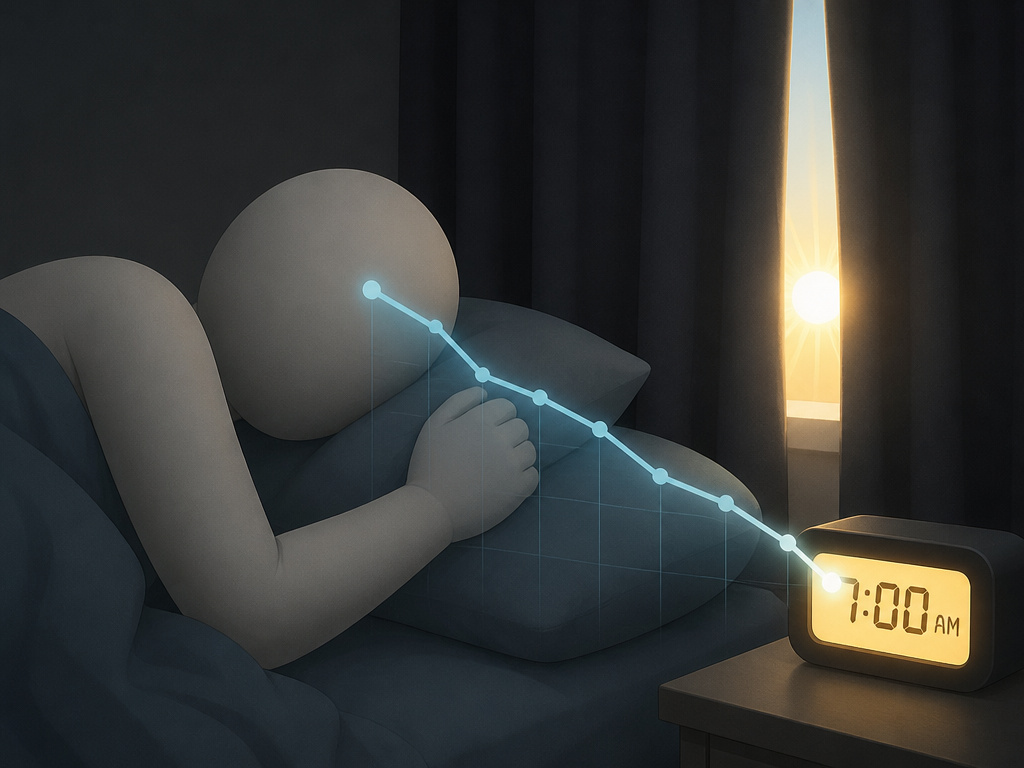
Shift Work Sleep Disorder arises from the chronic misalignment between your work schedule and your body’s natural sleep-wake cycle. For night workers, this often means sleeping during the day. Daytime sleep is associated with a reduction in slow-wave sleep compared to nighttime sleep. Conditions like obstructive sleep apnea can be much more severe during daytime sleep after a night shift. Research indicates that the timing of sleep may be more important than its total length for determining testosterone levels. Testosterone levels have been shown to decrease with increasing time awake. Therefore, the poor sleep quality and structure caused by SWSD can disrupt the natural patterns that support healthy hormone function, even if the average testosterone level remains unchanged.
Frequently Asked Questions
Is night shift bad for testosterone?
It’s complicated. The best-controlled study shows it doesn’t lower average testosterone levels. However, night shift work disrupts sleep timing and quality, which can indirectly suppress testosterone by 10–15% through sleep restriction and by promoting weight gain. The major risk is being misdiagnosed with low testosterone because blood is drawn at the wrong biological time.
What is the #1 testosterone killer for shift workers?
Fragmented, short-duration daytime sleep. The combination of reduced slow-wave sleep, worse sleep apnea, and missing the prime overnight testosterone secretion window does more direct damage to your hormone levels than the shift itself. Protecting a solid, dark, consistent 7–8 hour sleep block is the highest priority.
How unhealthy is it to work night shift long-term?
Long-term night shift work is classified as a probable carcinogen by the International Agency for Research on Cancer due to circadian disruption. Beyond cancer risk, it is strongly linked to metabolic syndrome, cardiovascular disease, and mood disorders. The hormonal piece, including potential impacts on testosterone, is one part of a larger picture of systemic stress that accumulates over years.
Can you reverse the effects of night shift on hormones?
Yes, most of the effects appear to be reversible. When you return to a regular daytime schedule, your circadian rhythms, including hormone timing, will gradually re-synchronize. The sleep deprivation and weight-related effects on testosterone can also be reversed through consistent sleep, improved diet, and exercise. The key is allowing sufficient time for recovery, it won’t reset in a single weekend.
Before You Go
The data says the night shift itself isn’t a direct testosterone assassin. The real damage comes from the poor sleep, mistimed light, and chaotic schedules that usually come with it. Your body can adapt its hormone production to a new time zone, but it needs consistency and the right signals to do so. Stop chasing a magic supplement to fix fatigue. Start with light-blocking glasses, blackout curtains, and a rigid sleep schedule. Get your blood drawn at your biological morning, not the lab’s opening time. That’s how you move from guessing about your health to measuring it.
