
Normal Testosterone Levels for Teenage Boys
This post contains affiliate links. As an Amazon Associate, we earn from qualifying purchases.
Normal testosterone levels for teenage boys rise from under 1 nmol/L before age 10 to near-adult levels of ~15 nmol/L between ages 16 and 17. The most critical rise happens between 11 and 15 years, with levels increasing nearly seven-fold. A single number is less useful than understanding the trajectory, the method used to measure it, and the time of day the blood was drawn.
The gap between a boy at 11 and a boy at 15 is the whole story. That’s where the engine of puberty turns over, where voices crack, growth spurts hit, and the hormonal landscape redraws itself. A static range on a lab sheet misses that motion entirely.
What follows breaks down the numbers from the largest longitudinal and cross-sectional studies, explains why two labs can report different “normal” ranges for the same boy, and gives you a framework for what to do with a specific result. This is about mapping the territory, not just pinning a point on a chart.
Key Takeaways
- Testosterone in boys under 10 is typically below 1 nmol/L, then climbs most sharply between ages 11 and 15.
- The testing method changes everything: LC-MS/MS assays report lower ranges than older immunoassays, know which your lab uses.
- Time of day matters. Levels exhibit a circadian rhythm in adolescents, peaking in the early morning (~0500 & 1000h) and dipping in the afternoon; always compare fasted morning draws. (Note: A separate source indicates the highest lifetime levels occur during the first months of life.)
- A single test is a snapshot. Trends over time and the presence of physical puberty signs (testicular growth) are more telling than one number.
- Population matters. Reference ranges from a study of healthy Indian boys may differ from those in Western cohorts, context is key.
The Core Numbers: Age-Based Testosterone Ranges
Forget the idea of one “teenage” range. A 13-year-old just starting puberty and a 17-year-old nearing its end are in different hormonal universes. The research gives us specific brackets.
The most detailed data comes from a study using liquid chromatography-tandem mass spectrometry (LC-MS/MS), considered the gold standard. It provided 97.5th percentile values, essentially the upper limit of normal, for key age groups. For parents holding a lab report, these are the comparison points that carry weight.
This 2013 study was the first to provide pediatric reference intervals for testosterone from birth to 18 years using LC/MS/MS. It found that intervals measured by this method “are lower than those established by immunoassays.”
| Age Group (Males) | 97.5th Percentile (ng/dL) | 97.5th Percentile (nmol/L) |
|---|---|---|
| 10-12 years | 418 | 14.5 |
| 13-14 years | 647 | 22.4 |
| 15-16 years | 880 | 30.5 |
Note the units. In the US, labs typically report in nanograms per deciliter (ng/dL). Elsewhere, it’s nanomoles per liter (nmol/L). To convert ng/dL to nmol/L, divide by 28.8.
A separate, large longitudinal study of over 500 boys traced the average trajectory of normal testosterone levels for teenage boys: levels are minimal (<1 nmol/L) before age 10, then increase nearly seven-fold between 10 and 15, reaching adult-like levels of around 15 nmol/L between 16 and 17 years.
So, is 700 ng/dL good? For a 14-year-old, 700 ng/dL is above the 97.5th percentile of 647 ng/dL (22.4 nmol/L) for his age group per the LC-MS/MS study. That doesn’t automatically mean a problem, some healthy boys are at the high end, but it’s a data point that warrants a conversation with a pediatric endocrinologist to rule out causes of early or excessive androgen production. Context is everything.
Why Lab Ranges Disagree: The Assay Method Matters
This is the part that causes the most confusion. You might get a test back from a lab, and the “normal” range for a 15-year-old will vary based on the assay method used. Then you look at a study from a major journal and its upper limit for 15-16-year-olds is 30.5 nmol/L. They seem to match. But what if the lab used a different method?
Most standard hospital and commercial labs still use immunoassays. They are cheaper and faster. The LC-MS/MS method is more precise, especially at the low levels seen in children and women. Critically, the 2013 LC-MS/MS study stated its intervals “are lower than those established by immunoassays.”
This isn’t a small technicality. It means a boy could have a result of 20 nmol/L. On an immunoassay report with an upper limit of 28 nmol/L, he’s well within range. On an LC-MS/MS report with an upper limit of 22.4 nmol/L for his age, he’s near the top. The number hasn’t changed, but the ruler you’re measuring it with has.
The Endocrine Society’s position is clear: for measuring testosterone in children, you should use “immunoassay after extraction and chromatography or LC/MS-MS.” If your son’s test was a standard, direct immunoassay, the result has a wider margin of error. This is why you must always note, or ask, which method the lab used. It changes the interpretation.
More Than Age: Tanner Stage and Testicular Volume
Chronological age is a blunt tool during puberty. Two boys exactly 13.5 years old can be at completely different stages of development. This is why pediatric endocrinologists use the Tanner scale (Stages 1-5) to assess physical puberty. Stage 1 is pre-puberty, Stage 5 is adult.
Research is pushing this further. A compelling study advocates for ditching age and even Tanner stage in favor of a more objective measure: testicular volume measured by ultrasound. This contrasts with the traditional consensus approach of using chronological age and Tanner stages. The reasoning is solid. During puberty, testicular volume accounts for more variance in serum testosterone than chronological age does.
A boy with a testicular volume of 4 mL is in a different hormonal phase than a boy with 12 mL, even if they share a birthday. This approach, detailed in a cross-sectional puberty reference data study, stratifies hormone references by actual physical development, not calendar years. It’s a more precise way to ask, “Is his testosterone appropriate for where he is physically?”
For parents, the takeaway isn’t to request an ultrasound. It’s to understand that a doctor’s physical exam, checking for testicular growth, pubic hair, isn’t just a formality. It’s the essential context for any blood test number. A “low” testosterone result in a boy with no physical signs of puberty (Tanner 1) points toward delayed puberty. The same number in a boy with otherwise normal physical development (Tanner 3-4) raises different questions.
The Test Itself: Timing, Variability, and What to Track
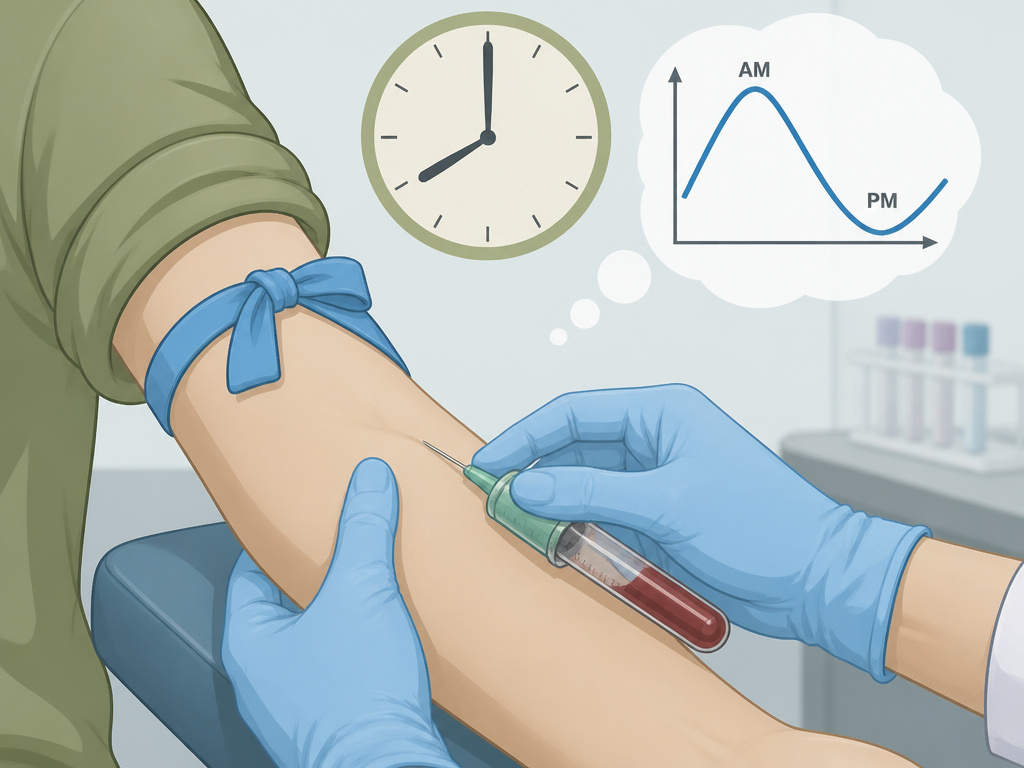
You can’t talk about a hormone level without talking about how it was captured. Testosterone isn’t static like cholesterol; it pulses and cycles.
The biggest cycle affecting normal testosterone levels for teenage boys is the diurnal rhythm. In adolescents, levels peak in the early morning (around 5 a.m. And again at 10 a.m.) and hit a nadir in the afternoon (around 2 p.m.) and late evening. That study of the hormone’s daily pattern is clear. A blood draw at 3 p.m. Will show a naturally lower level than one at 9 a.m.
It was noise, not signal.
Where this goes sideways: Comparing a fasting 8 a.m. Draw from one year to a non-fasting 4 p.m. Draw the next. You’re measuring two different biological states and calling it a trend.
The protocol is simple. For consistent, comparable results:
- Draw blood in the morning, ideally before 10 a.m.
- Be in a fasted state (water is okay).
- Note any acute illness, a bad cold or flu can temporarily suppress levels.
A single test is a snapshot. A trend line built from 2-3 tests under the same conditions, taken months apart, is a movie. The trend tells you far more about what’s happening.
Interpreting a Specific Result: From Number to Next Step
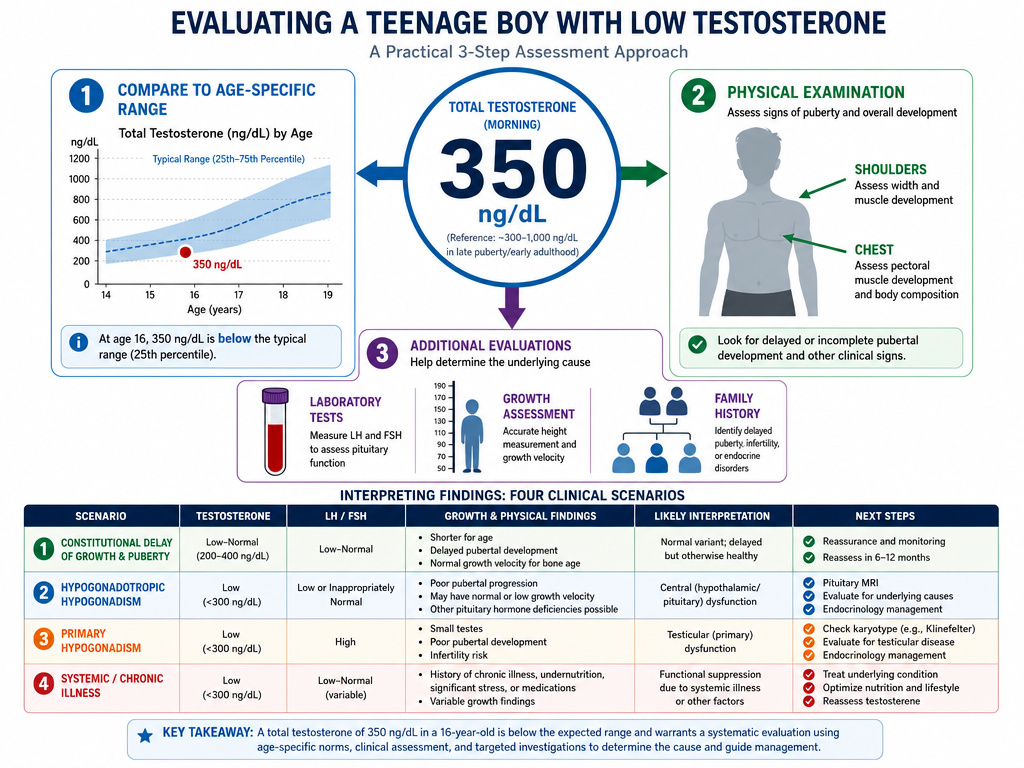
You have a number. Your son is 14, and his total testosterone is 350 ng/dL (12.1 nmol/L). Now what? This is where you move from population data to individual assessment.
First, locate the number on the age-specific chart. For a 14-year-old, 350 ng/dL is below the 97.5th percentile of 647 ng/dL but well above the prepubertal baseline of <29 ng/dL. It’s within the broad rise.
Second, look at the physical exam. Has puberty started? Is testicular volume increasing? If he’s physically at Tanner stage 2 or 3, this number might be perfectly appropriate for his stage of progression. If he’s at Tanner stage 4 with minimal growth, it raises a flag.
Third, consider the full picture. A testosterone blood test is rarely ordered in isolation. A pediatric endocrinologist will look at luteinizing hormone (LH) and follicle-stimulating hormone (FSH) to see if the brain (pituitary) is signaling the testes correctly. They’ll also consider height, growth velocity, and family history.
| Scenario | Testosterone Level | Physical Signs | Likely Interpretation | Next Step |
|---|---|---|---|---|
| A | Low for age (e.g., 50 ng/dL at 14) | No puberty (Tanner 1) | Constitutional Delay of Growth and Puberty (CDGP) | Monitor growth, reassess in 6 months. Common, often familial. |
| B | Low for age (e.g., 50 ng/dL at 14) | Partial puberty (Tanner 2-3) | Possible Hypogonadism | Requires full endocrine workup (LH, FSH, other tests). |
| C | High for age (e.g., 700 ng/dL at 14) | Advanced puberty | Possible Early (Precocious) Puberty or Variant | Needs evaluation to rule out adrenal/testicular tumors or other causes. |
| D | Mid-range for age | Progressing normally | Normal Pubertal Progression | Reassurance. No further testing needed. |
The jump from “number” to “action” hinges on that physical exam and the trend. A one-time, mildly low number in a boy who is otherwise starting to develop often just means wait and recheck. A persistently low or declining trend in a boy who should be advancing is what triggers a deeper dive.
Symptoms of high testosterone in teens

Identifying high testosterone in teenagers is complex, as many expected physical changes are part of normal puberty. The most marked progression in testosterone levels and physical development typically occurs between ages 11 and 15. While a clinical diagnosis requires specific lab testing, observable signs may align with being at the very high end of the normal spectrum. These can include exceptionally rapid muscle development, a pronounced increase in body hair, and a significantly deepened voice occurring earlier or more intensely than peers. Higher levels are also significantly associated with increased muscle and bone mass. Because testosterone exhibits a strong circadian rhythm, peaking in the early morning, a single blood test may not capture a true peak level.
Treatment options for low testosterone (e.g., TRT)
Treatment for low testosterone in teenage boys is a carefully considered decision made by pediatric endocrinologists. It is never a first step. A proper diagnosis requires accurate measurement using LC/MS-MS or immunoassay after extraction and chromatography, as reference intervals depend heavily on the assay used. The doctor must also account for the patient’s exact age and stage of pubertal development, as levels increase sharply at puberty’s onset. Treatment, which may include testosterone replacement therapy (TRT), is typically only considered for confirmed, persistent deficiencies that are causing clear health problems, not for variations within the wide normal range. The goal is to support healthy development while allowing the body’s own systems to function whenever possible.
Frequently Asked Questions
What should a 15 year old boy’s testosterone level be?
There’s a wide range. According to LC-MS/MS data, the upper limit of normal (97.5th percentile) for 15-16-year-olds is 880 ng/dL (30.5 nmol/L). The average level at this age is climbing toward the adult average of ~15 nmol/L. Most healthy 15-year-olds will fall within a wide range, with the exact number depending heavily on their individual pubertal tempo.
Is 700 a good testosterone level for a teenager?
It depends on his age. For a 15- or 16-year-old, 700 ng/dL is within the range observed during puberty. For a 13- or 14-year-old, it’s at the very high end of normal. The question isn’t just “is it good?” but “is it appropriate for his stage of physical development?” A level of 700 ng/dL in a boy with otherwise age-appropriate puberty is fine. The same level in a much younger boy would need explanation.
What happens if a 14-year-old has high testosterone?
Elevated testosterone drives the physical changes of puberty faster. This can mean a more rapid growth spurt, earlier development of facial and body hair, a deepening voice, and increased muscle mass. If the level is excessively high for the stage of testicular development, it could indicate a source of androgens outside the testes (like the adrenal glands) and requires medical evaluation to rule out specific conditions.
How to tell if your son has low testosterone?
Look for the absence of expected pubertal changes, such as no testicular growth by age 14 or no pubic hair by age 15. Key signs include: no testicular growth by age 14, no pubic hair by age 15, or a growth spurt that never materializes. Fatigue, low energy, and difficulty building muscle can be symptoms, but in teens, they are more commonly linked to other issues like poor sleep, nutrition, or mood. The clearest signs are physical, not behavioral. If you’re concerned, tracking his testosterone changes with age against a growth chart can provide useful context before a doctor’s visit.
Before You Go
One rule most guides skip: a testosterone level is a data point, not a diagnosis. It gets its meaning from the boy standing in front of it, his growth chart, his family’s timing of puberty, the size of his testes, and the time on the clock when the blood was taken.
The research shows a path forward. Use age-specific ranges from modern LC-MS/MS studies as your primary map. Remember that morning levels are the standard. And understand that a result that seems off on a single test is often just a call to recheck under consistent conditions, not a reason to panic. The trajectory of puberty spans years, not days. Watch the curve, not the dot.
For a boy who is developing normally, the best “intervention” is often nothing at all. Support good sleep, nutrition, and activity. The best vitamins for teenage boys are usually those that fill common dietary gaps, not exotic boosters. The engine knows what to do. Your job is mostly to make sure it has the fuel and the time to run.
