
Testosterone vs DHT: Key Differences Explained
This post contains affiliate links. As an Amazon Associate, we earn from qualifying purchases.
Testosterone and dihydrotestosterone (DHT) are distinct hormones. Testosterone (C19H28O2) is the primary male sex hormone, driving muscle, bone, and libido. DHT (C19H30O2) is a more potent metabolite made from testosterone by the enzyme 5-alpha-reductase. DHT binds the androgen receptor 2- to 5-fold more tightly and drives effects in the scalp, prostate, and skin. For most health decisions, the distinction is critical: muscle depends on testosterone; pattern hair loss is driven by DHT acting on genetically sensitive follicles.
The difference in receptor binding explains why the same hormone family can thicken a beard while thinning the scalp, and why two men with identical testosterone levels can have completely different hair when you compare a testosterone vs dht dynamic.
What follows: the exact biochemical split, what your lab numbers actually mean, and the one genetic factor that decides who loses hair and who doesn’t. We’ll walk the evidence on DHT blockers, the real impact of testosterone replacement therapy (TRT), and how to think about your own hormone balance.
Key Takeaways
- DHT is 2- to 5-fold more potent than testosterone at the receptor level, due to tighter binding and slower dissociation, this potency drives tissue-specific effects in the scalp and prostate.
- Pattern hair loss requires genetic follicle sensitivity to DHT, not high testosterone. Men with androgenetic alopecia do not reliably have higher serum testosterone than men who keep their hair.
- The enzyme 5-alpha-reductase converts about 10% of circulating testosterone into DHT daily; this local conversion in tissues like the scalp is what matters, not just blood levels.
- Finasteride lowers scalp DHT by 60-70%; dutasteride reduces it by about 90%. These DHT-blocking drugs like finasteride and dutasteride are the evidence-based core for slowing hair loss in susceptible men.
- The rise in DHT from testosterone replacement therapy (TRT) depends on the delivery method: injectable testosterone raises serum DHT to approximately 2.2x baseline, while transdermal testosterone raises it to approximately 5.5x baseline.
What DHT Is and How It’s Made
Dihydrotestosterone is a direct derivative of testosterone, not a separate hormone your body manufactures from scratch. The conversion happens through a single enzymatic step, but that step changes everything.
The enzyme 5-alpha-reductase acts on testosterone, reducing a specific double bond in its chemical structure. This turns testosterone (C19H28O2) into DHT (C19H30O2). That small structural change makes DHT bind the human androgen receptor about 2-fold more tightly and dissociate about 5-fold more slowly than testosterone. In practical terms, once DHT locks onto a receptor in a target tissue, it delivers a stronger, longer signal.
This enzymatic conversion is the rate-limiting step for DHT’s effects. The enzyme exists in two main isoforms: Type I is found in skin and liver; Type II is concentrated in the prostate, scalp hair follicles, and genital tissues. This tissue distribution explains why DHT’s impact is so localized.
The process isn’t theoretical. A government clinical trial registry protocol explicitly uses dutasteride to block this conversion, isolating DHT’s effects to study its specific role in bone and body composition. In the body, this conversion is constant. The Cleveland Clinic notes that roughly 10% of circulating testosterone is turned into DHT each day. Most of that DHT acts locally in the tissues where it’s made, it doesn’t all flood back into the bloodstream. This is why a blood test for testosterone tells you very little about what’s happening at your hair follicles.
Short version: DHT is turbocharged testosterone, made on-site in tissues like your scalp by a specific enzyme.
Testosterone vs DHT: A Side-by-Side Comparison
You need to see them together to spot the split. The table below lays out the decisive differences.
| Attribute | Testosterone | Dihydrotestosterone (DHT) |
|---|---|---|
| Molecular Formula | C₁₉H₂₈O₂ | C₁₉H₃₀O₂ |
| Source | Primarily testes (Leydig cells) | Conversion from testosterone via 5α-reductase |
| Receptor Binding Affinity | Moderate (1x reference) | High (2- to 5x testosterone) |
| Primary Physiological Roles | Skeletal muscle anabolism, bone density, erythropoiesis, libido | Scalp hair follicle miniaturization, prostate growth, beard/body hair, genital development |
| Can Be Aromatized to Estradiol | Yes | No |
| Adult Male Reference Range | 264–916 ng/dL (9.2–31.8 nmol/L) | 30–85 ng/dL (1.0–2.9 nmol/L) |
The “cannot be aromatized” line is a big one. Testosterone can be converted by another enzyme (aromatase) into estradiol, which influences bone health, fat distribution, and mood. DHT is a dead-end metabolite in this regard, it doesn’t contribute to estrogenic effects. This is why bodybuilders using DHT-derived steroids don’t deal with water retention or gynecomastia the way they might with straight testosterone.
The reference ranges show the concentration gap. His DHT level will typically sit between 30–85 ng/dL. They exist in a ratio, but not a fixed one. Your individual 5-alpha-reductase activity determines how much of your testosterone becomes DHT.
The Hair Loss Question: DHT Sensitivity, Not Testosterone
This is where the confusion costs men money and worry. The old myth says bald men have higher testosterone. The research says that’s false.
Multiple studies, including a landmark 1998 review in Hormone Research, have shown that bald and non-bald men have statistically similar serum testosterone levels. The real difference is in the follicles themselves. A clinical study found that bald scalp tissue contained 7.37 pmol/g of DHT compared to 4.20 pmol/g in hairy scalp of the same men. The testosterone level in the tissue didn’t differ. The problem was local DHT production and a follicle’s reaction to it.
Where this goes sideways: Assuming high testosterone causes baldness. The cause is genetic sensitivity to DHT, not the amount of testosterone in your bloodstream. Two men with identical levels can have opposite hair outcomes.
The genetic piece is the lock that DHT fits into. Variations in the Androgen Receptor (AR) gene, which you inherit primarily from your mother’s side, determine how sensitive your scalp follicles are to DHT’s signal. If you have high-sensitivity receptors, even normal DHT levels can gradually miniaturize follicles. This is the core mechanism of androgenetic alopecia, or male pattern baldness. It’s also why the back and sides of your head are often spared: those follicles are genetically programmed to be DHT-resistant.
This explains the transgender health data. Research shows that testosterone hormone therapy for transgender men increases the risk of hair loss. The exogenous testosterone provides more substrate for DHT conversion, accelerating the process in those who inherited the sensitivity.
Short version: Baldness results from your follicles’ genetic reaction to DHT, not high testosterone.
DHT’s Other Key Roles in the Body
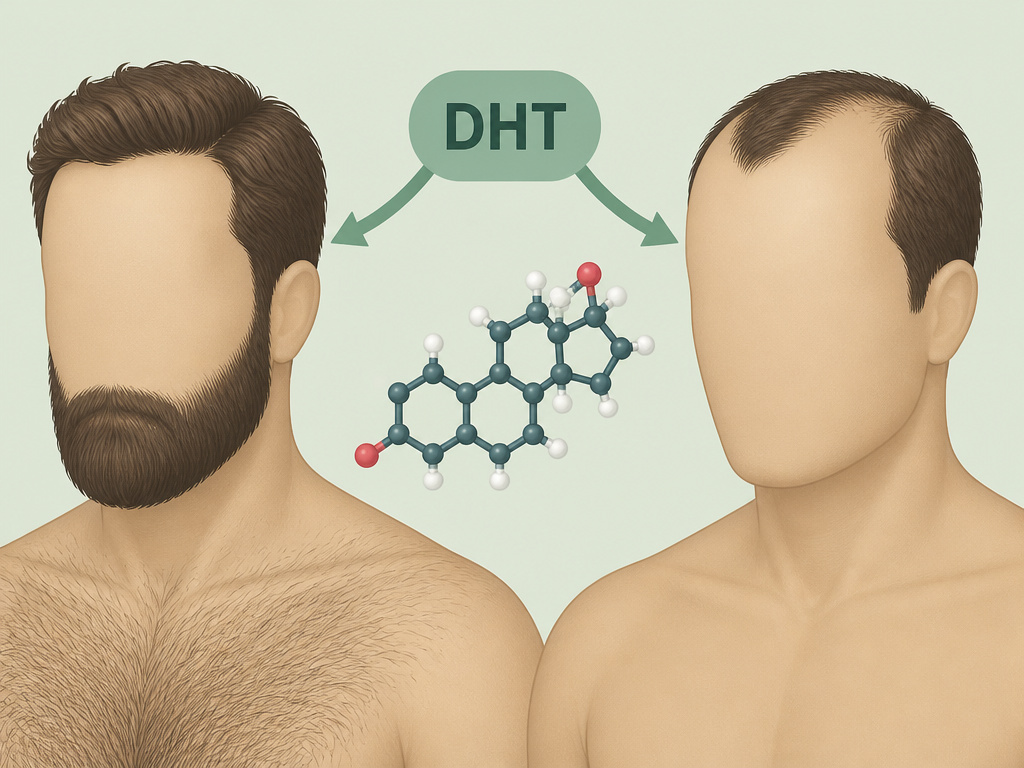
DHT isn’t just a hair-loss villain. It has essential jobs, especially during development. Men born with a genetic deficiency in the type 2 5-alpha-reductase enzyme have very low DHT. They often have underdeveloped external genitalia at birth, experience limited beard growth, and rarely develop male pattern baldness or severe acne. This natural experiment proves DHT’s irreplaceable role.
In adulthood, DHT remains the dominant androgen in a few specific tissues:
- Prostate: DHT is a primary driver of prostate growth and is implicated in benign prostatic hyperplasia (BPH). Its role in prostate growth is why DHT-blocking drugs are a first-line treatment for BPH.
- Skin & Sebaceous Glands: DHT stimulates sebum production, which is why it’s linked to androgens and acne.
- Body and Facial Hair: DHT signals the growth of terminal hair during and after puberty. This is the mechanism behind beard growth and increased body hair growth.
The strange duality is that the same hormone family thickens beard and body hair while thinning scalp hair. The hormone signal is identical. The genetic programming of the follicle in that specific body region determines the response.
How Testosterone Replacement Therapy (TRT) Changes the Equation
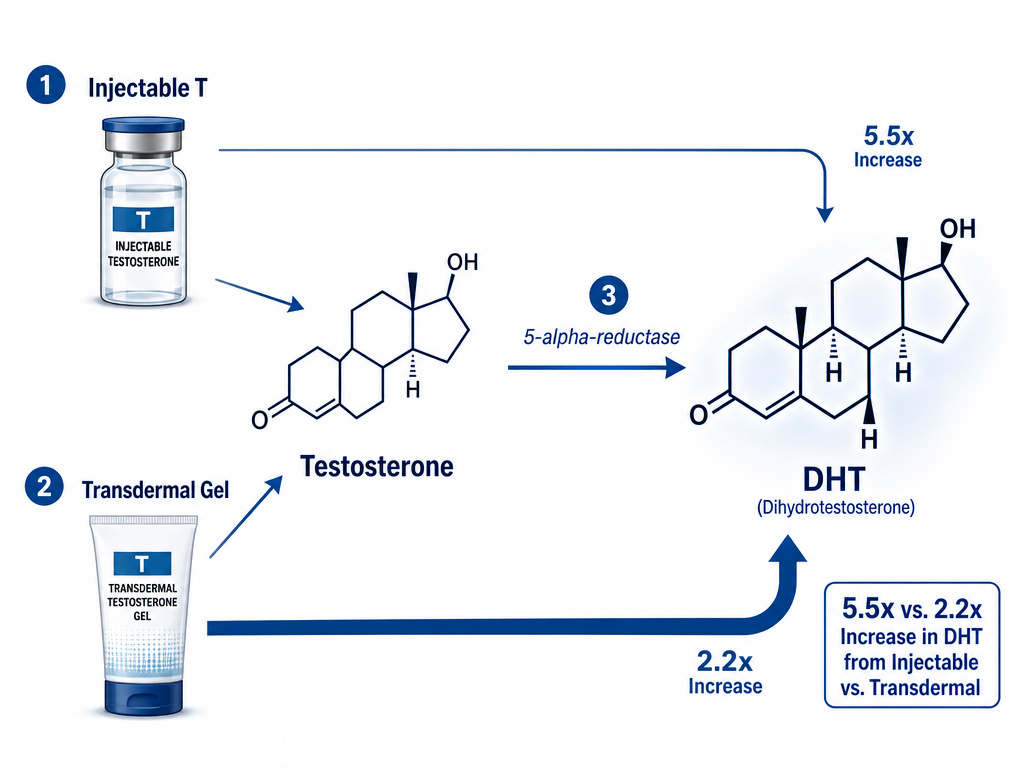
Adding external testosterone changes the substrate pool. If you give the body more testosterone, 5-alpha-reductase has more raw material to convert into DHT.
The rise in DHT depends heavily on the delivery method. According to clinical data:
- Injectable testosterone (enanthate): Raises serum DHT to approximately 2.2x baseline.
- Transdermal testosterone (gels, creams): Raises serum DHT to approximately 5.5x baseline. The skin is rich in 5-alpha-reductase, so applying testosterone directly to it fuels local conversion.
Common mistake: Starting TRT without understanding your genetic hair loss risk. Higher DHT only accelerates thinning if your follicles are sensitive to it.
Clinicians at Baylor College of Medicine note that TRT can raise DHT roughly two to three times above baseline. For a man already prone to androgenetic alopecia, this can turn a slow recession into a noticeable thin spot within a year. For a man without the genetic predisposition, even a 5-fold rise may not cause scalp hair loss. This is why the question of whether high testosterone causes hair loss is so individual.
The flip side is also misunderstood. Hair loss from low testosterone isn’t directly linked. Very low testosterone might affect body and beard hair, but it doesn’t protect a genetically sensitive scalp. The DHT pathway is still active if any testosterone is present.
Blocking DHT: How Finasteride and Dutasteride Work

Since DHT is the direct agent for hair loss and prostate growth, the logical intervention is to reduce its production. That’s what 5-alpha-reductase inhibitors do.
| Drug | Mechanism | DHT Reduction | Primary Use |
|---|---|---|---|
| Finasteride | Inhibits 5α-reductase Type II | ~60-70% in scalp; ~69-72% in serum | Male pattern hair loss (1 mg/day), BPH (5 mg/day) |
| Dutasteride | Inhibits 5α-reductase Types I & II | ~90% | BPH (off-label for hair loss) |
These prescription DHT blockers like finasteride and dutasteride are effective because they target the rate-limiting step. Finasteride, at the 1 mg daily dose for hair loss, slows or arrests progression in 80–90% of users at 12 months. It doesn’t usually regrow a full head of hair, but it halts the process for most men.
The evidence is rooted in the same tissue studies. Finasteride lowers scalp DHT by about 60 to 70%, bringing it closer to the level found in hairy scalp. It does this without lowering testosterone; in fact, serum testosterone may rise slightly because less is being converted.
Some men look for supplements marketed as DHT blockers. The evidence for herbal options like saw palmetto is weaker and less consistent than for prescription inhibitors. They might have a mild effect, but they don’t compare to the 70-90% reduction from pharmaceuticals.
Effects of low DHT levels (deficiency symptoms)
Clinical understanding of isolated DHT deficiency is limited, as low DHT typically stems from low testosterone or the use of 5-alpha-reductase inhibitors like finasteride or dutasteride. Since DHT is the dominant androgen in the prostate and scalp, a significant reduction can lead to changes in these tissues. The most documented effects relate to a decreased risk of male pattern hair loss and a reduction in prostate size. Men born without the enzyme needed to make DHT do not develop typical male pattern baldness. Outside of these specific areas, symptoms of a DHT reduction are often intertwined with broader androgen status, making it difficult to isolate a distinct deficiency syndrome.
DHT’s role vs. Testosterone in muscle mass/strength
Testosterone is the primary anabolic signal for skeletal muscle growth and strength. While DHT binds to the same androgen receptor with greater affinity, its role in building muscle is considered secondary. Testosterone’s action in muscle is direct and potent. Testosterone can also be aromatized into estradiol, which supports bone health and fat metabolism. These factors improve overall physical performance. DHT cannot be converted to estradiol. In practical terms, efforts to maximize muscle mass focus on optimizing testosterone levels and its anabolic pathway, not on selectively increasing DHT.
DHT’s role in sexual function/desire
DHT contributes to sexual function, but its specific role is complex and not fully separable from testosterone. Both hormones activate the same androgen receptor, with DHT binding more tightly and dissociating more slowly. This potent action is crucial for the development of male genitalia. In adulthood, DHT supports prostate health and may influence libido. However, a sharp reduction in DHT, such as from medication, does not uniformly impair sexual function for all men. Sexual desire and performance are influenced by a balance of testosterone, estradiol, and other factors, making DHT one component of a larger system.
Frequently Asked Questions
Does high testosterone always mean high DHT?
No. While DHT is made from testosterone, the rate of conversion depends on your individual 5-alpha-reductase enzyme activity. Two men with the same testosterone level can have different DHT levels. Also, local conversion in tissues like the scalp does not always match blood serum levels perfectly.
Is blocking DHT bad for testosterone levels?
Blocking DHT with finasteride or dutasteride does not lower testosterone. These drugs work by inhibiting the enzyme that converts testosterone to DHT. This means less testosterone is metabolized into DHT, so total and free testosterone levels may actually increase slightly. The drugs redirect the hormone, they don’t eliminate it.
Should I get my DHT levels tested?
DHT is rarely included in standard hormone panels. It’s most useful in specific clinical contexts: when evaluating aggressive hair loss on TRT, diagnosing certain endocrine disorders, or monitoring treatment for BPH. For most men concerned about hair loss, assessing the pattern (Norwood scale) and family history is more actionable than a DHT number. Total and free testosterone, along with SHBG, provide a broader picture of your hormonal status.
Can you have low DHT?
Yes, though it’s less common as a standalone concern. Genetic 5-alpha-reductase deficiency leads to very low DHT. Symptoms can include sparse body and facial hair, a small prostate, and a low incidence of baldness. Artificially low DHT from medication (like dutasteride) is generally well-tolerated, though some men report lowered libido as a side effect.
Before You Go
The testosterone vs DHT distinction is practical, as it determines treating the right hormone for the right problem.
If you’re looking at hair loss, the target is DHT and your follicles’ sensitivity to it, not your total testosterone. Chasing a higher T number won’t fix a genetic sensitivity, and it might speed up thinning. The proven path is a DHT blocker like finasteride, not a testosterone booster.
If you’re on TRT and noticing rapid shedding, the culprit is likely the DHT conversion, not the testosterone itself. A conversation about adding a low-dose DHT inhibitor can be part of managing that side effect.
And if you’re just trying to understand your own body, remember the ratio. Your health is in the balance between these two hormones, not in a single number. Get the full panel, testosterone, free T, SHBG, and if indicated, DHT, before you decide anything. Let the evidence lead, not the label.
