
Does Walking Increase Testosterone? The 12-Week Rule
This post contains affiliate links. As an Amazon Associate, we earn from qualifying purchases.
Walking can increase testosterone, but only under specific conditions. For men who are overweight, obese, or have type 2 diabetes, the research presents a nuanced picture: while studies reported no changes in testosterone concentrations following 8 weeks of exercise, significant increases were reported following 12 weeks of consistent aerobic exercise like brisk walking, especially when it leads to reductions in body fat. For healthy, active men, a single walk may cause a small, temporary bump, but the lasting hormonal benefits come from long-term body composition changes, not acute effort.
That 12-week threshold is the essential part. The research shows a clear tipping point: studies found no change in testosterone after 8 weeks of walking or other aerobic work, but significant increases consistently appeared at the 12-week mark. A key question is does walking increase testosterone, and the effect is tightly linked to fat loss. If the scale and the tape measure don’t move, the hormone panel probably won’t either.
What follows is a breakdown of the mechanics, why walking works for some and not others, how to structure your walks to hit that 12-week target, and the critical differences between a health-building routine and an endurance effort that can actually crash your levels.
Key Takeaways
- The benefit is long-term, not acute. Expect meaningful changes only after consistent 12-week routines, not from single walks.
- Walking boosts testosterone primarily through fat loss. Studies show increases only in men who also saw reductions in BMI, weight, or body fat percentage.
- Intensity matters. A leisurely stroll may not be enough; aim for a brisk pace that raises your heart rate into the moderate zone.
- Gender changes the equation. Research finds no significant increase, and sometimes a decrease, in testosterone for women following similar walking programs.
- Volume kills benefit. Extremely long-duration walking (marathons, multi-day hikes) can suppress testosterone, flipping the effect.
How Walking Influences Testosterone: The Fat Loss Connection
The link isn’t direct. Walking doesn’t magically signal your testes to produce more hormone. It works by remodeling the environment those hormones live in, specifically, by reducing excess body fat.
Adipose tissue, especially visceral fat, is metabolically active. It produces enzymes like aromatase that convert testosterone into estrogen and increases inflammatory signals that can suppress the hypothalamic-pituitary-gonadal (HPG) axis, your body’s hormone command center. A systematic review in PMC noted that obesity is a stronger risk factor for low testosterone in men than type 2 diabetes itself. When you burn fat through consistent energy expenditure, you’re slowly removing a primary inhibitor of healthy hormone function.
The Technical Mechanism: In men with obesity or insulin resistance, excess fat mass contributes to a state of low-grade inflammation and altered adipokine signaling (e.g., elevated leptin). This disrupts gonadotropin-releasing hormone (GnRH) pulsatility from the hypothalamus, leading to reduced luteinizing hormone (LH) secretion and, consequently, lower testosterone production from the testes. Reducing fat mass can help restore normal HPG axis feedback loops.
This is why the studies are so consistent. The PMC meta-analysis concluded that weight loss can increase testosterone in men who are obese. More tellingly, every study in that review that reported a significant increase in testosterone also reported a significant decrease in anthropometric measurements. BMI, body fat percentage, or body weight. The two results are packaged together, which is central to the does walking increase testosterone question. If your walking routine isn’t challenging or consistent enough to change your body composition, it’s unlikely to change your hormone levels. This is a cornerstone of using natural methods for hormonal health.
The 12-Week Rule: Why Duration Matters
Here’s where most people’s expectations crash into the data. You don’t get a medal, or a hormonal boost, for two good months.
The PMC systematic review paints a stark timeline. The researchers noted that studies reported no changes in testosterone concentrations in men following 8 weeks of low or moderate intensity exercise, or HIIT. However, significant increases were reported following 12 weeks of exercise. The intervention variables, intensity, frequency, session duration, weren’t vastly different between the 8-week and 12-week studies. The review authors suggest a potential tipping point for positive improvements between 8 and 12 weeks.
Think of the first eight weeks as digging a foundation. You’re building capillary density, improving insulin sensitivity, and teaching your body to efficiently burn fat for fuel. The hormonal system, conservative and slow-adapting, waits for proof of a sustained new normal, which is why the does walking increase testosterone answer requires patience. By week twelve, with consistent caloric deficit and improved metabolic health, the body starts to recalibrate. This timeline is a powerful argument against the quick-fix supplement mentality and for the grind of daily habits.
| Study Duration | Typical Testosterone Outcome | Key Condition |
|---|---|---|
| Single Walk (Acute) | Minor, temporary increase (if intensity is moderate/high) | Returns to baseline within 30-60 minutes. |
| 8 Weeks of Training | No significant change | Seen across low, moderate, and HIIT protocols. |
| 12+ Weeks of Training | Significant increase | Consistently paired with reductions in body fat/BMI. |
How to Structure a Walk for Hormonal Benefit
Forget “just go for a walk.” To trigger the fat-loss necessary for hormonal change, you need a dose. That means frequency, intensity, and duration.
First, frequency is critical. This is a drug you take daily, or at least 5-6 days a week. Consistency over months is the lever, not heroic effort once in a while. Pairing this with other testosterone-boosting exercises like resistance training creates a powerful synergy.
Second, intensity is your dial. A meandering stroll while window-shopping won’t provide the metabolic stimulus you need.
- Target Pace: “Brisk” is the keyword. You should be able to speak in short sentences, but not comfortably carry on a full conversation. Aim for a ‘brisk’ pace where you can speak in short sentences but not comfortably carry on a full conversation.
- Use Incline: A slight hill makes a major difference. It increases glute and hamstring engagement and boosts heart rate without the joint impact of running.
- Add Intervals: Every 5-10 minutes, pick up the pace for 60-90 seconds. This intermittent surge can improve cardiovascular fitness faster than steady-pace walking.
Third, track something. Don’t guess.
- Time: Start with a duration that is challenging but sustainable, and gradually increase it as your fitness improves.
- Steps: Using a step count can be a useful way to track general activity, but the key is consistent, purposeful walking over time. For dedicated fat-loss walks, ensure a significant portion of your daily steps come from these focused sessions.
- Heart Rate: Aim for a pace that raises your heart rate into the moderate intensity zone, where you can speak in short sentences but not comfortably carry on a full conversation. A fitness band makes this easy.
This structured approach is fundamentally different from the chronic, exhaustive volume that defines long distance running, which can have the opposite hormonal effect.
Walking vs. Running vs. HIIT: Which Is Best?
This is the most common question, and the answer is frustratingly contextual. It’s not about best, but about best for you right now.
- Walking: The best tool for beginners, the overweight, and the injured. Its low impact makes daily compliance possible, which is the entire game. It’s sustainable for the 12+ weeks required. Its downside is a lower calorie burn per minute, meaning you need longer sessions.
- Running: More metabolically potent per minute. It can accelerate fat loss if you can recover from it. The major risk is that it’s easy to overdo, turning a hormone-positive activity into a catabolic, stressful endurance training slog that elevates cortisol and can suppress testosterone. It’s a higher-reward, higher-risk option.
- HIIT (High-Intensity Interval Training): Like sprinting, HIIT is excellent for fitness and growth hormone release. However, the PMC review found 8 weeks of HIIT also produced no testosterone increase in the studied population. It’s incredibly demanding on recovery. For someone already stressed or under-slept, adding HIIT can backfire.
The Practical Verdict: If you’re currently sedentary or carrying extra weight, walking is the undisputed champion. It’s the base of the pyramid. Once you’re walking consistently for 30+ minutes a day without issue, then you can layer in one or two sessions of running or HIIT for variety and additional stimulus. Starting with high-intensity work when you’re deconditioned is like trying to build a roof before you have walls.
Critical Exceptions: When Walking Doesn’t Help (Or Hurts)
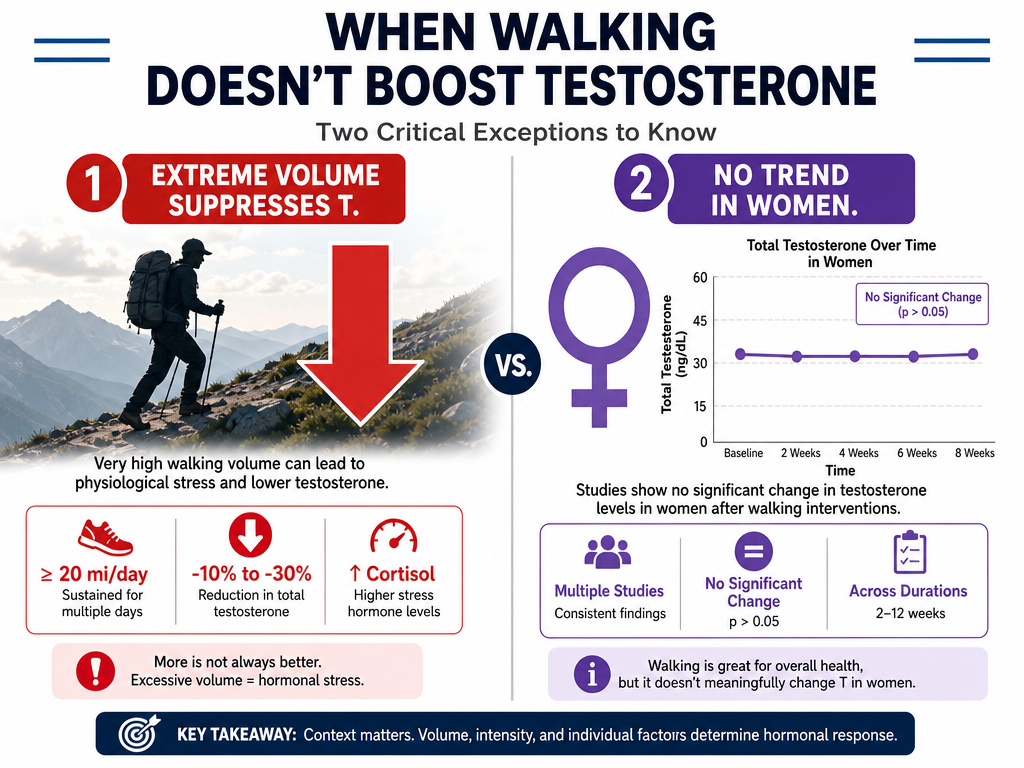
The standard advice flips under two conditions: extreme volume and gender.
1. Ultra-Endurance Walking Suppresses Testosterone.
The “dose makes the poison” principle applies perfectly. Studies of ultra-endurance walking, such as multi-day hikes covering extreme distances, have shown that such exhaustive volume can significantly lower testosterone as part of a general stress and catabolic response. This is a catabolic, high-stress state. The body prioritizes cortisol to mobilize energy and manage inflammation, directly opposing testosterone production. This is a world away from a daily 45-minute brisk walk and is a clear example of how prolonged cardio can cross into harmful territory.
2. The Effect in Women Is Different.
The same PMC meta-analysis that found benefits for men concluded there was no trend between exercise intervention and testosterone changes in women with obesity or type 2 diabetes, with studies reporting no change or even decreases. The physiology is different. For women, the hormonal response to exercise and fat loss differs from men. Some research suggests that women who lose > 2% body fat following three months of aerobic exercise have a subsequent 10.1% decline in total testosterone concentrations. The hormonal priority for women in a caloric deficit often shifts elsewhere.
The Role of SHBG and Why It’s Complicated
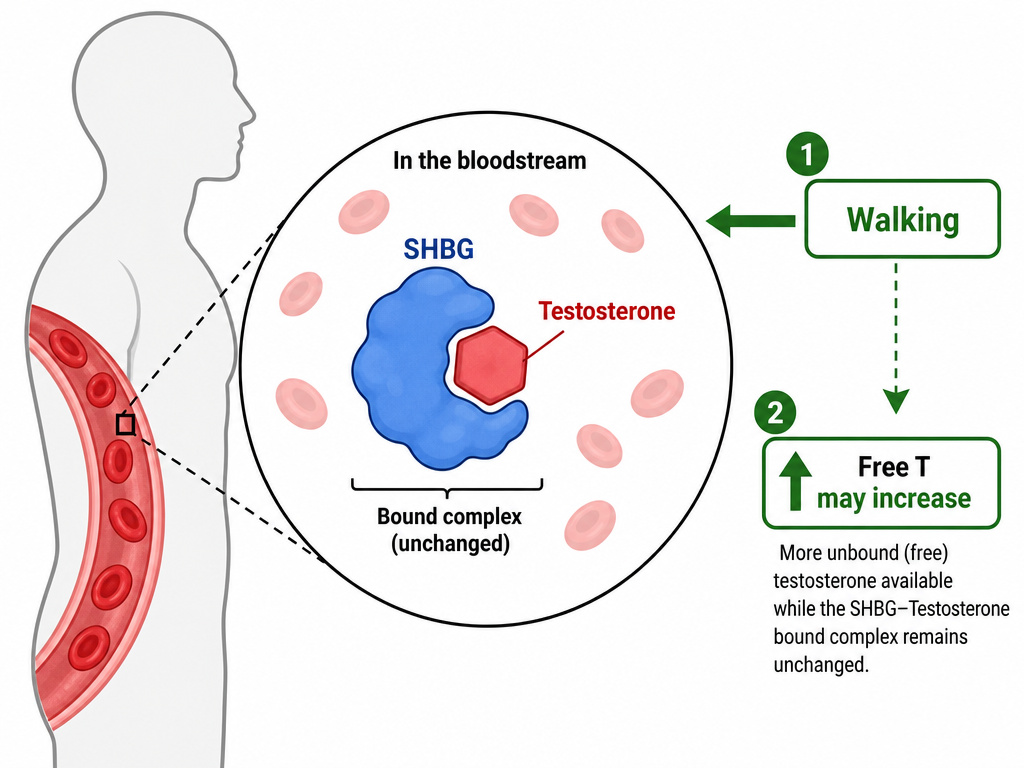
Sex Hormone-Binding Globulin (SHBG) is the transport protein that binds to testosterone, determining how much is “bioavailable” for your tissues to use. It’s a crucial piece of the puzzle.
The PMC meta-analysis found no significant changes in SHBG levels following aerobic exercise training in men and women who are obese or have type 2 diabetes, though other research shows SHBG can increase with substantial weight loss. This is interesting. If testosterone goes up but SHBG stays the same, the amount of free testosterone likely increases, a positive outcome.
However, other research introduces nuance. One study noted that weight loss of more than 5% incurred a significant increase in SHBG in women who were obese. Another found a 43% increase in SHBG in men who are obese after fat loss. Since individuals with obesity or type 2 diabetes often have lower SHBG to begin with, raising it can be part of improving metabolic health.
The Part Nobody Mentions: SHBG response might be more tied to the magnitude of fat loss or dietary change than to exercise itself. Your walking routine might boost total testosterone without moving SHBG, but a larger transformation involving significant weight loss might shift both markers.
Specific Step Count Targets
Research does not provide a universal step count target for increasing testosterone. The key factor is consistency over time to achieve fat loss, which drives hormone improvements. A systematic review found that significant increases in testosterone were reported following 12 weeks of exercise, suggesting a tipping point between 8 and 12 weeks. For men who are obese, studies show that significant decreases in body weight and body fat percentage are linked to significant increases in testosterone. Therefore, focus on a daily walking routine you can maintain consistently for at least three months, rather than a specific step number. This sustained effort is what helps reduce the adipose tissue that suppresses hormone function.
Frequently Asked Questions
Does walking 10,000 steps a day increase testosterone?
It can, but steps alone are a poor metric for this goal. The benefit comes from the consistent calorie burn and fat loss driven by purposeful, brisk walking. If your 10,000 steps are accumulated slowly throughout a sedentary day, the hormonal impact will be minimal. If a 45-minute brisk walk is a core part of hitting that step count, then you’re on the right track. Focus on dedicated walk time and intensity before obsessing over a step number.
Is walking or running better for testosterone?
For boosting testosterone through improved body composition, the better activity is the one you can do consistently without injury or burnout for 12+ weeks. For most people starting out, that’s walking. Running burns calories faster but carries a much higher risk of injury, overtraining, and elevated stress hormones, which can negate the benefits. Walk first, build a base, then add running later if you want.
How long does it take to see results from walking?
Based on the clinical research, you should not expect to see measurable changes in testosterone levels before 12 weeks of consistent training. Physically, you might feel better, have more energy, and see minor scale changes within 4-6 weeks, but the hormonal system lags behind. This long timeline is why combating a sedentary lifestyle requires patience, not just effort.
Can walking lower testosterone?
In normal, moderate doses, no. However, as covered in the exceptions, exhaustive, ultra-endurance walking (think multi-day hikes or marathon training volumes) can significantly lower testosterone as part of a general stress/catabolic response. For the vast majority of people, a daily brisk walk is protective, not harmful.
Before You Go
The most important rule is also the most boring: walk consistently, at a brisk pace, for more than two months. The 12-week threshold in the research isn’t a suggestion; it’s the observed biological lag time for this specific adaptation.
If you’re not tracking anything, start with time. Commit to 30 minutes, five days a week. Use a podcast or an audiobook to make it automatic. After a month, if that’s easy, add a hill or some intervals. The goal is to build a habit that outlives your motivation.
Finally, manage your expectations through the lens of fat loss. The walking is the input; a smaller waistline is the intermediary output; the hormonal shift is the final outcome. If the intermediary output isn’t happening after 12 weeks of honest effort, the input needs adjustment, more intensity, attention to diet, or a look at other lifestyle factors like sleep. Walking is a powerful, underrated tool, but it’s not magic. It’s mechanics.
