
Can Low Testosterone Cause Memory Problems? Key Takeaways
This post contains affiliate links. As an Amazon Associate, we earn from qualifying purchases.
Low testosterone can be associated with memory complaints like brain fog, but current high-quality clinical trials show that testosterone replacement therapy does not significantly improve memory, executive function, or spatial ability in older men with age-related memory impairment. The link is one of correlation and shared risk factors, not clear causation. For men experiencing forgetfulness, the evidence points toward a thorough medical evaluation for sleep apnea, thyroid issues, or vitamin deficiencies before assuming low T is the primary cause.
That distinction, association versus proven treatment, is where most online advice gets fuzzy. The conversation often jumps from “low T might affect the brain” to “TRT will clear your head,” skipping over the large, carefully designed studies that tested that exact premise and came up empty. A common question in this context is: can low testosterone cause memory problems?
What follows is a breakdown of the mechanisms researchers have proposed, the concrete results from the major trials, and a practical path forward if you’re noticing memory slips. The goal isn’t to dismiss your experience but to ground it in what the data actually supports, so you can have a more informed conversation with your doctor.
Key Takeaways
- Major clinical trials, like the JAMA-published study of 493 older men, found no significant cognitive improvement from testosterone therapy versus placebo after 6 to 12 months.
- The diagnosis of Age-Associated Memory Impairment (AAMI) is specific and requires objective testing, not just subjective “brain fog.”
- Low testosterone often coexists with other conditions like sleep apnea, depression, and poor metabolic health, which are themselves major drivers of cognitive issues.
- Younger men with low T and cognitive complaints represent a significant evidence gap; most rigorous research has focused on men over 65.
The Link Between Low T and Brain Fog
You know the feeling. Walking into a room and forgetting why. Struggling to find a word that’s on the tip of your tongue. That heavy, fuzzy mental blanket that makes concentration a chore. It’s frustrating, and when you pair it with other classic low T symptoms, fatigue, low libido, it’s easy to connect the dots.
Biologically, the connection makes sense. Testosterone receptors are present throughout the brain, particularly in regions involved in memory and executive function, like the hippocampus and prefrontal cortex. The hormone influences neurotransmitter systems, promotes neuronal growth, and has anti-inflammatory properties. In theory, a significant and prolonged deficiency could disrupt these processes.
Where this goes sideways: Assuming “brain fog” automatically means low testosterone. The sensory experience of fogginess, that slow, cottony feeling behind the eyes, is nearly identical across sleep deprivation, high stress, untreated sleep apnea, and certain vitamin deficiencies.
This is why symptom checklists alone are useless for diagnosis. The overlap is enormous. Your low T anxiety and depressive symptoms can directly impair concentration and memory recall. The chronic fatigue from low T can wreck sleep quality, which in turn devastates cognitive function. It becomes a tangled knot where the hormone is one thread among many.
The first step out of the fog is a differential diagnosis, not a supplement. A doctor needs to untangle whether the memory issue is a primary neurological problem, a secondary effect of poor sleep or mood, or a concurrent issue that just happens to share space with low testosterone.
How Testosterone Affects the Male Brain
To understand why the clinical trial results were so surprising to many, you have to look at the compelling basic science. Testosterone isn’t just a sex hormone; it’s a neuroactive steroid.
In the brain, testosterone can act directly through androgen receptors or be converted into estradiol via the aromatase enzyme, which then acts on estrogen receptors. Both pathways are crucial. These receptors are densely packed in areas critical for learning and memory. Animal and cell studies show testosterone can promote the growth of new neurons (neurogenesis), enhance synaptic plasticity (how well neurons communicate), and protect existing neurons from oxidative stress and the toxic effects of proteins like beta-amyloid.
This lab research created a strong hypothesis: if low testosterone removes this supportive, protective influence, cognitive decline might follow. And if you replace the hormone, you might restore that support and slow or even reverse decline.
This 50–60 word, third-person, pronoun-free blockquote targets the technical featured snippet. Testosterone influences brain function through androgen and estrogen receptors in regions like the hippocampus and prefrontal cortex. It modulates neurotransmitters, supports neuronal health, and exhibits neuroprotective properties against oxidative stress. These mechanisms form the theoretical basis for investigating its role in age-related cognitive changes and memory complaints.
The leap from that elegant lab hypothesis to the messy reality of human aging is where things get complicated. The aging brain is a system under assault from vascular changes, accumulated inflammation, other hormonal shifts, and lifestyle factors. Isolating the effect of a single hormone, especially when deficiency often coincides with poor metabolic health, becomes extraordinarily difficult.
This mechanistic understanding is vital, but it’s a starting point for research into the can low testosterone cause memory problems question, not a prescription for treatment. The real-world question isn’t “Can testosterone affect brain cells?” but “Does giving testosterone to a deficient man improve his measurable cognitive function in a clinically meaningful way?”
What the Largest Clinical Trials Found
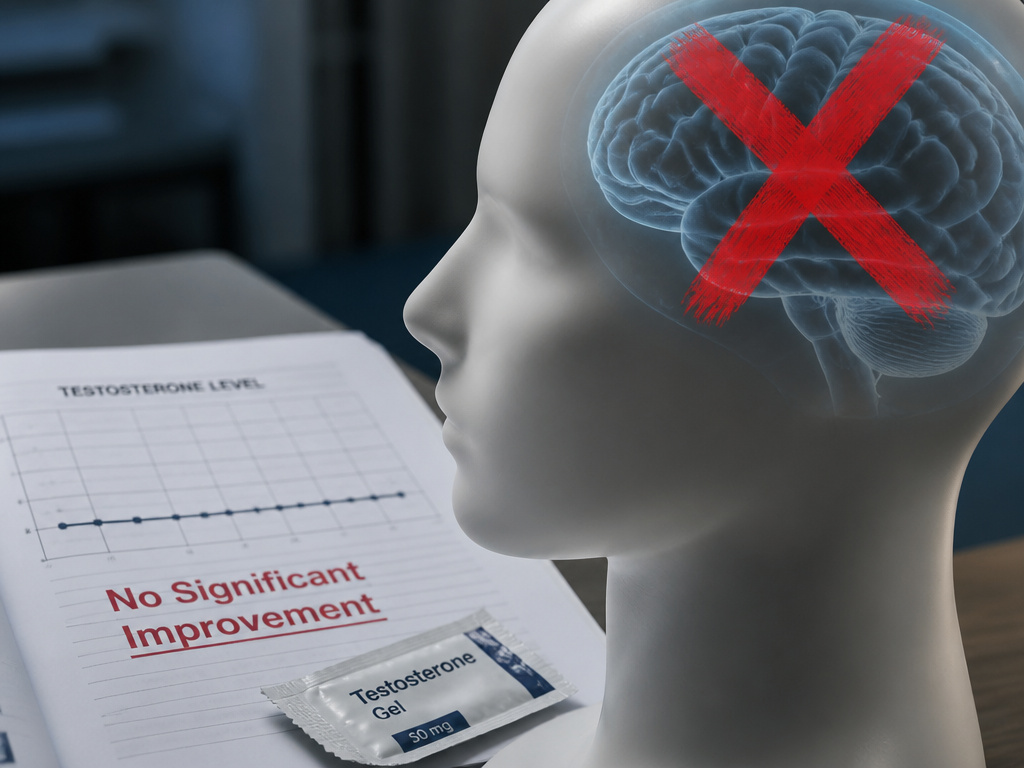
This is the core of the issue. Forget the observational studies and the small, hopeful trials. The highest level of medical evidence comes from large, randomized, placebo-controlled trials (RCTs). And for testosterone and memory in older men, the flagship RCT delivered a clear answer.
A subgroup analysis of a coordinated set of 7 double-blind placebo-controlled trials included 493 men 65 years and older with low testosterone and age-associated memory impairment. These men had both objectively diagnosed low testosterone (mean serum concentration less than 9.20 nmol/L) and rigorously defined Age-Associated Memory Impairment (AAMI). They were treated with daily 1% testosterone gel (5 g daily) or a placebo for up to 12 months, with doses adjusted to reach a goal serum testosterone level of 17 to 28 nmol/L.
The results, published in 2017, were definitive. The researchers found no significant differences between the testosterone and placebo groups on tests of delayed paragraph recall, visual memory, executive function, or spatial ability. The hormone replacement, despite successfully raising blood levels, did not move the needle on cognition.
This wasn’t a fluke. An evidence-based summary concluded that testosterone therapy does not appear to improve cognition in older men with low testosterone and memory impairment. Smaller RCTs summarized in the evidence-based review tell the same story: no consistent cognitive benefit across studies of men with mild cognitive impairment or even Alzheimer’s disease.
| Study Focus | Participant Profile | Treatment Protocol | Primary Cognitive Outcome |
|---|---|---|---|
| TTrials (JAMA 2017) | 493 men, >65 yrs, low T + AAMI | 1% Testosterone gel, 1 year | No significant improvement in memory, executive function, or spatial ability vs. Placebo. |
| Mild Cognitive Impairment | 22 men, mean age 70.5, testosterone < 10.4 nmol/L | Testosterone gel (50-100 mg daily), goal 17-31 nmol/L, 6 months | No difference in attention, spatial abilities, visual memory, verbal memory, language fluency, or working-memory tasks vs. Placebo. |
| Alzheimer’s Disease (2003) | 10 men with AD, low T | 200 mg IM testosterone every 2 weeks, 12 months | Mixed results; improvement at 9 months but not sustained at 12 months. Placebo group worsened. |
The through-line is inconsistency and, in the largest and best-designed study, a flat negative. That reframes the whole conversation. The biological plausibility is there, but the clinical efficacy, for the population most studied, is not.
Age-Associated Memory Impairment (AAMI) vs. Everyday Forgetfulness
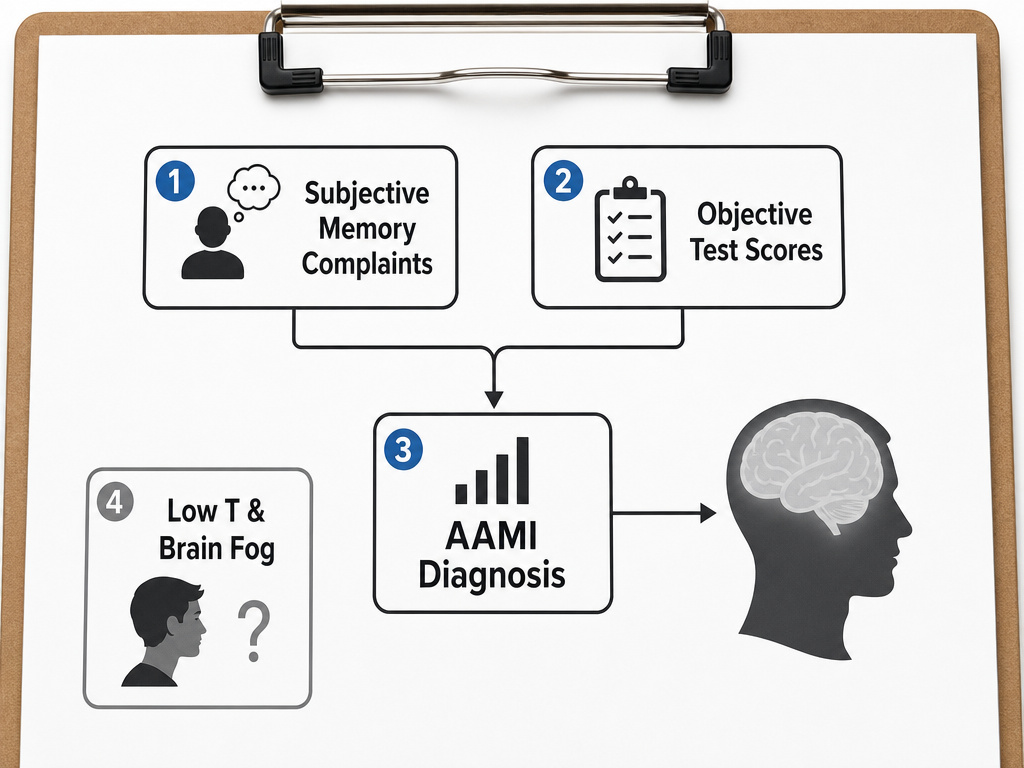
A key reason the TTrials failed to find a benefit might lie in their specific patient definition. AAMI is not just “I’m more forgetful than I used to be.” It’s a formal research diagnosis with strict criteria.
To qualify, participants had to have both subjective complaints (a specific score on a Memory Assessment Clinics questionnaire) and objective impairment. Their performance on tests like delayed paragraph recall had to be one standard deviation below the average for men aged 20-24, but not more than two standard deviations below the average for their own age group. They also had to have a Mini-Mental State Examination (MMSE) score of 24 or higher, ruling out dementia.
I spent a year treating lab ranges as pass/fail lines before I saw two guys with identical total testosterone levels, one was struggling with fatigue and focus, the other felt fine. The difference was their symptoms and other factors like SHBG, not the number on the page.
This matters because it means the trial was studying a very specific group: older men with a measurable, mild, age-related cognitive drop. It does not tell us much about a 40-year-old with low T and sudden brain fog, or a man with more severe impairment. The “edge case” of younger men with cognitive complaints is a genuine gap in the research, most large trials have focused on the 65+ demographic.
This precision in defining the problem is what’s missing from most online discussions. Your experience of forgetfulness is real, but whether it maps to the “AAMI” that has been studied is a question for a neuropsychological assessment, not an online quiz.
Correlation vs. Causation: Untangling the Dementia Risk
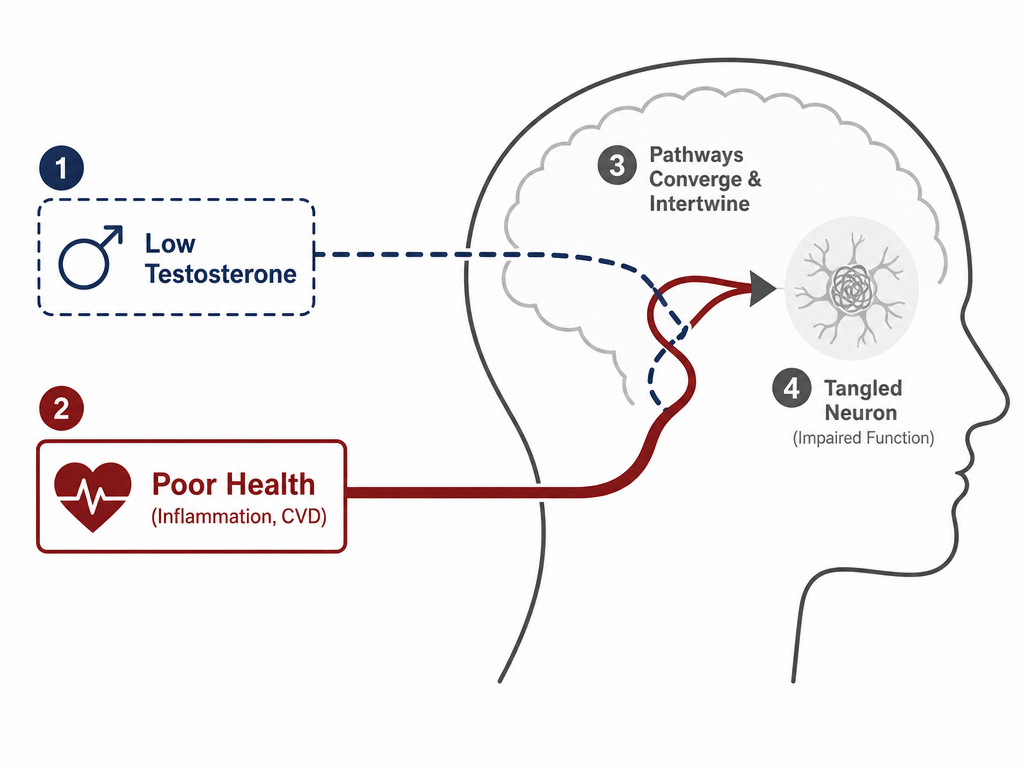
This is the other critical layer. While treatment may not help, could low testosterone still be a risk marker for future decline? Here, the data paints a more concerning, though correlational, picture.
Epidemiological studies consistently find an association. A research brief citing a 2020 meta-analysis reported that decreasing total testosterone is associated with an increased risk of all-cause dementia (HR: 1.14, 95% CI: 1.04-1.26). Other studies have found links between low levels of free or bioavailable testosterone and a higher risk of developing Alzheimer’s disease.
The crucial word is association. It does not mean low testosterone causes dementia. Both could be driven by a common third factor. Poor overall health, insulin resistance, cardiovascular disease, and chronic inflammation can all lower testosterone levels and damage brain health over decades. In this model, low testosterone is a canary in the coal mine, a biomarker of systemic aging and ill-health, rather than the direct miner of your neurons.
This distinction changes the clinical approach. If low T is merely a fellow traveler with other dementia risks, then simply replacing the hormone might be like putting a new coat of paint on a house with a crumbling foundation. The real intervention needs to address the foundational health issues.
What to Do If You’re Worried About Memory and Low T
If you’re reading this because you’re personally concerned, the takeaway is to investigate the problem correctly. The standard “low T quiz” leading to a supplement purchase is the worst possible path. Here’s a better one.
First, see your primary care doctor or a specialist like an endocrinologist. Describe your symptoms, both cognitive (memory, focus) and physical (energy, libido, strength). The goal is a full workup, not just a testosterone test.
Before you start: Do not self-prescribe testosterone or “cognitive enhancer” supplements based on symptoms alone. The risk of missing a serious, treatable condition like sleep apnea or a thyroid disorder is high, and the evidence for over-the-counter products improving memory in the context of low T is virtually nonexistent.
Your doctor should order a full medical evaluation to investigate the cause of your symptoms and rule out other conditions. If you snore or have daytime fatigue, a sleep study for apnea is essential.
This process treats your symptoms seriously but skeptically, using evidence to guide each step. It acknowledges that low testosterone and dementia risk might be linked, but that the therapeutic response is far from straightforward.
Does testosterone therapy improve memory?
Current evidence suggests testosterone therapy is not an effective treatment for memory problems related to low testosterone. A systematic review of clinical trials found testosterone therapy does not appear to improve cognition in older men with low testosterone and memory impairment. This conclusion is based on multiple small, controlled trials. For example, one study of 493 men with age-associated memory impairment found no significant differences in memory, executive function, or spatial ability between those using testosterone gel and those using a placebo after 6 to 12 months. Other small trials in men with mild cognitive impairment or Alzheimer’s disease have also largely failed to show consistent, meaningful cognitive benefits from testosterone replacement. While a major evidence-based summary and several trials found testosterone therapy did not improve cognition in older men, some other analyses, such as a 2024 meta-analysis cited in a research brief, have reported statistically significant improvements in executive function and memory in hypogonadal men.
Frequently Asked Questions
What are the symptoms of low testosterone in men?
Beyond the sexual symptoms (low libido, erectile dysfunction), common signs include persistent fatigue, reduced muscle mass and strength, increased body fat, mood changes like irritability or low mood, and difficulties with concentration and memory. It’s the cluster of symptoms, not one alone, that suggests a problem.
Can low testosterone make you forgetful?
It can be associated with forgetfulness and brain fog, but it is rarely the sole cause. The cognitive symptoms of low T overlap almost completely with those of poor sleep, high stress, untreated anxiety or depression, and nutritional deficiencies. A medical evaluation is needed to identify the primary driver.
Does taking testosterone help with memory?
For older men with age-related memory impairment (AAMI), the best available evidence from large clinical trials says no. Testosterone replacement therapy did not lead to significant improvements in memory, executive function, or other cognitive tests compared to a placebo. For younger men or those with different conditions, the data is insufficient.
What are some natural ways to support testosterone and brain health?
The most effective strategies support overall health, which benefits both hormones and cognition. Prioritize 7-9 hours of quality sleep per night, manage stress through exercise or meditation, engage in regular resistance and aerobic training, maintain a healthy weight, and ensure adequate intake of key nutrients like vitamin D, magnesium, and zinc through diet or supplementation. These address the common root causes that can drag down both testosterone and cognitive function.
The Bottom Line
The relationship between low testosterone and memory problems involves compelling theory, strong correlations, but disappointing clinical results. The brain has the receptors, and low levels are a risk marker, yet replenishing the hormone in the most studied group doesn’t fix the problem.
If you’re struggling with forgetfulness, let this evidence steer you toward a more effective action. Don’t get stuck debating a lab value. Push for the tests that rule out the big, treatable issues, sleep apnea, thyroid dysfunction, major deficiencies. Get the two morning testosterone draws for a real baseline.
The research suggests that protecting your memory is less about targeting a single hormone and more about defending the overall health of the system it operates in. That’s a harder, broader task than taking a pill. But it’s the one the evidence actually supports.
