
Does D Aspartic Acid Increase Testosterone?
This post contains affiliate links. As an Amazon Associate, we earn from qualifying purchases.
D-aspartic acid (DAA) does not reliably increase testosterone in most men, especially those who are already resistance-trained. The evidence is contradictory: one early study in untrained men with low baseline testosterone showed a 42% increase with 3.12 grams daily, while multiple later studies in trained athletes found no benefit, and one even reported a significant decrease, with doses of 3 or 6 grams per day.
That 42% figure gets recycled in every marketing pitch. It comes from a single, small 2009 study. The problem is, at least four subsequent human trials failed to replicate that result in athletic populations. The difference isn’t academic. It’s the difference between spending money on something that might fix a specific, uncommon deficiency and wasting it on a supplement that does nothing for a healthy, active guy. Many people ask, does d aspartic acid increase testosterone, but the evidence suggests it does not for most athletes.
What follows is a walk through the actual study numbers, the two critical variables that explain the conflict (your training status and the dose), and a straight answer on the does d aspartic acid increase testosterone question for whether this compound belongs in your stack.
Key Takeaways
- The famous 42% testosterone increase claim comes from a single 2009 study (Topo et al.) using 3.12 grams/day in untrained men with low starting levels (~4.5 ng/ml).
- In resistance-trained men, three human trials found 3 grams/day of DAA had no significant effect on testosterone (Melville & Siegler 2017, Camic et al. 2018).
- At a 6 gram/day dose, research in trained men shows disagreement: the Melville & Siegler (2017) study found it significantly reduced total and free testosterone, while the Willoughby & Leutholtz (2013) and Krzysztofik et al. (2023) studies found no significant change.
- Your training status is the biggest predictor of response. DAA appears ineffective for boosting testosterone in athletes and likely only works, if at all, in sedentary individuals with a hormonal deficiency.
- The Natural Medicines Comprehensive Database does not list DAA as a testosterone booster and cautions that sufficient safety and efficacy data is not available.
The Dose-Dependent Mess: 3 Grams vs. 6 Grams
You can’t talk about DAA without talking numbers, and the numbers tell two different stories depending on how much you take. This is where most articles gloss over the details, but the dose makes all the difference when you compare a does d aspartic acid increase testosterone study.
Where this goes sideways: Assuming more is better. With DAA, a 3-gram dose showed mixed results, but jumping to 6 grams introduced a real risk of lowering your levels, according to one robust trial.
The 2009 study by Topo et al. Used a solution of 10 ml of 2.0 M sodium D-aspartate (3.12 g/10 ml) supplemented with vitamin B6, folic acid and vitamin B12. In their group of untrained men, total testosterone rose from an average of 4.5 ng/ml to 6.4 ng/ml after 12 days, that’s the 42% increase. Three days after stopping, levels were still elevated at 5.8 ng/ml. This is the foundational study every DAA product cites.
Fast forward to 2017. The Melville & Siegler study tested two doses in resistance-trained men: 3 grams/day and 6 grams/day for 14 days. The 3-gram group saw no significant change. The 6-gram group, however, saw total and free testosterone drop significantly compared to placebo. The authors noted baseline levels in their trained subjects were 6.3 ng/ml, which was higher than the 4.5 ng/ml baseline in the Topo study.
| Daily Dose | Study (Population) | Effect on Testosterone | Key Detail |
|---|---|---|---|
| ~3.12 g | Topo et al. 2009 (Untrained men) | 42% increase (4.5 to 6.4 ng/ml) | Baseline levels were low; effect lasted 3 days post-use. |
| 3 g | Melville & Siegler 2017 (Trained men) | No significant change | Baseline ~6.3 ng/ml; mirrors other null findings in athletes. |
| 6 g | Melville & Siegler 2017 (Trained men) | Significant decrease vs. Placebo | The higher dose had a negative impact in this cohort. |
| 6 g | Willoughby & Leutholtz 2013 (Trained men) | No change over 12 weeks | Did find a 16% reduction in estradiol. |
| 6 g | Krzysztofik et al. 2023 (Boxers) | No change under hypoxia | Also no effect on cortisol or hematological markers. |
So we have a contradiction at 6 grams: one study says it lowers T, two others say it does nothing. This kind of disagreement in the literature is a huge red flag. It means the effect is not robust or reproducible. When evaluating ingredients for research-backed support, consistency across trials is what you look for first. DAA fails that test.
Who Actually Might See a Bump? The Training Status Divide
If the dose tells one story, your training history tells the other. The single biggest reason for the conflicting data isn’t the supplement, it’s the person taking it.
The positive 2009 study used healthy male volunteers (aged 27-37 years) who were not resistance-trained. Every subsequent study that found no effect or a negative effect used athletes: resistance-trained men, climbers, boxers. This isn’t a coincidence. Trained individuals generally operate with a different hormonal baseline. General research consensus in resistance training literature indicates testosterone levels range from 5.8–8.6 ng/ml for trained individuals and 4.9–6.6 ng/ml for untrained individuals.
The men in the Topo study started at 4.5 ng/ml, which is below the typical untrained range of 4.9–6.6 ng/ml cited in resistance training literature. The theory is that DAA might only have a measurable effect when there’s room to move upward from a suboptimal baseline. If you’re already in the healthy, trained range, the signal from DAA might be too weak to push the needle.
I learned a similar lesson with zinc. I looked up the numbers when I got sick of oyster hype: about six medium oysters has over 30 mg of zinc. That “works” for people who are clinically low because it fixes a deficiency. It’s not a magic food effect. DAA might be the same: a deficiency fix, not a performance enhancer. For the average guy looking for the best testosterone supplements, a deficiency fix isn’t the goal; sustained, optimal function is.
How DAA Should Work: The HPG Axis Mechanism
On paper, the mechanism is solid. That’s why it gained traction. D-aspartic acid is a natural amino acid found in the pituitary gland and testes. Its proposed role is to act as a signaling molecule on the hypothalamic-pituitary-gonadal (HPG) axis.
The DAA molecular mechanism review explains that D-aspartate is thought to stimulate the release of gonadotropin-releasing hormone (GnRH), which triggers the pituitary to release more luteinizing hormone (LH). LH then travels to the testes and signals Leydig cells to produce more testosterone. In rat studies, this pathway is clear.
The 2009 human study seemed to confirm this. They reported LH increased by 33% and testosterone by 42%. The problem is, this neat chain of events hasn’t held up in follow-up human research. The short-term DAA climbing study found 3 grams daily for two weeks did not affect serum testosterone, calculated free testosterone, or LH in male climbers. The mechanism might be real in rodents or in specific human scenarios, but it appears to be easily saturated or irrelevant in healthy, trained men.
When a great story in the lab doesn’t translate to the body, it’s time to listen to the body. The mechanism is interesting, but it’s not a guarantee of results. This is a common trap with marketing for testosterone boosters, where a plausible biological story gets sold as a proven outcome.
Safety and Side Effects: What We Don’t Know

The research isn’t just mixed on efficacy; it’s thin on long-term safety. The Natural Medicines Comprehensive Database monograph does not list DAA as a testosterone booster and explicitly cautions that “sufficient and reliable information about its safety and effectiveness is not available.”
That’s a formal way of saying we’re guessing on long-term use. Most human trials have lasted only 2 to 12 weeks. We have no data on what happens after six months or a year of daily supplementation.
From the shorter studies, a couple of potential effects emerge:
- Hormonal Downside: The Melville & Siegler finding that 6 grams lowered T is a serious potential side effect of testosterone boosters you won’t see on a label.
- Estradiol Impact: The Willoughby & Leutholtz study noted a 16% reduction in estradiol after 12 weeks. While lowering estrogen can be a goal for some, an unchecked drop can negatively impact libido, joint health, and mood. It’s not a side effect to ignore.
The lack of long-term data means any recommendation for chronic use is an experiment. Compared to foundational supplements for testosterone support like vitamin D or magnesium, which have decades of safety data, DAA is a speculative compound.
A Practical Guide: Should You Try DAA?

Given the conflicting evidence, here’s a decision framework. This isn’t about what a label claims; it’s about matching the supplement to your actual situation.
First, get a baseline. If you’re curious enough to consider DAA, you should be curious enough to check a hormone panel first. You need to know your starting total and free testosterone. Guessing is expensive hoping.
Skip this if: Your total testosterone is already above 6.0 ng/ml and you train regularly. The evidence strongly suggests you will see zero benefit and might even see a negative effect.
If your levels are below 5.0 ng/ml and you are not engaged in consistent resistance training, the 2009 study suggests a short course of ~3 grams daily might help. This is a big “might.” You would be attempting to replicate a single, old study. Even if it worked, the increase was temporary, levels began to drop three days after stopping.
For everyone else, the vast majority of men browsing for over-the-counter testosterone supplements, DAA is a low-priority option. Your money and focus are better spent elsewhere. Fixing sleep, managing stress, ensuring adequate vitamin D and zinc status, and dialing in your training will have more predictable and lasting effects on your hormonal health than this inconsistent amino acid.
Effects on fertility and sperm quality
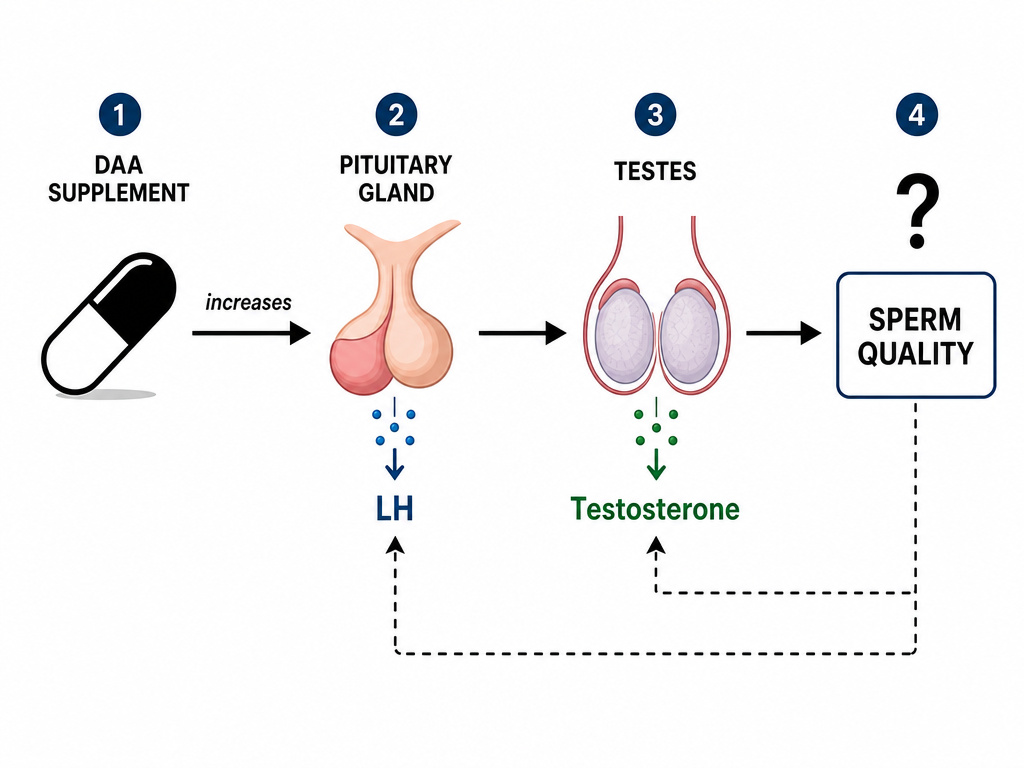
The research on D-aspartic acid’s direct impact on fertility and sperm quality in humans is limited. The existing studies primarily measure hormonal endpoints like testosterone and luteinizing hormone (LH), which are involved in the reproductive process. For instance, one study found DAA supplementation significantly increased LH, a hormone that stimulates testosterone production in the testes. However, no studies in the provided fact sheet directly report measurements of sperm count, motility, or morphology following DAA supplementation. While modulating reproductive hormones could theoretically influence fertility parameters, there is currently insufficient and reliable clinical data to confirm any specific benefits or harms to sperm quality from using DAA supplements.
Natural dietary sources of DAA
D-aspartic acid is not a common component of the standard diet in significant amounts. Unlike its counterpart L-aspartic acid, which is abundant in protein-rich foods like meat, eggs, and dairy, the D form is found in much lower concentrations. It is present in some specific foods like shellfish and certain types of seaweed, but the quantities are typically minimal. The doses used in research studies, such as 3.12 grams or 6 grams per day, are far higher than what you could reasonably obtain from food alone. Therefore, if someone is aiming to replicate the supplemental doses investigated for potential hormonal effects, they would need to use a purified DAA supplement, not dietary sources.
Frequently Asked Questions
Is D-aspartic acid worth taking?
For most men, especially those who are physically active, the current evidence says no. The single positive study involved untrained men with low baseline testosterone. Multiple studies in trained populations found no benefit, and one found it lowered testosterone. The risk of no effect or a negative effect outweighs the potential for a minor, temporary bump.
What is the #1 testosterone killer?
Chronic stress, poor sleep, and significant calorie deficits are among the most common lifestyle factors that suppress testosterone. From a supplement perspective, consistently high doses of opioids or long-term, unsupervised use of certain corticosteroids can be major suppressors. DAA itself was shown to be a “testosterone killer” in one study at a 6-gram dose.
Does not ejaculating for 7 days increase testosterone?
The short-term data on this is mixed and generally shows any increase is minor and transient. A 2021 study found a slight peak around day 7, but levels returned to baseline quickly. This strategy does not produce a meaningful, sustained elevation in testosterone that would impact muscle growth or overall vitality.
Can I take D-aspartic acid every day?
The longest human safety trial lasted 12 weeks. There is no reliable long-term safety data for daily DAA consumption. Given the lack of proven benefit for most people and the potential for negative hormonal effects at higher doses, there is no compelling reason to adopt DAA as a daily supplement.
Before You Go
The data on D-aspartic acid is a case study in how supplement marketing works. An intriguing early result gets amplified, while the larger body of contradictory evidence gets buried in the small print. For trained individuals, the collective research is clear: DAA is not an effective testosterone booster.
If you still want to experiment, treat it as a two-week test, not a permanent addition. Use a dose of 3 grams daily, not 6. And measure your baseline first, otherwise, you’re flying blind. But honestly, your effort is better spent on the fundamentals. A basic stack of proven natural testosterone boosters like tongkat ali (for stress) or fenugreek (for libido), backed by better human data, will serve you more reliably than chasing the ghost of a 42% increase from 2009.
