
Does Melatonin Affect Testosterone? The Human Evidence
This post contains affiliate links. As an Amazon Associate, we earn from qualifying purchases.
Human studies show no significant effect of supplemental melatonin on testosterone levels. This holds true across a wide dose range, from a 6 mg daily dose taken for a month to a single acute 80 mg dose. The consistent finding from clinical research is that melatonin supplementation does not alter serum testosterone or gonadotropin levels in men. Rodent studies tell a different, conflicting story, but the human evidence is clear.
That clarity matters if you take melatonin for sleep. You’re probably not a lab rat, and your hormonal system doesn’t respond to pills the way a rodent’s does. The disconnect between animal models and human outcomes is where most online confusion starts, including the question of does melatonin affect testosterone. This guide walks through the actual studies, explains why the data splits, and gives you a practical framework for using melatonin without second-guessing your testosterone.
What follows: a breakdown of the key human trials, a look at the contradictory rodent data, the mechanisms at play, and straightforward advice for anyone adding melatonin to their routine.
Key Takeaways
- Human clinical trials, including a study using a single 80 mg dose, show no alteration of testosterone or gonadotropin levels.
- The primary human effect noted is a rise in prolactin levels, which returned to baseline after the melatonin cleared.
- Rodent studies conflict, showing both inhibitory and stimulatory effects on testosterone, highlighting a major species-specific difference.
- The RORα receptor pathway is a key mechanism in rodents, but its relevance to oral melatonin in humans is unclear.
- For practical use, stick to low doses close to bedtime.
The Short Answer: What Human Studies Show
We begin with the direct evidence. If you take a melatonin supplement, your body processes it as an exogenous hormone, something from outside. The question of does melatonin affect testosterone is whether that signal disrupts the complex chain of commands that ends with testosterone production.
The chain is called the hypothalamic-pituitary-gonadal (HPG) axis. It’s a feedback loop involving your brain and testes. A 2000 double-blind, placebo-controlled trial in Human Reproduction put this to the test. Men took 6 mg of melatonin every night for a month. The result? No change in the nocturnal secretion patterns of luteinizing hormone (LH), follicle-stimulating hormone (FSH), or testosterone. The HPG axis kept ticking along as usual.
A single 80 mg oral dose of melatonin in male adolescents did not alter serum gonadotropin or testosterone levels. Serum prolactin levels, however, rose from 4.6±0.7 ng/ml to 7.6±0.9 ng/ml.
That blockquote is from a 1984 study in Pediatric Research. It’s worth highlighting for two reasons. First, the dose is massive, far beyond anything you’d find in a store. Second, even at that extreme, testosterone and the gonadotropins that stimulate it (LH and FSH) didn’t budge. The pulsatile secretion pattern of gonadotropins wasn’t altered either. The only hormonal shift was a transient increase in prolactin, a hormone involved in lactation which also returned to normal.
A 2022 human study defined ‘low-dose’ melatonin supplementation as ≤5 mg.
Bottom line: The human clinical record, spanning decades and a wide dose range, finds no evidence that melatonin supplementation lowers testosterone.
The Rodent Data: A Different Story
Open a rodent study and the narrative changes completely. This is the source of the widespread confusion and contradictory headlines online about the does melatonin affect testosterone issue. In animal models, melatonin clearly regulates testicular function.
The disagreement starts within the rodent literature itself. A 2001 study concluded melatonin inhibits testosterone secretion by acting on the hypothalamo-pituitary axis in rats. Over a decade later, a 2021 study in Biology of Reproduction concluded melatonin increases testosterone synthesis in mammalian Leydig cells. So which is it? Inhibit or stimulate?
| Study Type | Dose / Model | Finding on Testosterone | Key Mechanism Proposed |
|---|---|---|---|
| Human Trial (2000) | 6 mg/day for 1 month | No significant change | No alteration of LH, FSH, or testosterone secretion patterns. |
| Human Acute Dose (1984) | Single 80 mg dose | No change | No effect on gonadotropins; increased prolactin. |
| Rodent Study (2001) | Not specified in fact sheet | Inhibits secretion | Action at the hypothalamo-pituitary-gonadal (HPG) axis. |
| Rodent Study (2021) | Endogenously elevated levels | Increases synthesis | Activates RORα receptor pathway in Leydig cells. |
The table shows the core conflict. The 2021 study points to a specific mechanism: the nuclear receptor RORα (RAR-related orphan receptor alpha). In rodents, melatonin binding to RORα appears to turn on genes involved in testosterone synthesis, like StAR. However, the researchers used genetic models to elevate melatonin endogenously, from within the animal’s own system. They highlight this distinction, noting it may not translate to effects from a pill.
Where this goes sideways: Assuming rodent results directly apply to human hormone supplementation. The physiological systems, baseline melatonin levels, and light-response pathways are profoundly different between species.
This isn’t just an academic footnote. It’s the reason you can’t cite an animal study to predict what will happen in your body. Human clinical studies (2000, 2022) consistently report no significant effect of supplemental melatonin on testosterone levels in men, while multiple rodent studies (2001, 2011, 2021) demonstrate clear regulatory effects of melatonin on testosterone synthesis and secretion.
Melatonin, Sleep, and Your Hormonal Ecosystem
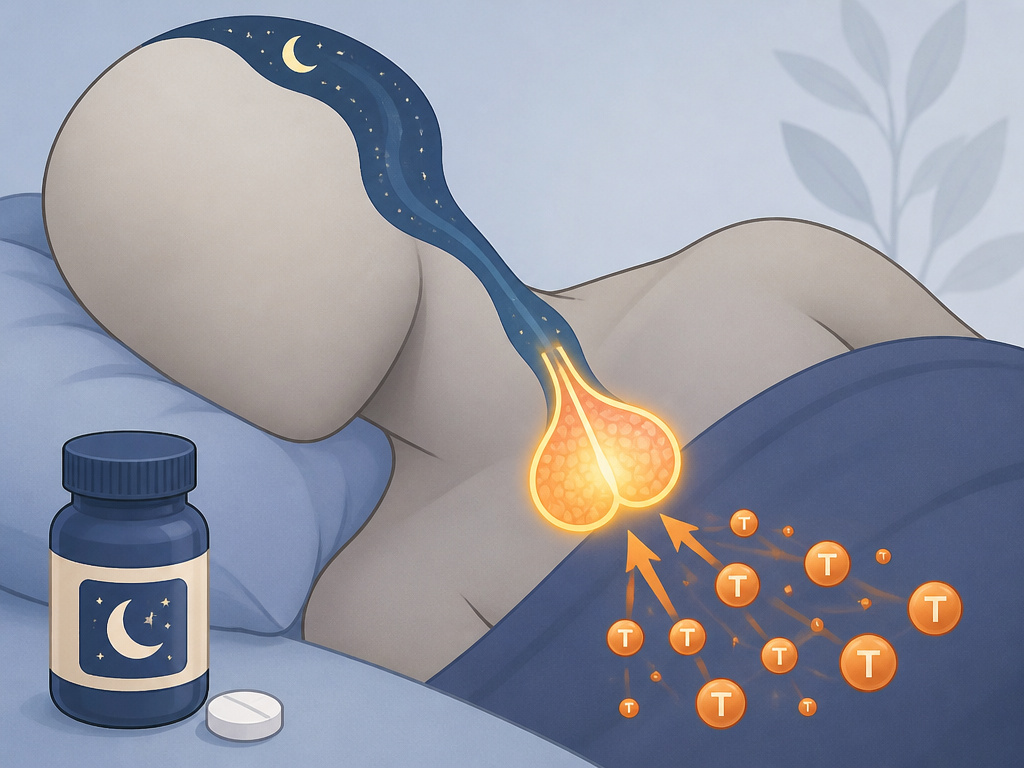
If melatonin pills don’t touch testosterone directly, why does the question keep coming up? It’s because sleep quality is foundational for healthy testosterone levels. People logically connect the sleep aid with the sleep-dependent hormone.
Testosterone production follows a strong circadian rhythm, peaking in the early morning. This morning testosterone peak depends on a cascade of events that starts with good sleep architecture, particularly deep, slow-wave sleep. Disrupt that with poor sleep, and you disrupt the hormonal pulse.
Melatonin’s primary job is to signal darkness, priming your body for sleep. By improving sleep onset and potentially quality, it indirectly supports the conditions under which optimal testosterone production occurs. This is the real relationship. It’s not that melatonin boosts testosterone; it’s that better sleep, which melatonin may facilitate, helps maintain your natural hormonal rhythm.
This is why improving sleep is a first-line strategy for anyone concerned about low testosterone. It’s also why night shift work and chronic circadian rhythm disruption are so damaging to hormonal health.
Prolactin: The One Hormone That Does Change
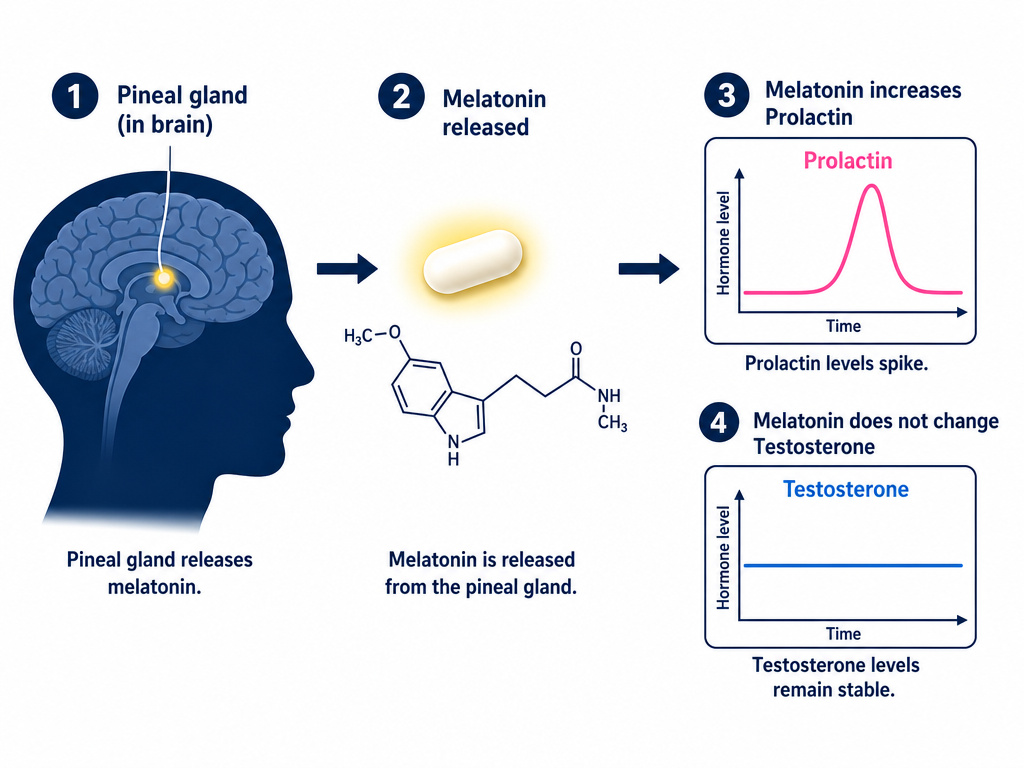
While testosterone stays steady, the 1984 study caught a clear signal with another hormone: prolactin. Levels rose significantly after that large 80 mg dose. Prolactin has an inverse relationship with dopamine and, in theory, very high levels could suppress libido and gonadal function.
Should you worry? In the context of normal supplemental use, probably not. The prolactin increase in the study was acute and dose-dependent. It spiked and then fell back. At the low doses (0.5–5 mg) used for sleep, this effect is likely minimal or absent. Chronic elevation is a medical concern, but it’s not a typical outcome of occasional melatonin use. The takeaway is that melatonin has measurable endocrine effects, just not on the axis you might be watching.
A Practical Guide to Using Melatonin

Given the evidence, how should you approach melatonin? Your goal is to mimic the natural pineal signal, not overwhelm the system.
-
Prioritize sleep hygiene. Melatonin is a helper, not a replacement for good habits. Darken your room, manage evening blue light from screens, and keep a consistent schedule.
-
Know when to skip it. If you already sleep well, adding melatonin probably won’t help. Its benefit is clearest for shift workers, jet lag, or occasional sleep-onset insomnia.
Common mistake: Reaching for a high-dose melatonin product first. The side effect profile (grogginess, headaches) increases with dose, while the sleep benefit does not. Start small.
Remember, the relationship between low testosterone and insomnia can be a two-way street, poor sleep lowers T, and low T can worsen sleep.
Does melatonin supplementation lower or raise testosterone?
The research presents a clear split between animal and human studies. A 2001 rodent study concluded melatonin inhibits testosterone secretion, while a 2021 rodent study concluded melatonin increases testosterone synthesis in mammalian Leydig cells. However, human clinical trials tell a different story. Studies from 2000 and 2022, using doses ranging from 6 mg per day for a month to a single 80 mg dose, consistently report no significant change in testosterone levels in men. Even an older study from 1984 using a high single dose in adolescents found no alteration in testosterone or the hormones that stimulate its production. The current human evidence suggests supplemental melatonin does not meaningfully affect testosterone.
How could melatonin theoretically affect testosterone?
Research points to several potential pathways, primarily studied in animal models. Melatonin may interact with the hypothalamic-pituitary-gonadal (HPG) axis, the hormonal circuit governing testosterone production. A specific nuclear receptor called RORα has been identified in rodent studies as a primary mediator for melatonin’s action on genes involved in testosterone synthesis. Melatonin’s well-known antioxidant properties could also theoretically protect testosterone-producing cells from damage. However, human studies monitoring this axis have not found disruption. For example, research showed that melatonin supplementation did not alter the pulsatile secretion patterns of key gonadotropins, indicating the central brain signals for testosterone production remained unchanged.
Does aging change the relationship between melatonin and testosterone?
Both melatonin and testosterone production naturally decline with age. This parallel decline has led to scientific interest in whether boosting one could influence the other. Some rodent research suggests that endogenously elevated melatonin, meaning the body’s own production, can promote testosterone synthesis. This highlights a key distinction: the body’s natural nightly melatonin pulse may play a different role than taking an oral supplement. In aging humans, the practical evidence from supplementation studies remains consistent with findings in younger adults. Clinical trials have not shown that taking melatonin supplements can counteract the age-related drop in testosterone levels. The two declines appear to be correlated but not causally linked through supplementation.
Frequently Asked Questions
Does taking melatonin suppress testosterone?
No, human clinical studies do not show suppression. Research using doses from 6 mg daily for a month to a single 80 mg dose found no significant effect on testosterone or the gonadotropin hormones that stimulate its production.
Is it bad to take melatonin every night?
From a hormonal perspective, the evidence suggests no negative impact on testosterone with regular use.
Does melatonin affect erectile function?
There is no direct evidence that melatonin causes erectile dysfunction. Since it does not lower testosterone, a primary driver of libido and erectile function, any negative effect is unlikely to be hormonal.
Does melatonin increase estrogen levels in men?
There is no credible evidence that melatonin supplementation increases estrogen levels in men. This appears to be an internet myth conflated with its transient effect on prolactin. The human studies measuring hormone panels did not report changes in estradiol.
Who should be cautious with melatonin?
Adolescents and young adults with developing endocrine systems should consult a doctor before use, as the long-term effects are less studied.
Before You Go
The evidence shows a clear line: melatonin for sleep does not threaten your testosterone. The human data is consistent, and the rodent contradictions highlight a species gap, not a hidden danger in your supplement.
If you’re using melatonin, let this simplify your choice. Stick to a low dose, time it right, and pair it with solid sleep strategies.
One final, important distinction. The studies showing no effect are on supplemental melatonin in otherwise healthy men. If you have a diagnosed sleep disorder or a specific endocrine condition, the calculus is different, that’s a conversation for your doctor. For the vast majority using it as a sleep aid, the path is straightforward and backed by clinical research.
