
Primary vs Secondary Hypogonadism: Which Is Right for You?
This post contains affiliate links. As an Amazon Associate, we earn from qualifying purchases.
Primary hypogonadism starts in the testes, while secondary hypogonadism begins in the brain’s pituitary or hypothalamus. The key lab difference is your luteinizing hormone (LH) level. A reading at or above 9.4 IU/L alongside low testosterone points to a primary, testicular problem. A low or normal LH with low testosterone signals a secondary, brain-driven issue. This distinction changes everything about treatment and long-term management.
That 9.4 IU/L threshold comes from the European Male Aging Study. It’s the number that splits the diagnostic path. But it’s not just about a single lab value. The type of hypogonadism you have dictates whether testosterone replacement is a lifelong necessity or if there’s a reversible cause you can address first. A key distinction is primary vs secondary hypogonadism.
What follows: a breakdown of the causes you can’t change versus the ones you might, the exact testing protocol doctors use, and why your treatment options, from testosterone injections to fertility-preserving drugs, hinge entirely on getting this classification right.
Key Takeaways
- Some guidelines, such as those from the Italian Society of Andrology and Sexual Medicine citing EMAS, identify an LH level of 9.4 IU/L as a key threshold. Above it suggests primary failure; below it points toward secondary causes. Other sources define primary hypogonadism by high gonadotropin levels without a specific cutoff.
- Primary hypogonadism is often permanent, linked to genetic conditions like Klinefelter syndrome or physical testicular damage. Secondary hypogonadism is frequently reversible, tied to obesity, medications, or correctable pituitary issues.
- Testosterone monotherapy shuts down sperm production. If future fertility is a goal, this is a major consideration, especially for men with secondary hypogonadism who have other options.
- A single low testosterone test is not enough. Diagnosis requires confirmation with a second morning test (between 7-10 AM) and the presence of consistent symptoms.
- Elevated BMI is a strong predictor. Men with secondary hypogonadism have a median BMI over 30, making weight management a potential first-line treatment strategy.
The One Lab Test That Tells You Which Is Which
You have low testosterone. Your doctor orders a panel. The luteinizing hormone result matters more than the testosterone number itself.
A luteinizing hormone (LH) concentration ≥ 9.4 IU/L in the presence of low total or free testosterone suggests primary hypogonadism. For LH concentrations < 9.4 IU/L, measuring follicular stimulating hormone (FSH) is helpful in the differential diagnosis.
This threshold, established by the European Male Aging Study and cited in the Italian Society clinical practice guidelines, is your roadmap. Here’s how to read it.
If your LH is high (≥ 9.4 IU/L), your pituitary gland is shouting at your testes. It’s pumping out maximum signal, but the testes aren’t listening or can’t respond. That’s primary hypogonadism, the problem is in the testicular factory.
If your LH is low or stuck in the “normal” range despite low testosterone, the problem is upstream. The pituitary or hypothalamus isn’t sending the right signals. That’s secondary hypogonadism.
Where this goes sideways: Relying on total testosterone alone. The Endocrine Society guidelines state you need a second confirmatory test, drawn between 7:00 AM and 10:00 AM. Testosterone fluctuates. A single borderline reading, especially in the afternoon, is not a diagnosis.
The process looks like this:
- Symptom Check: Low libido, fatigue, erectile dysfunction, depressed mood.
- First Test: Morning total testosterone. If below 250 ng/dL (a threshold considered low by some laboratories), proceed.
- Confirmatory Test: Repeat morning total testosterone and add free testosterone.
- Classification: Measure LH. ≥ 9.4 IU/L = primary. < 9.4 IU/L = secondary.
- FSH Tie-Breaker: If LH is close to 9.4, FSH can help tip the scale toward a primary diagnosis, though there’s no universal FSH cutoff.
This practical distinction separates lifelong hormone injections from potentially addressing the root cause.
Primary Hypogonadism: When the Testes Fail
Primary hypogonadism means the problem is local. The testicular machinery is broken. The pituitary, doing its job, ramps up LH production to try and force the issue. That’s why it’s called “hypergonadotropic”, high gonadotropin (LH/FSH) levels.
The causes are usually organic and permanent. Think of a factory damaged beyond repair.
Common mistake: Assuming all low testosterone is age-related. True primary hypogonadism often has a specific, structural cause.
The list includes:
- Genetic: Klinefelter syndrome (an extra X chromosome) is the most common genetic cause.
- Physical Damage: Trauma, torsion, or radiation therapy to the pelvis.
- Infection: Severe cases of mumps orchitis.
- Toxins: Chemotherapy drugs or heavy alcohol use.
A physical exam often reveals small, firm testes. An orchidometer can measure this. Gynecomastia (breast tissue development) is also more common here because high LH increases testicular aromatase, converting more testosterone to estrogen.
The prognosis? It’s typically a lifelong condition. The testicular function isn’t coming back. Treatment focuses on replacing what’s missing and managing symptoms.
Secondary Hypogonadism: A Signal From the Brain Gets Lost
Secondary hypogonadism is a communication breakdown. The testes are usually capable, but the orders from headquarters, the hypothalamus and pituitary, are weak or absent. LH and FSH are low or inappropriately normal. This is “hypogonadotropic” hypogonadism.
Where this goes sideways: Treating secondary hypogonadism with testosterone alone without investigating the cause. You might mask a pituitary tumor or a reversible condition.
The causes split into two big categories: organic and functional. Organic causes are problems in the brain itself, like a pituitary tumor or congenital issue like Kallmann syndrome. Functional causes are far more common and are potentially reversible.
A study of men at a tertiary academic center found 42.4% of the hypogonadal cohort had secondary hypogonadism. The standout predictor was weight. Men with secondary hypogonadism had a median BMI of 30.93 kg/m², compared to 27.69 kg/m² in men with normal hormone levels. This data, from the PMC obesity-related hypogonadism research, underscores a key point.
Functional causes include:
- Obesity & Metabolic Syndrome: Fat tissue increases estrogen and inflammatory markers that suppress the HPG axis.
- Medications: Opioids, glucocorticoids (like prednisone), and certain antidepressants.
- Chronic Illness: Liver or kidney failure, uncontrolled diabetes.
- Sleep Apnea: Poor sleep quality directly disrupts hormonal pulses.
- Excessive Exercise or Caloric Restriction: Seen in athletes and those with eating disorders.
The big difference here is potential reversibility. Lose significant weight, treat sleep apnea, or change a medication, and the hypogonadism might resolve. That’s why jumping straight to testosterone can be a mistake.
Head-to-Head: Causes, Symptoms, and Diagnosis
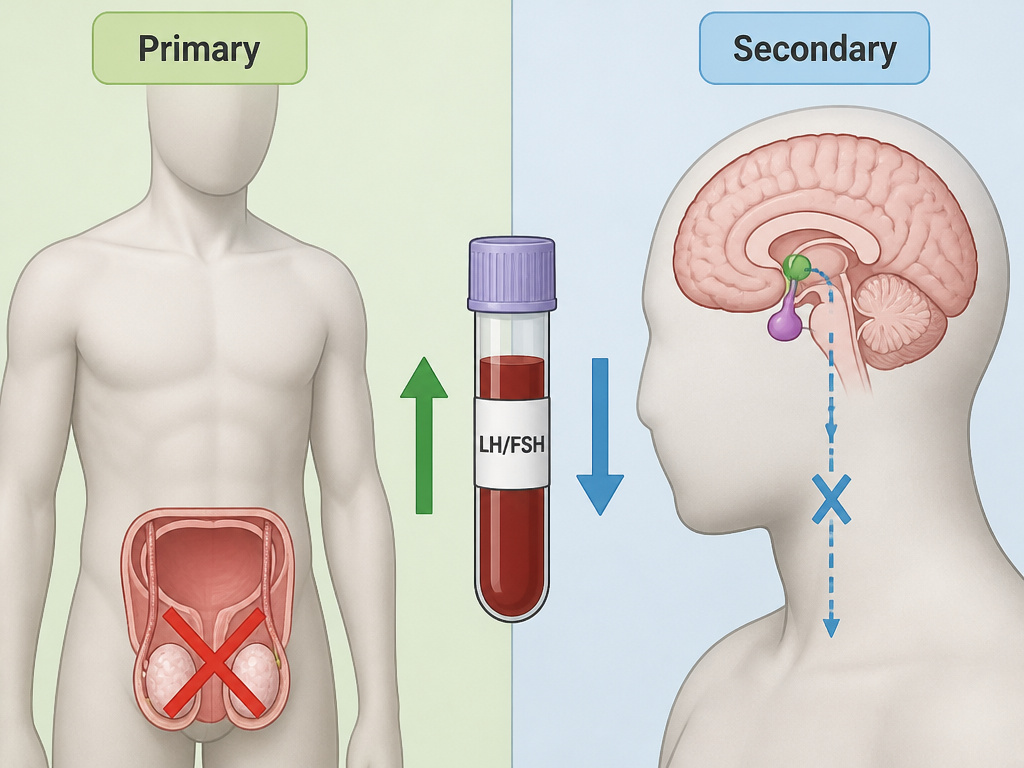
A side-by-side view makes the distinctions stark. This table covers the fundamentals.
| Aspect | Primary Hypogonadism | Secondary Hypogonadism |
|---|---|---|
| Site of Problem | Testes | Hypothalamus or Pituitary Gland |
| LH / FSH Levels | High (LH ≥ 9.4 IU/L is diagnostic threshold) | Low or Inappropriately Normal |
| Common Causes | Klinefelter syndrome, physical trauma, chemotherapy, mumps | Obesity, pituitary tumors, medications (opioids, steroids), chronic illness |
| Testicular Exam | Often small and firm | Often normal size |
| Fertility Impact | Severe; often irreversible due to testicular damage | Variable; often reversible if the central cause is corrected |
| Initial Treatment | Testosterone Replacement Therapy (TRT) | Address reversible cause (e.g., weight loss); TRT or alternatives like clomiphene |
The symptom overlap is significant. Both types cause low libido, fatigue, loss of muscle mass, and erectile dysfunction. You can’t reliably tell them apart by symptoms alone when you compare a primary vs secondary hypogonadism. That’s why the diagnosing hypogonadism process is lab-driven.
One physical clue is testicular size. In primary hypogonadism, the testes are usually small. In secondary, they may be normal because they haven’t been starved of signal for a lifetime. Gynecomastia is also more frequently noted in primary cases due to the hormonal imbalance.
The Treatment Paths Diverge
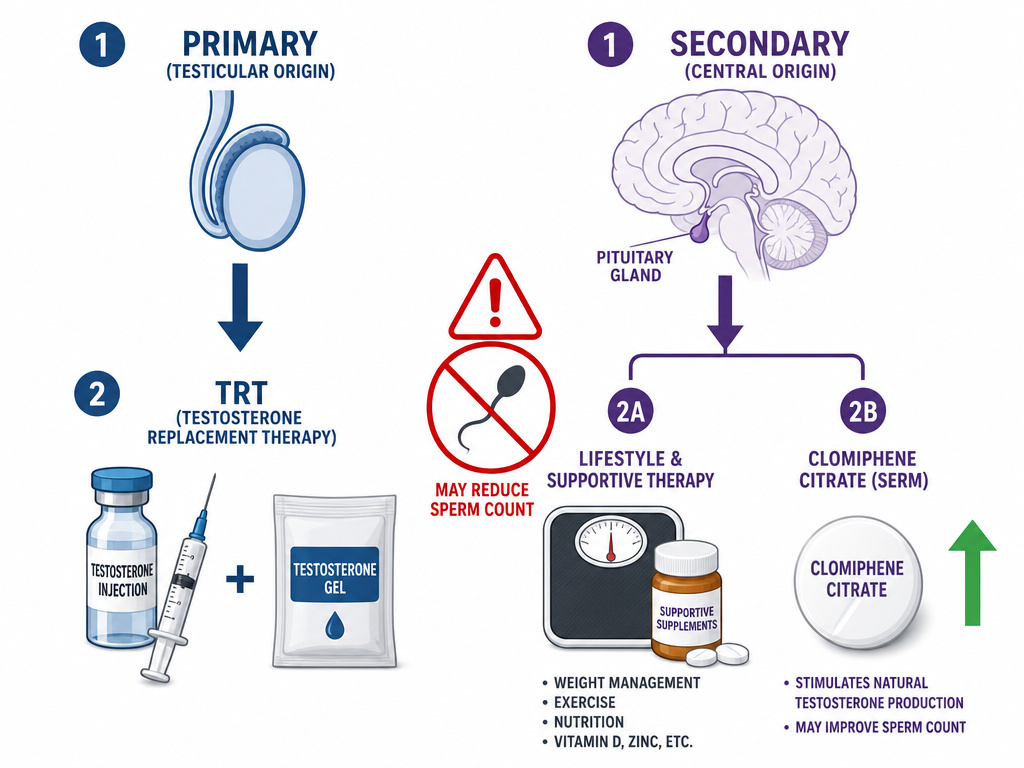
Getting the classification right is critical because the treatment logic splits. The goals are different.
For primary hypogonadism, the testicular function is gone. The only path is replacement. Testosterone replacement therapy (TRT), via gel, injection, or pellet, is the standard. It’s about managing symptoms and preventing long-term issues like osteoporosis. The FDA has warned that testosterone replacement therapy (TRT) should be considered only for men with “classical hypogonadism”.
However, TRT comes with a major caveat: it suppresses the already-high LH and FSH further, which completely halts sperm production. For a young man with primary hypogonadism who may want fertility, this is a serious discussion. Sperm extraction techniques might be needed before starting TRT.
For secondary hypogonadism, you have options. The first question is: is this reversible?
If the cause is obesity, the secondary hypogonadism and BMI study suggests weight loss should be the first intervention. For a medication side effect, discuss alternatives with your doctor. If it’s a prolactinoma (a benign pituitary tumor), medication can shrink it and restore function.
If TRT is chosen, monitoring is specific. Levels should be checked midway between injections or 2–8 hours after applying a gel. But there’s another path: clomiphene citrate. This pill tricks the pituitary into producing more LH and FSH, boosting your own natural testosterone. It’s a less favorable option for men with primary hypogonadism because their testes can’t respond. But for secondary hypogonadism with intact testicular function, it can be effective and has the huge advantage of preserving fertility.
Common mistake: Starting TRT without a fertility plan. Exogenous testosterone shuts down sperm production in both types. Have that conversation first.
The Endocrine Society guidelines recommend monitoring testosterone and hematocrit 3–6 months after starting any therapy. The road you start on depends entirely on the primary vs secondary hypogonadism type you have.
Fertility, “Compensated” States, and Long-Term Outlook
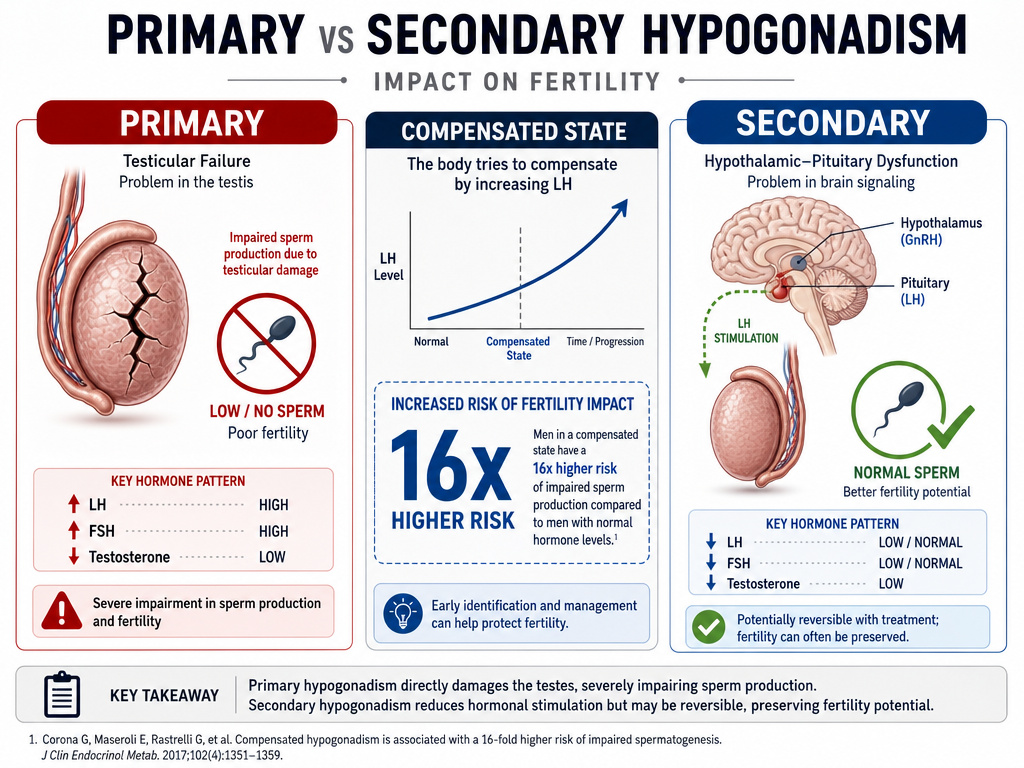
The long-term view changes dramatically based on your diagnosis.
Fertility is the biggest differentiator. Primary hypogonadism usually means infertility from the start due to testicular damage. Secondary hypogonadism often allows for fertility preservation or restoration. Using clomiphene or other gonadotropin therapies can stimulate sperm production. This is a core reason why seeing a specialist, an endocrinologist or reproductive urologist, is essential.
Then there’s a third, in-between state: compensated hypogonadism. This is when your testosterone is still in the normal range, but your LH is already elevated (≥ 9.4 IU/L). Think of it as your pituitary screaming to keep a failing factory running at the last acceptable output.
Data from the EMAS consortium, cited by the Italian Society of Andrology and Sexual Medicine, shows men in this state have a 16-fold increased risk of progressing to full-blown primary hypogonadism over time. It’s a warning sign. You wouldn’t ignore a check-engine light for a knocking engine. Don’t ignore this. It warrants watchful follow-up, not necessarily immediate treatment.
The prevalence numbers tell a story of their own. Estimates for hypogonadism in men over 45 range from 23.3% to 38.7%, with secondary being the most common subtype. Obesity multiplies the risk. Studies cited by Quest Diagnostics indicate serum testosterone is 30% lower in obese men than in normal-BMI men at any age.
So, can it be cured? Primary hypogonadism is generally not curable, only managed. Functional hypogonadism (a type of secondary) often can be, by fixing the underlying trigger. The outlook focuses on understanding the origin rather than merely a prescription.
How is hypogonadism initially screened for?
While structured questionnaires can help identify potential symptoms, a clinical diagnosis of hypogonadism and its classification requires specific blood tests. The initial step is measuring total testosterone, with specimens ideally collected in the morning due to natural diurnal variation. Because levels can fluctuate, a second confirmatory test is recommended before diagnosis. If low testosterone is confirmed, the classification into primary or secondary hypogonadism depends on the levels of pituitary hormones. A luteinizing hormone concentration at or above a specific threshold in the presence of low testosterone suggests primary hypogonadism. For lower LH values, measuring follicle-stimulating hormone is helpful for the differential diagnosis, though there is no universally agreed FSH threshold. This biochemical pattern, not a questionnaire score, definitively guides the classification.
Frequently Asked Questions
How do I know if I have primary or secondary hypogonadism?
You need blood work. A morning testosterone test confirmed on a second day, plus a luteinizing hormone (LH) test, provides the answer. An LH level at or above 9.4 IU/L with low testosterone points to primary. An LH that is low or normal with low testosterone points to secondary. A doctor will interpret these results in the context of your symptoms and physical exam.
Can you fix secondary hypogonadism?
Often, yes, if it’s “functional.” Causes like obesity, certain medications, sleep apnea, or excessive stress are potentially reversible. Correcting the root cause can restore normal testosterone production. If the cause is a structural pituitary problem, it may require specific treatment (like surgery or medication for a tumor), but the hormonal axis may recover.
Is secondary hypogonadism serious?
It can be, for two reasons. First, the symptoms of low testosterone affect quality of life. Second, it can be a sign of a serious underlying condition, such as a pituitary tumor, hemochromatosis (iron overload), or a systemic illness. It should never be ignored or self-treated without a medical evaluation to rule out these causes.
What is the most common cause of primary hypogonadism?
Klinefelter syndrome (47,XXY) is the most common genetic cause. The most common acquired causes include physical testicular damage from trauma, radiation, or chemotherapy, and viral infections like mumps orchitis. These lead to irreversible damage to the testicular tissue.
Does treatment differ for primary and secondary?
Fundamentally, yes. Primary hypogonadism typically requires lifelong testosterone replacement therapy (TRT). Secondary hypogonadism treatment first focuses on addressing any reversible cause (like weight loss). If hormone therapy is needed, options include TRT or fertility-preserving medications like clomiphene citrate, which stimulate the body’s own production.
The Bottom Line
Here is what actually moved the needle for me in understanding this: stop looking for one answer. Low testosterone is a sign, not a disease. The 9.4 IU/L LH threshold is your first and most important clue to whether that sign points to a testicular problem or a brain-driven one.
If your labs suggest primary hypogonadism, the conversation is about managing a lifelong condition and making informed choices about fertility upfront. If they point to secondary, your job is to become a detective, with your doctor, for a reversible cause. Your BMI is a great place to start.
Change one thing at a time. Get the bloodwork. Understand the LH number. Then, and only then, can you walk into a discussion about hypogonadism treatment with the clarity to choose a path based on your LH and testosterone results, not just the available one.
