
Does Low Testosterone Shorten Lifespan? What Studies Show
This post contains affiliate links. As an Amazon Associate, we earn from qualifying purchases.
Yes, low testosterone is associated with a shorter lifespan, but it’s likely a powerful marker of underlying poor health more than a direct cause of death. Large observational studies consistently link lower testosterone levels to a higher risk of all-cause and cardiovascular mortality. However, the strength of this link depends heavily on study design, participant age, and baseline health, suggesting low T is often a sign of existing chronic disease.
That distinction between marker and cause is where most summaries stop. The real story is in the details that change the risk math: the time of day blood is drawn, the length of the study, and the average age of the men involved. A single morning lab number tells you far less than the pattern behind it, which is why researchers ask: does low testosterone shorten lifespan?
What follows is a breakdown of the key studies, the numbers they produced, and the three critical variables that reshape the risk. We’ll also walk through what a meaningful baseline assessment actually looks like, because the answer isn’t just in a total testosterone figure.
Key Takeaways
- Men with total testosterone below 300 ng/dL show a statistically higher risk of premature death, with one large study showing an odds ratio of 2.07.
- The association is strongest in older, sicker cohorts and in studies with shorter follow-up periods (under 9.6 years), hinting that low T often flags existing illness.
- Blood sampling time matters. Studies using non-morning blood draws reported a 61% higher relative risk, versus a 15% higher (and statistically insignificant) risk in morning-draw studies.
- Testosterone Replacement Therapy (TRT) was not shown to reverse this mortality risk in the largest studies we have; treating the number without addressing root causes may miss the point.
- Your first step isn’t a supplement. It’s a full baseline panel (total T, free T, SHBG, LH, FSH) from two separate morning draws to establish a real pattern.
The Core Association: What the Numbers Show
A 2011 systematic review and meta-analysis of 11 studies, covering 16,184 men with an average age of 61, found low endogenous testosterone levels are associated with increased risk of all-cause and cardiovascular death in community-based studies. The average follow-up time was 9.7 years.
The link isn’t theoretical. It’s documented in large, peer-reviewed datasets that directly address the does low testosterone shorten lifespan question. It defined low testosterone as <300 ng/dL, per the American Urological Association guideline, and found men in this category had 2.07 times the odds of premature death compared to men with normal levels.
Another way to frame the risk is through hazard ratios. The same NHANES analysis, after adjusting for other factors, calculated a hazard ratio of 1.66. This means the group with low T had a 66% higher rate of death over the study period. The JAMA meta-analysis on testosterone and mortality and other major reviews have echoed this consistent, troubling signal.
But an association is not a sentence. The real question is what drives it, which is precisely the does low testosterone shorten lifespan debate. Is low testosterone actively damaging the cardiovascular system, or is it a sensitive barometer that drops when a man’s health is already failing? The data leans heavily toward the latter.
What the Studies Actually Measured
The devil—and the daylight—is in the methodology. When you pull apart the large meta-analyses, three specific factors dramatically change the reported risk. This isn’t academic. It changes how you should interpret a single lab result.
Follow-up time. In the 2011 meta-analysis, studies that tracked men for 9.6 years or less found a relative risk of 1.63 for death. Studies that followed men for longer than 9.6 years found a relative risk of 1.13, which was not statistically significant. Why? The most plausible explanation is that men who are already sick (and thus more likely to die soon) have lower testosterone. Over a short window, that link looks strong. Over a longer window, as other factors dominate, the signal fades.
Time of blood draw. Testosterone has a strong diurnal rhythm, peaking in the early morning. The 2011 review found that studies which took blood throughout the day (not standardized to morning) showed a relative risk of 1.61. Studies that used morning samples only showed a relative risk of 1.15, again not statistically significant. A non-morning draw can misclassify a healthy man as having low T, inflating the perceived danger in the “low T” group.
Age and baseline health. The risk was concentrated in studies of older men (average age over 61) and those with lower average baseline testosterone. Healthier, younger cohorts showed a much weaker link. This directly supports the idea that low T is a marker of frailty and chronic disease.
Low Testosterone: Cause, Consequence, or Just a Correlate?
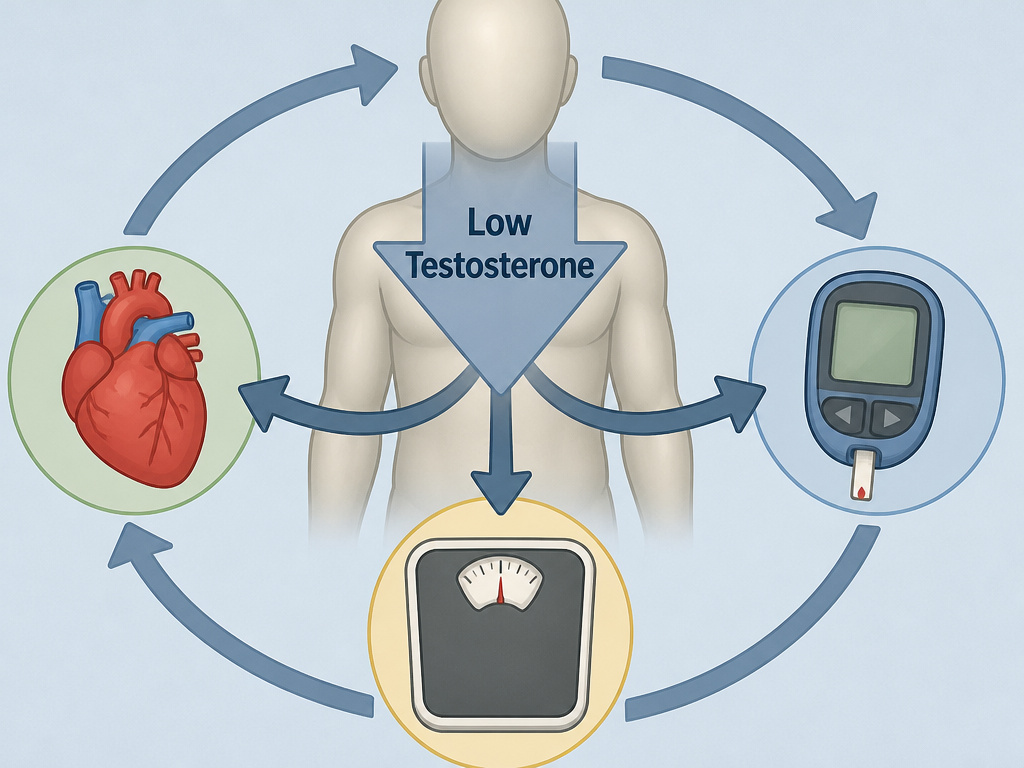
This is the central debate in the research, and the sources disagree.
So which is it? The truth probably lies in the middle, in a vicious cycle. Poor health from obesity, diabetes, and chronic inflammation suppresses testosterone production. In turn, low testosterone can worsen insulin resistance, increase fat mass, and sap motivation for exercise, deepening the health crisis. It becomes hard to untangle where it started.
Common mistake: Chasing a single testosterone number without screening for the common conditions that suppress it. Fixing sleep apnea, losing weight, or managing diabetes often raises T levels as a side effect.
This is why the link to heart disease risk is so strong but ambiguous. Men with low T have more heart disease. Does low T cause heart disease, or do the same poor metabolic habits cause both? The current evidence better supports the latter pathway.
The Critical Role of Baseline Health & Comorbidities
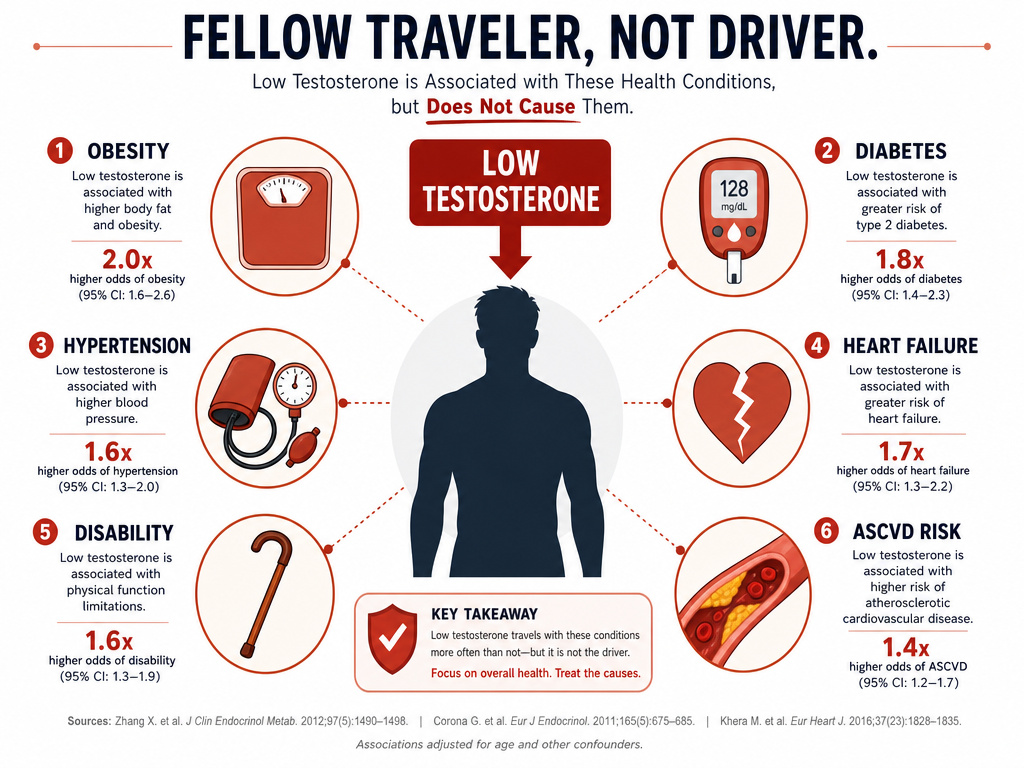
The studies are unanimous on one point: men with low testosterone are sicker. Compared to men with normal levels, those with low T were significantly more likely to have:
- Obesity
- Diabetes
- Hypertension
- A history of heart failure or heart attack
- A walking disability
- A higher calculated risk for atherosclerotic cardiovascular disease (ASCVD)
This cluster isn’t a coincidence. This cluster of conditions is a known suppressor of testosterone. When you see a low number, your first thought shouldn’t be “What booster should I take?” It should be “What’s suppressing this?” The causes of low T are often these exact lifestyle and metabolic conditions.
This connection also helps explain the link to increased dementia risk and osteoporosis risk. Systemic inflammation and vascular damage from poor metabolic health harm the brain and bones. Low testosterone is again a fellow traveler on that path, not necessarily the driver.
Testosterone Replacement Therapy (TRT) and Mortality: Does Fixing the Number Fix the Risk?
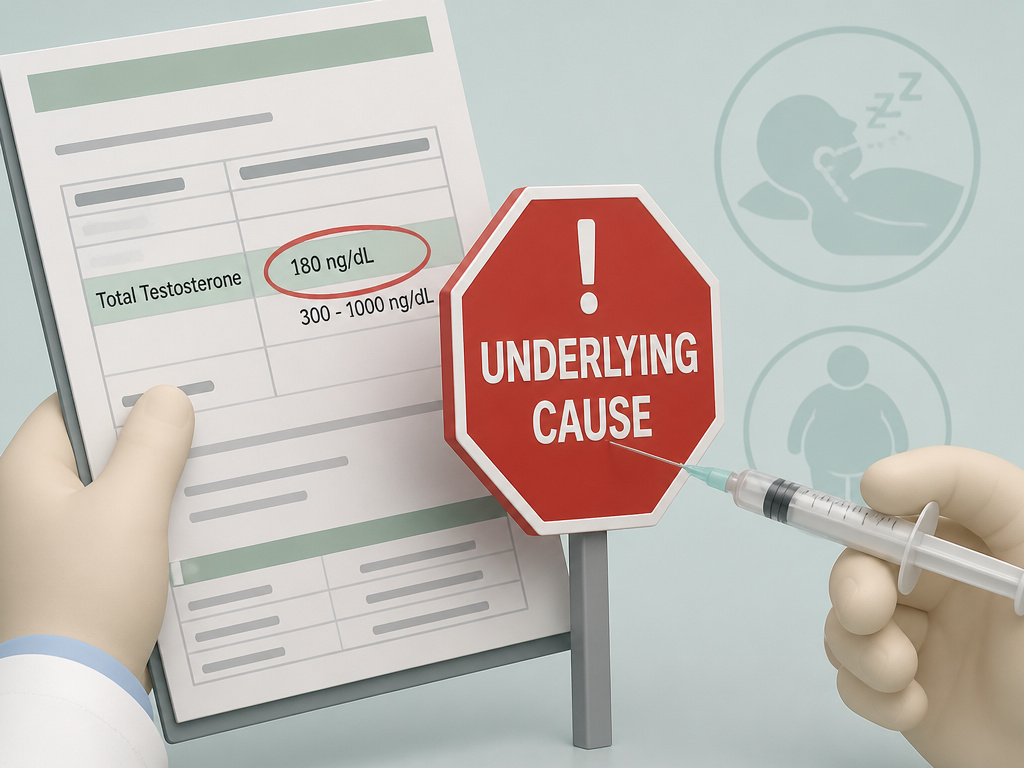
This is the million-dollar question, and the answer is frustratingly unclear. The large observational studies we have link naturally occurring low testosterone to higher mortality. They do not show that prescribing TRT to correct that number reduces mortality risk back to normal.
The fundamental issue remains: if a man’s low T is primarily a symptom of untreated sleep apnea and obesity, giving him testosterone shots might mask the symptom without treating the life-threatening diseases.
Where this goes sideways: Starting TRT based on a single borderline-low test without a full health workup. You might treat a lab value while missing obstructive sleep apnea, which itself carries a major mortality risk.
The decision to start testosterone replacement therapy is complex and should be made with a doctor who will look at the whole picture—symptoms, comprehensive labs, and underlying health—not just a number below 300 ng/dL.
A Practical Framework: What to Do with This Information
If you’re concerned about your levels and your long-term health, a reactive panic is useless. A systematic, evidence-based approach is what works. This is where most generic advice fails. They say “get tested” but don’t tell you how to test smart.
First, establish a baseline using multiple tests. This is the lesson I learned the hard way. A single total testosterone test is almost worthless. You need context.
- Test twice. Draw blood at 8-10 AM on two separate days, a week or two apart. Testosterone has a strong diurnal rhythm; one point on the graph is noise.
- Test the right panel. You must move beyond total T. You need Free Testosterone (the active fraction), SHBG (which locks up total T), and LH & FSH (which tell you if the problem is in the testes or the brain).
- Establish your symptom baseline. Use a validated symptom questionnaire. How is your energy, drive, mood, and sleep? Numbers without symptoms are just numbers.
Second, investigate the suppressors. Before you consider any intervention, rule out or address the common killers of testosterone:
- Poor sleep quality or sleep apnea (get a sleep study if you snore and are tired)
-
Obesity, especially abdominal fat 3.
-
Chronic, high stress
- Excessive alcohol use
Addressing these can often raise testosterone significantly, while simultaneously lowering your real mortality risk. This is the definition of a high-value intervention.
Third, understand the thresholds. The standard <300 ng/dL cutoff is useful, but it’s not a magic line. The normal levels show a clear age-related decline. Treat the patient, not the lab slip.
| Factor | Stronger Mortality Link | Weaker Mortality Link |
|---|---|---|
| Study Follow-up | ≤ 9.6 years (RR 1.63) | > 9.6 years (RR 1.13) |
| Blood Draw Time | Non-morning samples (RR 1.61) | Morning samples only (RR 1.15) |
| Cohort Age | Mean age > 61 years (RR 1.54) | Mean age ≤ 61 years (RR 1.12) |
| Baseline T Level | Lower average T (RR 1.55) | Higher average T (RR 1.09) |
Bottom line: Your action plan should be diagnostic long before it’s therapeutic. The goal is to find out why your levels are where they are, not just to jack them up.
What do studies on neutered animals or eunuchs show about lifespan?
Therefore, no direct conclusions can be drawn from the provided research about this specific comparison. The available human studies focus on the association between low endogenous testosterone levels and mortality risk in community-based populations. They do not examine the effects of surgical or chemical castration. For practical guidance, it is critical to understand that the hormonal and physiological context of age-related decline differs fundamentally from abrupt, complete removal of testosterone production. Extrapolating findings from one context to the other is not supported by the data presented here.
What needs to be monitored during testosterone replacement therapy (TRT)?
The research focuses on the association between naturally low testosterone and mortality risk, not on the management of TRT. For practical guidance, anyone undergoing TRT must be under a doctor’s supervision with a structured monitoring plan. This typically involves regular blood tests to ensure hormone levels are in a safe, therapeutic range and to watch for potential side effects. Key health markers related to blood thickness, cardiovascular health, and prostate function are commonly checked at scheduled intervals to maintain safety and adjust treatment as needed.
What are the dosing and administration methods for TRT?
The research exclusively analyzes the relationship between low endogenous testosterone levels and mortality risk in observational studies. For practical guidance, TRT dosing is highly individualized and must be prescribed and managed by a healthcare professional. The goal is to restore testosterone levels to a normal physiological range, not to exceed it. The method of administration is chosen based on patient preference, lifestyle, and medical history, with each method having different dosing schedules and considerations for consistency and safety.
Frequently Asked Questions
Can you live a long life with low testosterone?
Yes, many men do. The statistical association with higher mortality is a population-level trend, not an individual destiny. If your low testosterone is an isolated finding without underlying metabolic disease (like diabetes or severe obesity), your lifespan may be unaffected. The key is your overall health profile, not a single hormone level.
Will taking testosterone lower my life expectancy?
The current evidence does not show that testosterone replacement therapy (TRT) prescribed and monitored by a doctor reduces life expectancy. However, it also hasn’t definitively proven that it extends life, even for men with low levels. The focus of TRT should be on improving quality of life and symptoms, with the understanding that managing overall health is paramount for longevity.
What is the #1 testosterone killer?
In the context of lifestyle factors, chronic obesity is a powerful suppressant of testosterone. Excess fat, especially visceral fat, increases the conversion of testosterone to estrogen and promotes a state of chronic inflammation that directly inhibits testosterone production in the testes. Fixing diet and body composition often has the largest impact on reversing low T.
What was the average testosterone level in 1970?
While some older studies suggest a decline over decades, these claims are confounded by changes in lab methods, participant health, and testing standards. Comparing your levels to outdated averages is not useful. Compare them to modern, age-matched reference ranges from a reputable lab.
Before You Go
The data is clear that low testosterone and shorter lifespan travel together. The crucial, often-missed next step is asking why they’re linked.
Don’t let a number on a page trigger a fear-based search for a quick fix. Let it trigger a curiosity-based audit of your foundational health. The most powerful “testosterone therapy” available isn’t in a vial or a gel packet. It’s in achieving a healthy weight, treating sleep apnea, managing stress, and correcting nutrient deficiencies. These actions address the root causes that drag down both your hormone levels and your long-term health.
If you pursue testing, do it thoroughly—two morning draws, a full panel including LH and SHBG. And if you and your doctor then decide that raising your levels naturally or through replacement is the right path, you’ll be doing it from a place of knowledge, not panic. You’ll be treating a condition, not just a correlation.
