
How Testosterone Affects the Male Brain: Key Takeaways
This post contains affiliate links. As an Amazon Associate, we earn from qualifying purchases.
Testosterone affects the male brain by influencing specific cognitive functions like spatial ability and memory, altering mood and motivation through dopamine pathways, and shaping brain structure and blood flow, but the effects are highly dependent on your baseline levels, the dose, and whether testosterone is converted to estradiol in the brain. The research is messy, with studies on men who already have normal hormone levels showing minimal cognitive benefit, while studies on men with clinically low testosterone show clearer short-term improvements.
That gap between normal and low is where most of the confusion lives. If you start with levels in the standard range, adding more testosterone is like pouring water into a full glass — it mostly just spills over. But if the glass is half empty, topping it up changes how you feel and function. The brain’s response isn’t a simple on/off switch; it’s a complex system that reacts differently to a slight nudge versus a major correction, which is a key part of understanding how testosterone affects the male brain.
What follows is a breakdown of the evidence, stripped of supplement marketing. We’ll look at what improves, what stays the same, where the studies directly contradict each other, and the one physical change in the brain that nearly every researcher agrees on.
Key Takeaways
- For men with normal baseline testosterone (eugonadal), a major meta-analysis of 23 RCTs found a non-significant pooled cognitive effect (Hedges’ g = 0.09). Don’t expect a mental boost from extra T if you’re already in range.
- A 2020 meta-analysis of treatment studies in men with low testosterone found a short-term improvement in Mini-Mental State Examination scores (Mean Difference: 3.4).
- The effect on cognition is curvilinear and dose-dependent — moderate levels are often optimal, while very high or very low levels can impair functions like verbal memory.
- Testosterone’s action in the brain is largely mediated by its conversion to estradiol via aromatase, though rapid, non-genomic effects are also being studied.
- Long-term, lower testosterone is associated with a 14% increased risk of all-cause dementia per decrease in total T, but this observational link doesn’t prove causation.
The Cognitive Effect: What the Data Actually Shows
The first thing to check is your starting point. Are we talking about a man with clinically low testosterone (hypogonadism) or a man with levels that are normal for his age? This distinction changes everything the research tells us.
A 2019 meta-analysis of 23 randomized controlled trials in eugonadal men (those with normal baseline T) found a pooled effect size of Hedges’ g = 0.09 for overall cognitive function, with a confidence interval that included zero (-0.02 to 0.19). This means the effect was statistically non-significant. A subset analysis of men who started in the normal range showed a slightly higher g = 0.17, but the lower bound of its confidence interval was still 0.00.
Translation: if your testosterone is already normal, raising it further probably won’t make you smarter. The changes are so small they’re buried in statistical noise. This is the core finding that much of the “brain boost” marketing glosses over.
The picture shifts when we look at men who begin with a deficiency. A separate 2020 systematic review focused on men with low testosterone found that treatment led to measurable, short-term gains on specific cognitive screens. A 2020 systematic review found that treatment in men with low testosterone led to a mean difference of 3.4 points on the Mini-Mental State Examination and 4.4 points on the Developmental Test of Visual-Motor Integration. These aren’t subtle tweaks; they’re clinically noticeable improvements. The catch is the “short-term” part — most of these studies ran for weeks or months, not years.
The Dose-Response Curve: More Isn’t Better
This is where it gets counterintuitive. The brain’s response to testosterone isn’t linear; it follows an inverted U-shaped curve. Both very low and very high levels can be suboptimal.
- Moderate dosing improves memory, but not low and very high increases of testosterone. This finding, noted in a 2015 review, has been observed in human and animal studies. In adult male rats, only moderate testosterone doses improved spatial memory.
- In elderly men, a single testosterone injection worsened verbal memory, and biweekly injections for 90 days resulted in memory decline. Meanwhile, a short 6-week treatment in other studies improved spatial and verbal memory. The difference? Likely the dosing protocol and the individual’s starting point.
- In women, the results are just as mixed. A single dose improved spatial memory in young women. Yet, in postmenopausal women with surgically induced menopause, adding testosterone to estrogen therapy worsened verbal memory. Another, longer study in postmenopausal women showed the opposite — improvement.
The takeaway is blunt: flooding the system doesn’t work. The goal is sufficiency, not excess. This curvilinear relationship in how testosterone affects the male brain explains why study results can seem to contradict each other — a small dose in one population helps, while a large dose in another hurts.
The Empathy Debate: A Case Study in Contradiction
Few areas show the volatility of this research better than the study of social cognition. A high-profile 2017 study suggested that a single dose of testosterone impaired cognitive empathy (‘mind reading’) in men. It was a clean, compelling story that fit a popular narrative about testosterone blunting social sensitivity.
Then science did its job. A 2019 large-scale replication attempt with 400 men, using two different administration protocols, found no evidence that cognitive empathy is impaired by testosterone administration. The earlier result likely came from a smaller, underpowered sample. This is a perfect example of why you should be skeptical of single, dramatic studies. The evidence is contradictory: a 2017 study (n=243) suggested testosterone administration impaired cognitive empathy, while a 2019 large-scale replication attempt (n=400) found no evidence of impairment.
Mood, Motivation, and the Dopamine Link
While the pure cognition data is murky, the link between testosterone and how you feel is more consistent. This is where men with low T report the most dramatic changes after treatment: improved mood, renewed drive, and a sharper sense of motivation. The mechanism often points to dopamine.
Testosterone influences the brain’s reward and motivation pathways. Testosterone influences the brain’s reward and motivation pathways, which are linked to dopamine. This isn’t about raw intelligence; it’s about the gas pedal for goal-directed behavior. When testosterone is low, that pathway can feel dampened, leading to the low motivation and anhedonia (loss of pleasure) commonly reported. Correcting the deficiency can restore the tone of this system, making effort feel more worthwhile.
Where this goes sideways: Assuming low motivation is always a “testosterone problem.” Chronic stress, poor sleep, and depression can all crush dopamine and mimic low-T symptoms. Treating one without addressing the others is like fixing a single spark plug in a flooded engine.
This interaction in how testosterone affects the male brain is why the testosterone and dopamine relationship is a key area of study. It’s not that testosterone is dopamine, but it modulates the system that uses it. Our article on how testosterone and dopamine interact explains these pathways in detail. The mood lift many men experience with treatment likely comes from this neurochemical fine-tuning, not from a direct antidepressant effect.
From Structure to Blood Flow: The Brain’s Physical Response
Beyond chemicals and feelings, testosterone physically alters the male brain. Imaging studies show it influences both structure and perfusion.
A 2015 quantitative review of neuroimaging studies found notable correlations:
- In a study of 68 healthy males, testosterone was positively correlated with the area of the posterior half of the corpus callosum, the thick bundle of nerves connecting the brain’s two hemispheres.
- In a study of 514 twin men, higher baseline testosterone concentrations were associated with larger frontal and parietal lobe volumes.
- In a study of 40 men aged 57 years at baseline, a higher ratio of testosterone to SHBG and higher total testosterone concentrations measured over 14 years were associated with higher regional cerebral blood flow.
These structural and vascular changes are tangible. They suggest testosterone plays a maintenance role in brain infrastructure. An uncontrolled study of seven men with low free testosterone showed enhanced cerebral perfusion in the midbrain and superior frontal gyrus at 3–5 weeks of treatment, and in the midbrain and midcingulate gyrus at 12–14 weeks.
| Brain Region | Observed Change with Testosterone | Potential Functional Implication |
|---|---|---|
| Corpus Callosum | Larger posterior half area | Improved inter-hemispheric communication |
| Frontal & Parietal Lobes | Increased volume with higher baseline T | Associated with executive function and sensory integration |
| Cerebral Blood Flow | Increased regional perfusion | Better delivery of oxygen and nutrients to neural tissue |
The most consistent structural links involve regions critical for emotion and memory, like the amygdala and hippocampus. This ties directly to the emotional and cognitive symptoms of low T. When men talk about brain fog or emotional flatness, they might be describing the functional output of these physical changes. For a closer look at that specific symptom, our guide on low testosterone and brain fog explores the connection.
Testosterone, Dementia, and Long-Term Brain Aging
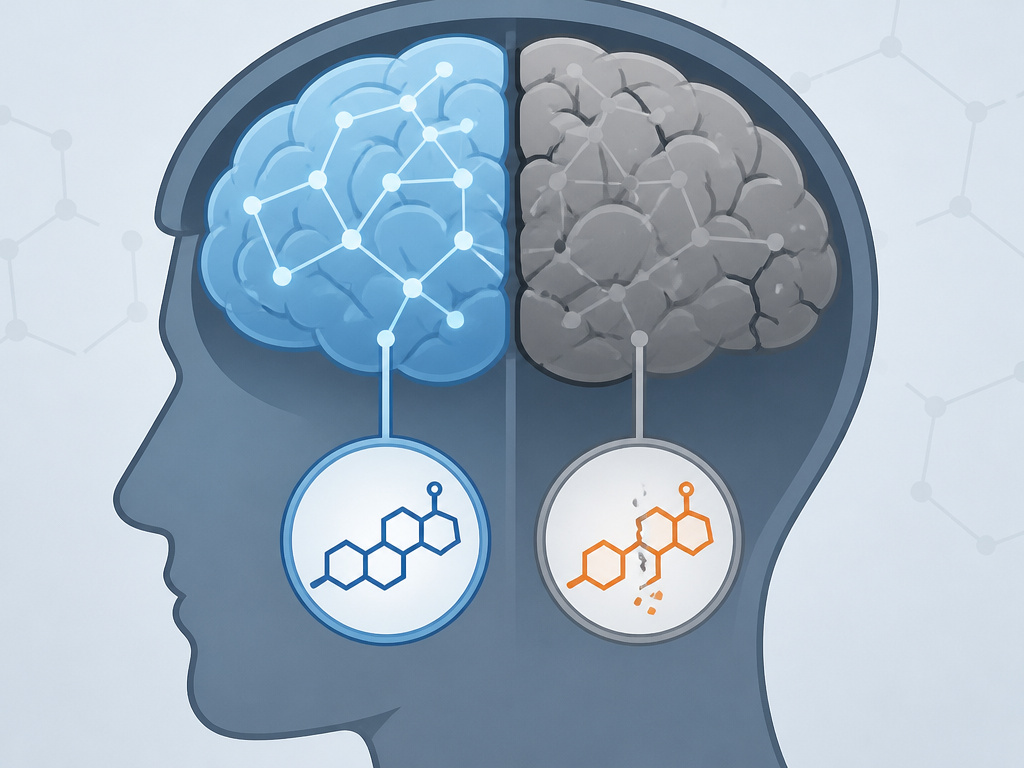
This is the million-dollar question: does having higher testosterone protect your brain from aging, and does low testosterone increase dementia risk? The evidence here is observational and mixed, which means we can see associations but can’t prove cause and effect.
A 2020 meta-analysis of 4,572 participants found a 14% increased risk of all-cause dementia per decrease in total testosterone. That’s a statistically significant association from observational data. A post-mortem study found that brain testosterone concentrations were lower in men with Alzheimer’s disease compared to neuropathologically normal men.
However, the American College of Physicians’ 2020 evidence report states the evidence on testosterone and cognition is of low certainty and shows little to no benefit, which contrasts with observational studies linking low testosterone to higher dementia risk. This apparent contradiction is classic in nutrition and hormone science: an observational link (low T → higher dementia risk) does not guarantee that treatment (raising T) will prevent the outcome.
Some of the strongest indirect evidence comes from the opposite scenario: drastically lowering testosterone. Studies of men undergoing androgen deprivation therapy (ADT) for prostate cancer show a concerning pattern. A meta-analysis of seven cohort studies including 90,543 men associated ADT with a higher incidence of subsequent dementia. Another meta-analysis of seven studies including 50,541 individuals showed an increased risk of dementia in ADT users.
The part nobody mentions: These ADT studies are often cited as proof that testosterone protects the brain. But they actually show that catastrophically low testosterone, achieved medically, is harmful. It’s a different scenario from the natural, gradual decline of aging. It confirms testosterone is necessary for brain health, but not that supra-normal levels are protective.
The relationship with Alzheimer’s pathology itself is unclear. In a study of 118 men who underwent PiB-PET scanning for detection of brain β-amyloid, free testosterone was not associated with PiB retention. Only in a subset of 24 men with mild cognitive impairment was there an inverse association of free testosterone with PiB retention. A study of 133 men aged 72 years found that free testosterone concentration was not associated with presence of cerebral β-amyloid but was associated with hippocampal volume. This suggests any protective effect might work through non-Alzheimer pathology-related mechanisms, like supporting vascular health or general neural resilience.
For a detailed analysis of this complex risk calculation, our resource walking through the major studies on low testosterone and dementia is available.
How Testosterone Actually Works in the Brain: Estradiol’s Role
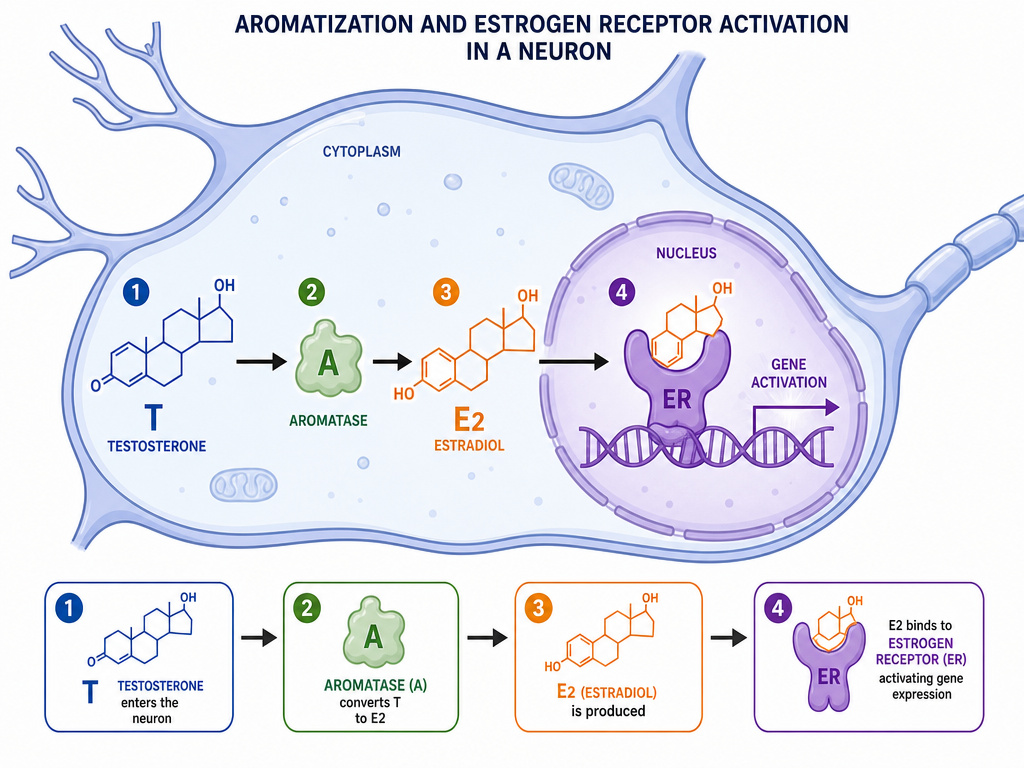
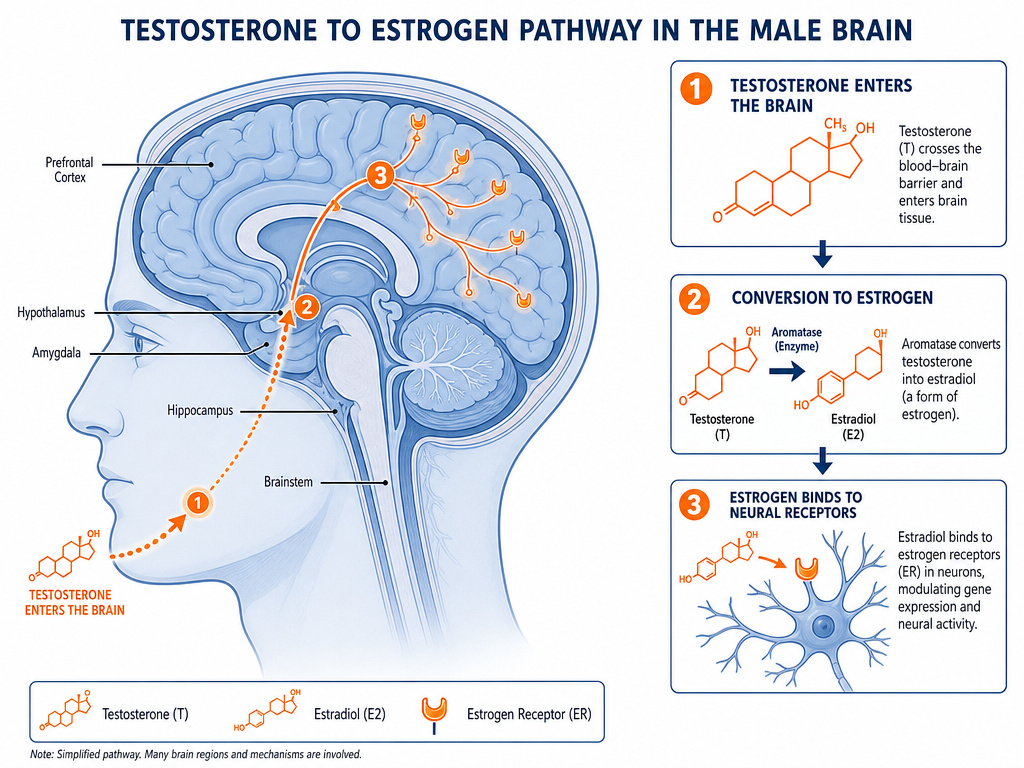
Much of testosterone’s effect in the male brain doesn’t come directly from testosterone itself. It’s from estradiol, the estrogen it gets converted into.
Many actions of testosterone in the male brain are actually mediated by the aromatized estrogenic metabolites of this androgen. The brain contains aromatase enzymes that perform this conversion locally.
This is considered the classical genomic pathway, though there is also emerging evidence for rapid, ‘non-classical’ or membrane-initiated actions of testosterone itself. Testosterone enters a brain cell, gets converted to estradiol by aromatase, and that estradiol then binds to estrogen receptors to influence gene expression and cell function. This process is crucial for the development of male brain circuits in utero.
There is also emerging evidence for rapid, ‘non-classical’ or membrane-initiated actions of testosterone itself, effects that happen in minutes rather than hours or days. The field is moving from seeing testosterone as a simple signal to understanding it as a multi-tool, with different effects based on its form (testosterone vs. Estradiol), the location in the brain, and the type of receptor it engages.
This conversion mechanism is why simply measuring total testosterone in the blood can be misleading. It doesn’t tell you how much is being converted to the active form in the relevant brain tissue. It also complicates the use of drugs that block aromatase; while they might keep serum estradiol low, they could inadvertently dampen testosterone’s positive effects in the central nervous system.
How is testosterone made in the male body?
Testosterone production begins very early in male development. A 2021 review notes that in humans, testes begin to secrete testosterone as early as the 7th week of gestation. The same review states that a surge of testosterone in male fetuses between the 16th and 24th week of gestation mediates the so-called organizational effect. This early programming is foundational. In adulthood, the hormone’s actions in the brain are complex; many are actually mediated by its aromatized estrogenic metabolites. This means testosterone often exerts its influence by being converted into estrogen within the brain itself, highlighting an intricate relationship between these steroid hormones in neural function.
How does testosterone create differences between male and female brains?
The organizational surge of testosterone during fetal development is a key driver in shaping the male brain. Research shows this early exposure correlates with lasting structural differences. For instance, in a study of 514 twin men, higher baseline testosterone concentrations were associated with larger frontal and parietal lobe volumes. One study of 68 healthy males found testosterone was positively correlated with the area of the posterior half of the corpus callosum. However, the effects are not uniform across all regions and can be specific; one study found an association with smaller left occipital lobe volumes. These anatomical differences underpin many of the functional variations observed between sexes.
How does testosterone interact with stress hormones?
The fact sheet does not contain specific information on the interaction between testosterone and cortisol, the primary stress hormone. In the absence of direct evidence, practical guidance focuses on general principles of hormonal balance. Chronic stress elevates cortisol, which can disrupt the body’s endocrine systems. Maintaining a lifestyle that manages stress effectively is considered a foundational step for supporting healthy testosterone physiology. This includes prioritizing quality sleep, engaging in regular physical activity, and employing stress-reduction techniques, as these factors collectively influence the hormonal milieu.
Frequently Asked Questions
Does high testosterone increase IQ?
No, there is no reliable evidence that high testosterone increases general intelligence (IQ). In men with normal levels, raising testosterone further has a negligible effect on overall cognitive function. The relationship is more nuanced, affecting specific domains like spatial ability or memory in a dose-dependent way, not global IQ.
Is testosterone linked to autism?
Research has explored a potential link, often through the “extreme male brain” theory, which suggests autism may be associated with elevated prenatal testosterone exposure. A 2021 review notes that testosterone surges in male fetuses between the 16th and 24th week of gestation mediate organizational effects on the brain. While this is an active area of study, it is a complex developmental hypothesis and not a direct cause-and-effect relationship established in adults.
What is the #1 thing that lowers testosterone?
There isn’t a single universal “testosterone killer,” but chronic lifestyle factors are the most common suppressors in otherwise healthy men. The top contenders are chronic sleep deprivation, sustained high stress (elevated cortisol), and excessive alcohol consumption. Obesity, particularly excess abdominal fat, is also a major driver due to increased aromatase activity, which converts testosterone to estrogen.
Does not ejaculating for 7 days increase testosterone?
The short-term effect is minimal and transient. Some small studies show a very slight peak in testosterone around day 7 of abstinence, but levels quickly return to baseline. This minor fluctuation is not meaningful for long-term hormone optimization or brain function. It does not produce a sustained, clinically relevant increase.
Before You Go
The brain isn’t a testosterone meter where more input equals more output. The research paints a picture of a system built for sufficiency. If you’re clinically low, correction can improve mood, motivation, and some cognitive metrics. If you’re already in range, pushing higher is unlikely to create new mental abilities and could even backfire for some functions.
Start with a blood test. Guessing your status is the first and most expensive mistake. Know your total testosterone, free testosterone, and estradiol. That report is your map.
If your levels are low and you’re experiencing brain fog, low motivation, or mood changes, addressing the deficiency under medical guidance is the evidence-based step. If your levels are normal, direct your effort toward the proven foundations of brain health: consistent, quality sleep, managing chronic stress, and regular exercise. These do more for long-term cognitive resilience than any hormone tweak at the margins.
The most powerful thing you can do is ignore the binary hype. Testosterone isn’t a brain hero or villain. It’s a key part of a complex orchestra. Make sure it’s playing in tune, but don’t expect it to carry the whole symphony.
